
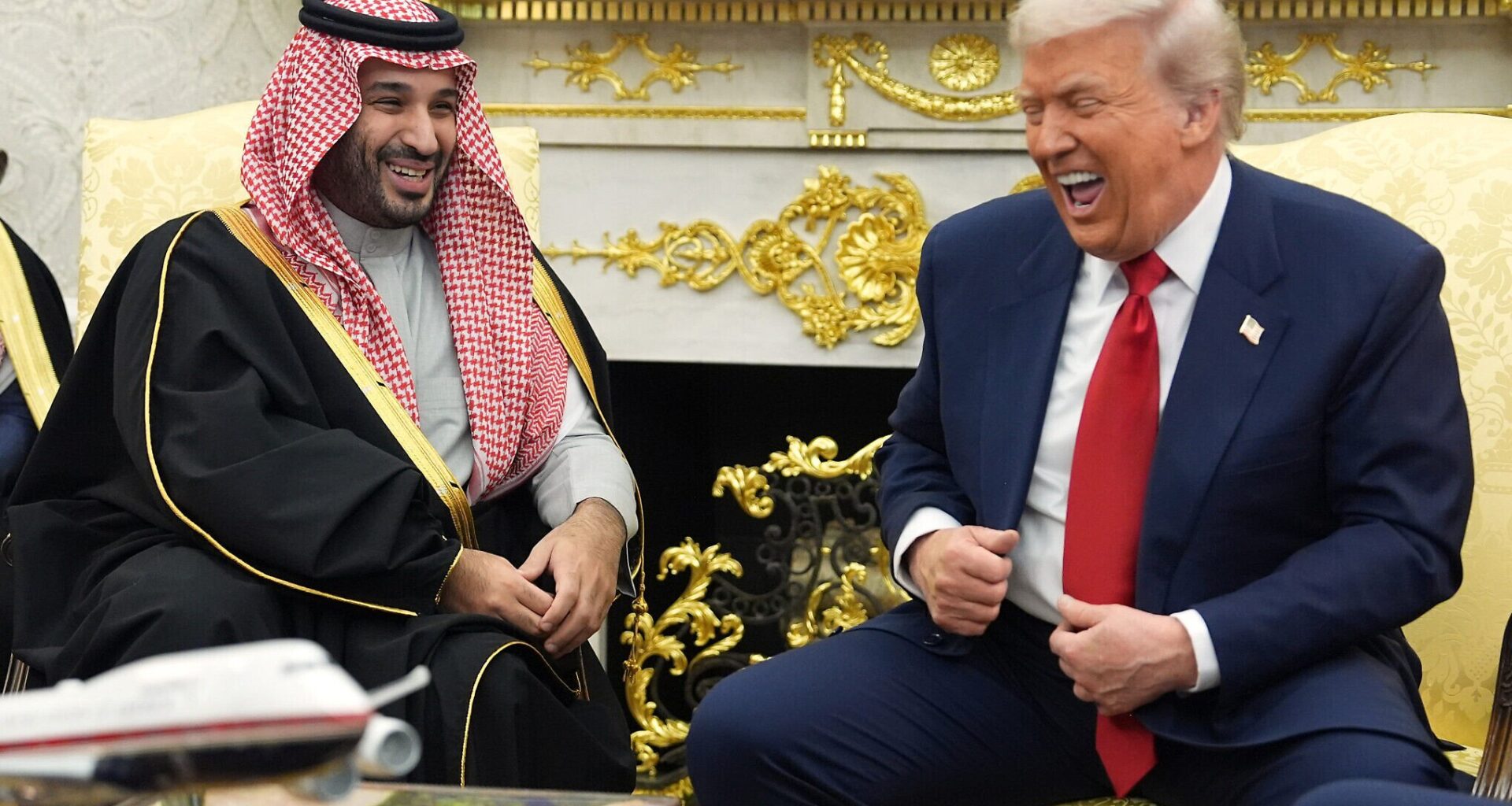
Sitting alongside the US president, the gold trim of his robes matching the molding of Donald Trump’s Oval Office, Saudi Crown Prince Mohammed bin Salman radiated regal confidence.
Smiling easily, the kingdom’s 40-year-old de facto leader delighted Trump by announcing a nearly $1 trillion investment in the US economy. Trump patted the powerful Saudi prince’s shoulder repeatedly, and angrily defended the royal known as MBS in the face of hostile questions about his record from the Washington press corps.
Behind the elaborate trappings, the warm physical contact, and the smiles, it was an uneasy MBS who came to Washington this month. His grand economic plans, on which he is staking the future of the kingdom, are nowhere close to where he wants them to be. The kingdom finds itself on the back foot while Saudi Arabia’s rivals are driving events in the Middle East.
MBS came to Washington to try to reassert the oil-rich kingdom’s position in a region that’s been leaving it behind, and in that regard, the visit was a marked success, consolidating much of what was promised during Trump’s visit to Riyadh in May and cementing the crown prince as one of Trump’s top allies in the region.
But by helping add muscle to Saudi Arabia and boosting its stature in the Middle East, the White House may have also raised the price on long-sought normalization between Riyadh and Jerusalem.
Get The Times of Israel’s Daily Edition
by email and never miss our top stories
By signing up, you agree to the terms
Saudi Arabia has for years been considered the holy grail of the Abraham Accords alliance, its importance in the region and the world far outweighing the countries that have normalized with Israel under the pact thus far. From the waning days of the first Trump administration, through Joe Biden’s White House and into Trump’s second term, diplomats have described the prize as just beyond reach.
Riyadh had long insisted that such a deal be predicated on Palestinian statehood, but there had been signs in recent years that it was willing to compromise and perhaps accept an ambiguous commitment as enough to join up, along with some defense goodies from the US.
But with the Gaza war knocking Israel’s standing down a notch and the new deals struck between MBS and Trump stiffening Saudi Arabia’s bargaining position, Jerusalem may now have even further to climb before it can reach this peak of normalization.
Riyadh in retreat
Though Israelis were largely focused on the security aspects of MBS’s trip, the crown prince’s prime interest was economic.
As he rapidly rose from relative obscurity to the top of the Saudi power structure a decade ago, MBS forged a sweeping social, economic, and religious modernization program, aiming to transform Saudi Arabia from an oil-based kingdom to a world leader in technology and global commerce.

A handout picture provided by Saudi’s NEOM on July 26, 2022 shows the design plan for the 500-metre tall parallel structures, known collectively as The Line, in the heart of the Red Sea megacity NEOM. (NEOM / AFP)
But his flagship futuristic megacity NEOM is largely foundering, and he is facing difficulties in positioning Saudi Arabia as an AI powerhouse. Despite vast tracts of empty land, access to cheap energy, and money, Saudi Arabia lacks the top-line indigenous talent or technology to lure data centers for leading international AI companies.
On the second count, at least, MBS made major headway during his White House visit. The two countries signed a Strategic Artificial Intelligence Partnership, and Humain — the Saudi AI company created by its sovereign wealth fund — signed a flurry of joint ventures with Cisco, Qualcomm, AMD, and Elon Musk’s xAI.
MBS also made up ground on the slipping status of his country, and his own standing in the halls of power, after years in which he was personally shunned in world capitals due to international revulsion over the 2018 murder and dismemberment of dissident Saudi journalist Jamal Khashoggi, widely believed to have been carried out at the crown prince’s orders.
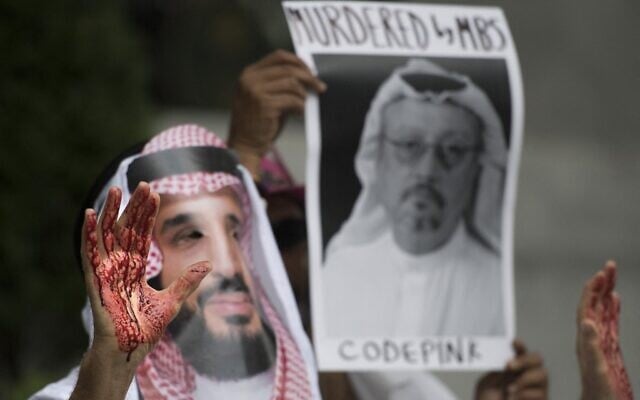
In this file photo taken on October 10, 2018, a demonstrator dressed as Saudi Arabian Crown Prince Mohammed bin Salman (C) with blood on his hands protests outside the Saudi Embassy in Washington, DC, demanding justice for missing Saudi journalist Jamal Khashoggi. (Jim Watson/AFP)
Though MBS is not a head of state, he was still received by Trump with honors reserved for only the most powerful world leaders — and, notably, not for Prime Minister Benjamin Netanyahu.
Even though MBS’s own status improved markedly as the Russian invasion of Ukraine spiked Western demand for Saudi oil production, he had reason to worry about Riyadh falling behind its rivals. Tiny neighboring countries enjoyed new pacts and weapons from the US while Saudi Arabia waited on the sidelines. Qatar — with which Saudi Arabia cut ties for several years starting in 2017 — was designated a major US non-NATO ally in 2022, and received unprecedented defense guarantees from Trump after the Israeli strike in Doha in September.
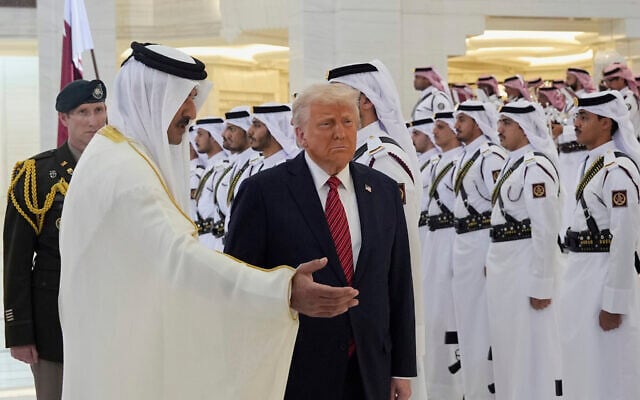
Qatar’s Emir Sheikh Tamim bin Hamad Al Thani, left, welcomes US President Donald Trump during an official welcoming ceremony at the Amiri Diwan in Doha, Qatar, May 14, 2025. (AP Photo/Alex Brandon)
“He’s now playing catch up to a very small country on his border, that has a fraction of the kingdom’s global clout and influence, and whose support for the Muslim Brotherhood and other extremists has been a more or less constant thorn in Saudi Arabia’s side for years,” said John Hannah, senior fellow at the Jewish Institute for National Security of America and former national security adviser to former US vice president Dick Cheney.
For more on this topic, watch the Lazar Focus:
“Given the storied 8-decade history of the US-Saudi strategic relationship, finding yourself in a second-tier status to Qatar in terms of Washington’s array of regional security commitments couldn’t have been comfortable,” he added.
The main security threat for the Saudis remains Iran. In his first years as a leading Saudi figure, MBS adopted an aggressive posture toward the Iranian axis, going to war against the Houthis in Yemen and kidnapping Lebanon’s prime minister for being too soft on Hezbollah.
In recent years, however, MBS has opened diplomatic channels with Tehran in order to mitigate the Iranian threat.
The Saudis were undoubtedly happy to see Hamas, Hezbollah, Bashar al-Assad’s Syria, the Houthis, and the Iranians themselves battered by Israel since October 7, 2023.
What they weren’t counting on was Iran being replaced by an aggressive Israel, willing to carry out attacks at will across the region, regardless of whether they were allied with the US (see: Qatar) or Saudi Arabia (see: Syria’s new regime).
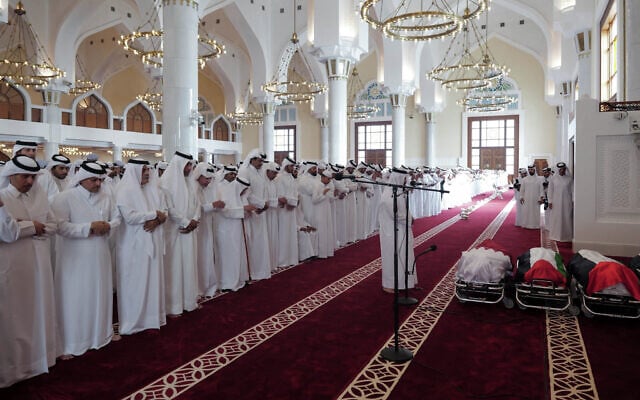
This handout picture made available by the Qatar Amiri Diwan, shows Qatar’s Emir Sheikh Tamim bin Hamad Al-Thani (C) attending the funeral of people killed in an Israeli strike on Hamas leaders two days earlier, at Sheikh Mohammed bin Abdul Wahhab Mosque in Doha on September 11, 2025. (Photo by Qatar Amiri Diwan / AFP)
“It undermines, or to some extent weakens, Saudi Arabia’s ability to be the regional policeman — as if Israel is becoming responsible for the regional order instead of Saudi Arabia,” said Moran Zaga, a Gulf scholar at national security consulting firm MIND Israel.
“Israel has increased its self-confidence here, and its footprint, let’s call it, in the region — and this is something for which Saudi Arabia will want some kind of response or compensation,” Zaga said.
Saudis strike back
With Israel and Qatar on the rise, and Iran in retreat, MBS wanted to restore his kingdom as Washington’s premier security partner in the region.
He has been insisting on a full Senate-approved defense treaty that would not be subject to changes in administration in Washington. Instead, he left with only the status of major non-NATO ally — a position which Israel, Egypt, Jordan, Kuwait, Morocco, Tunisia, and Qatar already enjoy — and a vague US-Saudi Strategic Defense Agreement.
“He’s going to have to settle for a temporary and highly personalized commitment from a deeply polarizing, mercurial, and increasingly unpopular president who will be out of office in three years,” said Hannah.
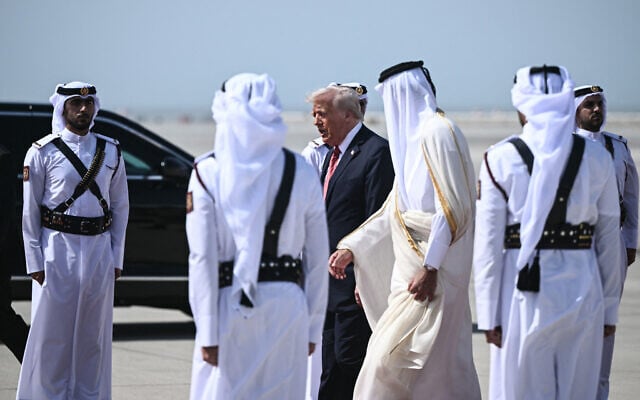
Qatar’s Amir Sheikh Tamim bin Hamad al-Thani (2nd-R) welcomes US President Donald Trump upon his arrival in the Qatari capital Doha from Saudi Arabia on May 14, 2025 (Brendan SMIALOWSKI / AFP)
Nonetheless, MBS still came away with some big wins, foremost among them Trump’s commitment to, at some point, sell F-35s to the Saudis, which would make the kingdom the first Muslim and Arab country to operate the most advanced fighter jet in the world.
If Saudis get the jets, it would likely end Israel’s ability to dominate the region’s skies, though as things stand, the countries are extremely unlikely to use them against each other.
“We should admit it’s hard to conjure up any realistic scenario in which MBS would ever make the decision to wage war against Israel,” said Hannah. “But this is the Middle East. Regimes and intentions can change while capabilities remain.”
Events in the region over the last 15 years have underscored how quickly even ostensibly stable regimes allied with the US can fall.
The potential danger doesn’t mean that Israel has to work now to spike the sale. Israel can push for guarantees on defense cooperation in a new 20-year MOU that Prime Minister Benjamin Netanyahu is said to be pushing for. The US can also provide a Senate-ratified mutual defense treaty.
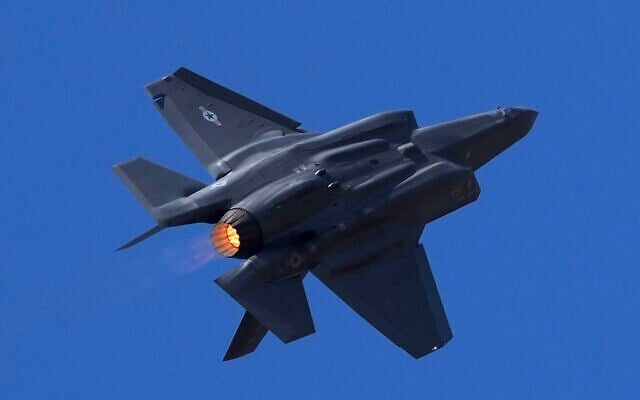
US Air Force fighter aircraft F-35 performs aerobatic maneuvers on the second day of the Aero India 2025, a biennial event, at Yelahanka air base in Bengaluru, India, February 11, 2025. (AP/Aijaz Rahi)
MBS also sealed a long-sought agreement on civil nuclear energy that “builds the legal foundation for a decades-long, multi-billion-dollar” partnership in line with “strong nonproliferation standards,” according to the White House.
If Saudi civil nuclear reactors are powered by imported fuel rods, there’s nothing to worry about in Israel. On the other hand, if agreements with the US open the door for the Saudis to master the entire nuclear fuel cycle, Israel would face a transformed security landscape.
Harder bargain
For Israel, the possibility of normalization with Saudi Arabia could mitigate any future risks posed by the country.
MBS stressed at the White House that he eventually intends to normalize ties with Israel: “We want to be part of the Abraham Accords, but we want also to be sure that [we] secure a clear path [toward a] two-state solution.”
But after the two years of war in Gaza, the Saudi leader needs a much stronger commitment from Israel on a Palestinian state than he may have been willing to go with before 2023 if he is to foist normalization on a hostile Saudi public.
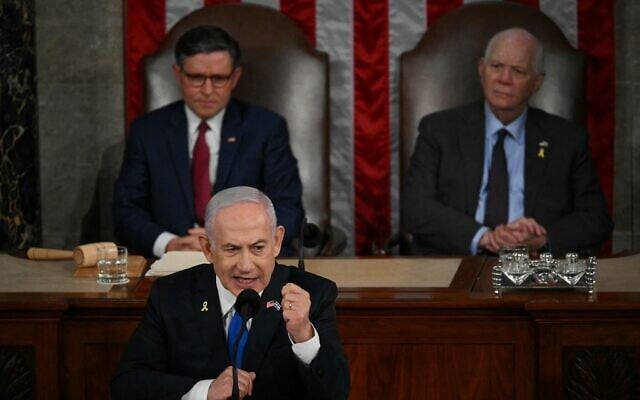
Prime Minister Benjamin Netanyahu addresses a joint meeting of Congress at the US Capitol on July 24, 2024, in Washington, DC. (Drew Angerer / AFP)
“The fires of Gaza are too fresh, the ceasefire too fragile, Saudi leaders too concerned about their public’s opinion to move forward absent a credible path ahead for Palestinians, and Israeli leadership is unwilling to offer one,” said Daniel Benaim of the Middle East Institute. “The mood of the US Congress is also less internationalist than before. Several of these conditions will need to shift — which seems quite possible over time, but unlikely soon.”
MBS’s gains in Washington add to the challenge. The defense upgrades he received could have been conditioned on a normalization package. Now, a full mutual defense treaty could be the only way to finalize the Saudis joining the Abraham Accords.
Moreover, there isn’t that much MBS needs from Israel right now. The doors to Trump’s office are wide open for him, with no need for Israel to help smooth the way.
And in high-priority realms where Israel can be an important asset for Riyadh — like AI — the US has committed to providing Saudi Arabia far more than Israel ever could.
For Netanyahu, the most concerning aspect of MBS’s visit may be the indication that Trump’s vision for the Middle East no longer aligns with his own bellicose stance.
“Saudi Arabia — and the Gulf states in general — have a distinct view of what the region requires at this moment, with a greater emphasis on de-escalation, diplomacy, trade, and investment,” said Benaim.
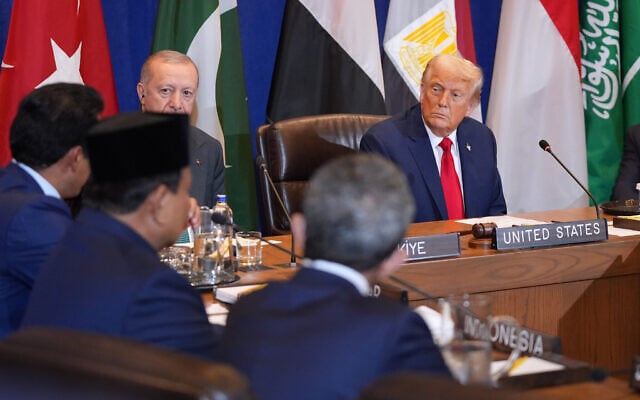
US President Donald Trump listens during a multilateral meeting with leaders of Qatar, Jordan, Turkey, Pakistan, Indonesia, Egypt United Arab Emirates, and Saudi Arabia, during the United Nations General Assembly, September 23, 2025, in New York. (AP Photo/Evan Vucci)
That approach, and not Israel’s pugnacious post-October 7 posture, lines up nicely with what Trump wants to do in the region and beyond. Gulf states, and Turkey, have become in recent months Trump’s preferred interlocutors on mediation and the future of the region.
In the long run, though, Israel likely has advantages for the US as a partner over Saudi Arabia, and the pendulum may well swing back. Trump himself is famously mercurial, and he will be out of office in three years. A Democratic administration could well turn on an autocrat who became one of Trump’s closest partners.
Over time, Hannah said, neither MBS’s personal bonds with Trump nor a flood of investment “can substitute for the reliability, performance, and professionalism of the Israeli military and intelligence services, and the world-class character of Israel’s innovation high-tech economy.”
“Those are huge and lasting assets for the United States that no other regional state can match,” he argued, “and that have in the last year overturned the Middle East’s balance of power in ways overwhelmingly favorable to the United States.”