
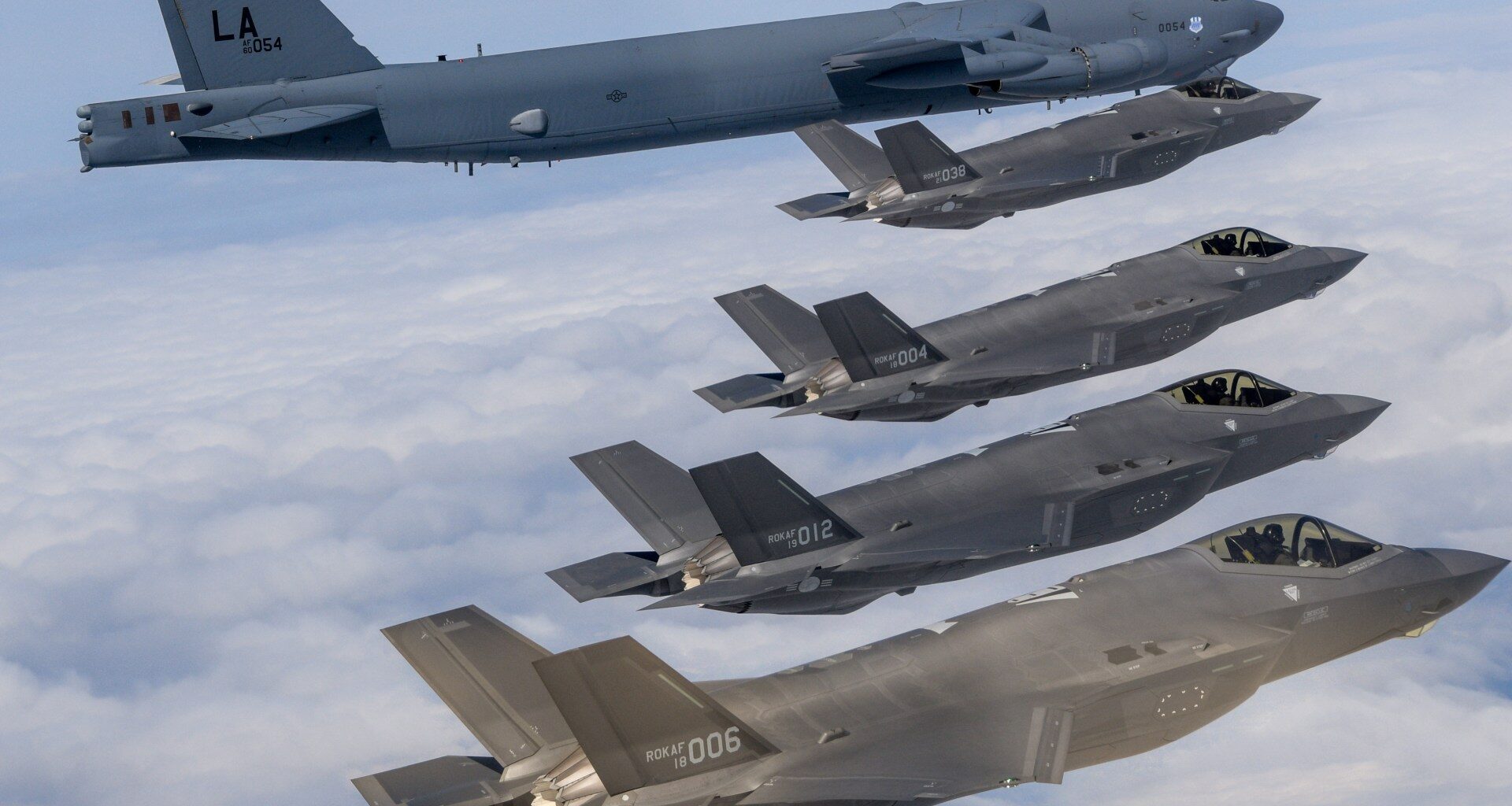
Revenues from sales of weapons and military services by the 100 largest global arms-producing companies reached a record $679bn in 2024, according to new data released by the Stockholm International Peace Research Institute (SIPRI).
The Gaza and Ukraine wars, as well as global and regional geopolitical tensions and ever-higher military expenditures, increased revenues generated by the companies from sales of military goods and services to customers domestic and abroad by 5.9 percent compared to the year before, the organisation said in a report published on Monday.
Recommended Stories list of 4 itemsend of list
The bulk of the global rise was attributed to companies based in Europe and the United States, but there were year-on-year increases in all regions except for Asia and Oceania, where issues within the Chinese arms industry drove down the regional total.
Lockheed Martin, Northrop Grumman and General Dynamics led the pack in the US, where the combined arms revenues of arms companies in the top 100 grew by 3.8 percent in 2024 to reach $334bn, with 30 out of the 39 US companies in the ranking increasing their revenues.
However, SIPRI said widespread delays and budget overruns continue to plague key projects such as the F-35 fighter jet, the Columbia and Virginia-class submarines, and the Sentinel intercontinental ballistic missile.
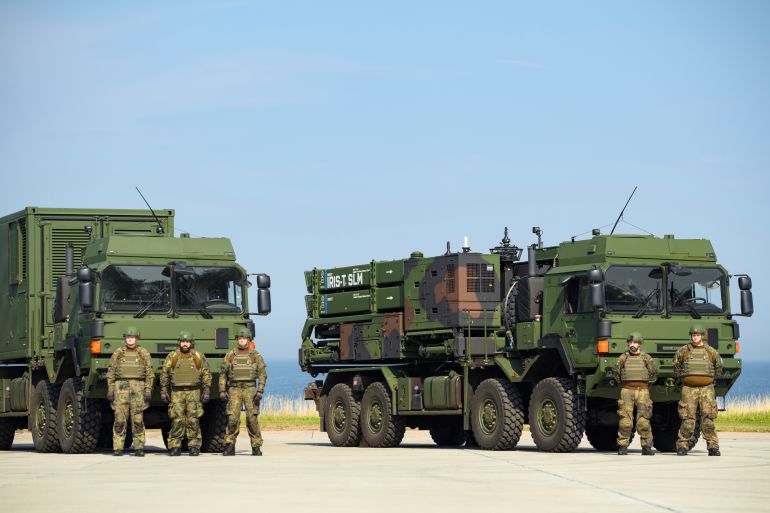 Soldiers stand guard in front of an IRIS-T SLM air defence system prior to the arrival of former German Chancellor Olaf Scholz and top military commanders at the Todendorf military base on September 4, 2024 in Panker, Germany [File: Gregor Fischer/Getty Images]
Elon Musk’s SpaceX appeared in the list of top global military manufacturers for the first time, after its arms revenues more than doubled compared with 2023 to reach $1.8bn.
Excluding Russia, there were 26 arms companies in the top 100 based in Europe, and 23 of them recorded increases in revenues from sales of weapons and equipment. Their aggregate arms revenues grew by 13 percent to $151bn.
After boosting revenues by 193 percent to reach $3.6bn through making artillery shells for Ukraine, Czech company Czechoslovak Group recorded the sharpest percentage increase in arms revenues of any top 100 company in 2024.
As Ukraine faces a relentless Russian offensive in its eastern regions, the country’s JSC Ukrainian Defense Industry increased its arms revenues by 41 percent to $3bn.
European arms companies have been investing in new production capacity to fight off Russia, the SIPRI report said, but it cautioned that sourcing materials – particularly in the case of dependence on critical minerals – could pose a “growing challenge” as China also tightens export controls.
Rostec and United Shipbuilding Corporation are the only two Russian arms companies in the ranking, and they also increased their combined arms revenues by 23 percent to $31.2bn despite being hit by Western-led sanctions over the Ukraine war.
Last year, weapons makers in Asia and Oceania still registered $130bn in revenues after a 1.2 percent decline compared to 2023.
The regional drop was due to a combined 10 percent decline in arms revenues among the eight Chinese arms companies in the ranking, most prominently the 31 percent fall in the arms revenues of NORINCO, China’s primary producer of land systems.
“A host of corruption allegations in Chinese arms procurement led to major arms contracts being postponed or cancelled in 2024,” said Nan Tian, Director of the SIPRI Military Expenditure and Arms Production Programme. “This deepens uncertainty around the status of China’s military modernisation efforts and when new capabilities will materialise.”
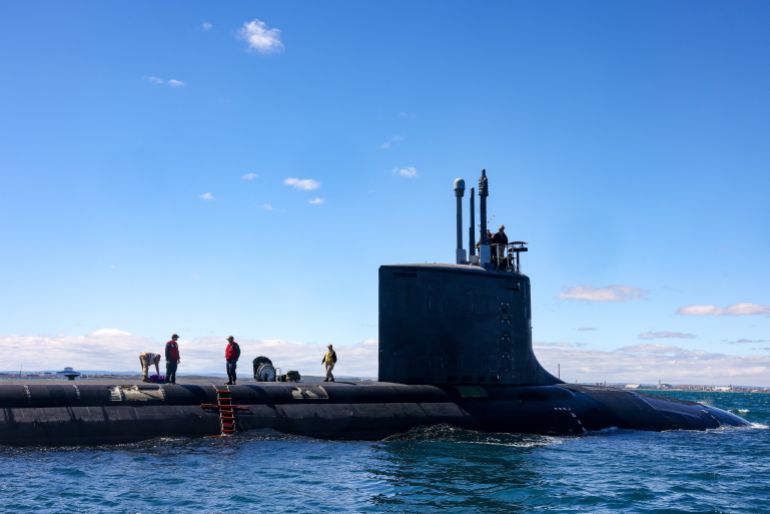 The USS Minnesota (SSN-783) fast-attack submarine sails off the coast of Western Australia on March 16, 2025 [Colin Murty-Pool/Getty Images]
But Japanese and South Korean arms manufacturers’ sales surged on the back of strong demand from European as well as domestic customers amid simmering tensions over Taiwan and North Korea.
Five Japanese companies in the ranking increased their combined arms revenues by 40 percent to $13.3bn, while four South Korean producers saw a 31 percent jump to $14.1bn in revenue. South Korea’s largest arms company, Hanwha Group, recorded a 42 percent surge in 2024, with more than half coming from arms exports.
Israel reaps profits of Gaza genocide
For the first time, nine of the top 100 arms companies were based in the Middle East, according to SIPRI. The nine companies racked up a combined $31bn in revenue in 2024, showing a regional increase of 14 percent.
As the United Arab Emirates continues to face international allegations of arming the devastating war in Sudan, the institute noted its regional figure excludes Emirati-based EDGE Group due to a lack of revenue data for 2023. The UAE rejects the accusations.
The three Israeli arms companies in the ranking increased their combined arms revenues by 16 percent to $16.2bn amid the ongoing genocidal war on Gaza, which has killed nearly 70,000 Palestinians and destroyed most of the besieged enclave.
Elbit Systems pocketed $6.28bn in profits, followed by Israel Aerospace Industries with $5.19bn and Rafael Advanced Defense Systems with $4.7bn.
SIPRI said there was an international surge in interest in Israeli unmanned aerial vehicles and counter-drone systems. Rafael’s surge was tied to Iran, as demand for the company’s air defence systems rose to “unprecedented levels” after Iran’s large-scale retaliatory strikes against Israel in April and October 2024 that used ballistic missiles and drones.
Five Turkish companies were in the top 100 – also a record. Their combined arms revenues amounted to $10.1bn, showing an 11 percent increase.
Baykar, which makes, among other things, advanced drones most recently sold to Ukraine, saw 95 percent of its $1.9bn in arms revenue in 2024 come from exports to other countries.
Military companies from the United Kingdom, France, Germany, Italy, India, Taiwan, Norway, Canada, Spain, Poland and Indonesia were in the ranking as well.