
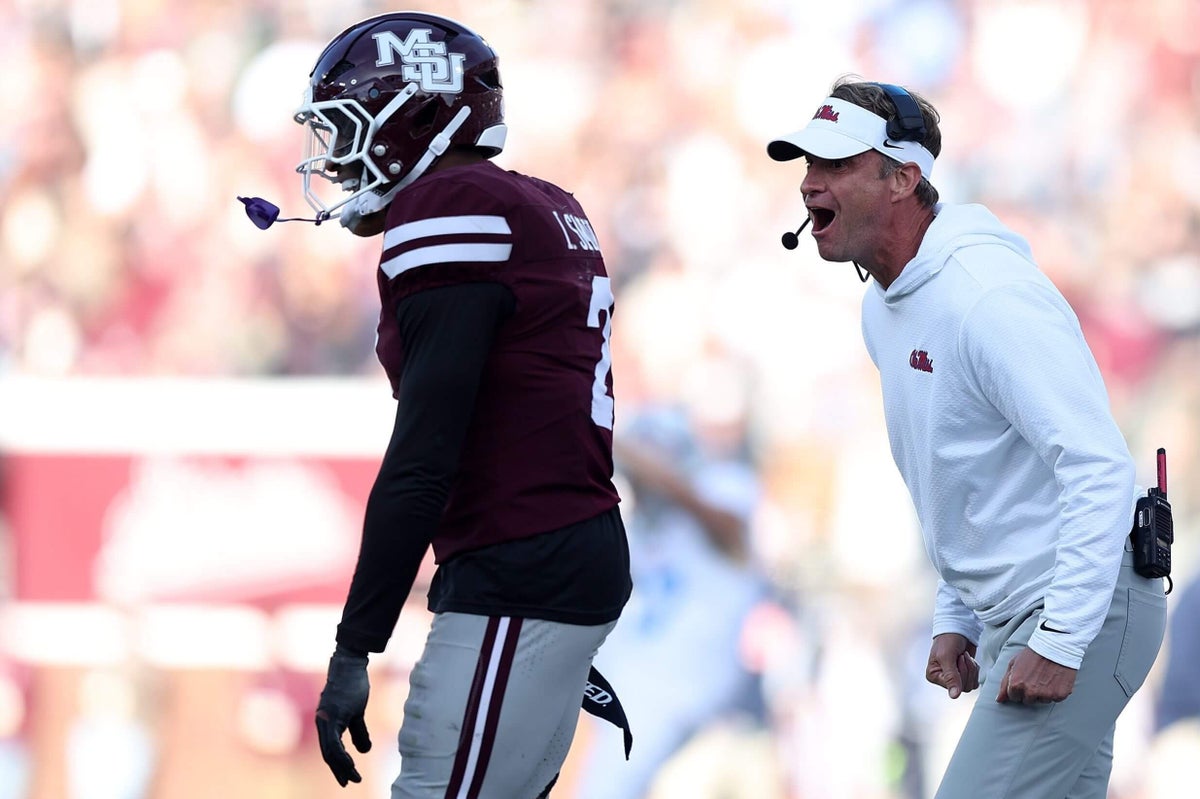
He really did it. Lane Kiffin really did ditch a team with a 99 percent chance of reaching the College Football Playoff three weeks before the Playoff begins. And now that he did, the wildly popular, yet terminally broken sport of college football is never going to be the same.
All it took was one school, LSU, whose governor is running its coaching search, that couldn’t wait until after the season to make its next move, and one coach, Kiffin, with an already long history of burning bridges, to set an infuriating precedent.
Fans are now going to expect their school to fire a lame-duck coach as early as possible in the season to get a head start on hiring the next one. Schools are going to expect an answer from their candidates as soon as possible, so they don’t miss out on someone else.
And coaches who really want another job now have cover to leave their team early, even if that team has an opportunity to win the national championship. They can even send their families on private planes to go scope out the suitors.
It’s such a screwed-up situation that certain ESPN personalities tried to portray Ole Miss as the villain in this triangle for not letting a coach who’s leaving for one of its direct competitors stick around for the Playoff. “Sure, coach. We’ll make sure your office is clean, too. Just let us know which of our players you plan to take with you once you’re done.”
Rebels athletic director Keith Carter pivoted instead and named Kiffin’s defensive coordinator, Pete Golding, as the school’s next permanent coach. But Kiffin is so diabolical, he’s even whisking away several assistants to LSU immediately, leaving Ole Miss to prepare for a Playoff game with the kind of Frankenstein staff you might expect from a team in the Birmingham Bowl.
Nobody wants this. Not even the parties involved. But nobody is going to do anything to stop it, either. They’re too busy trying to prevent athletes from doing the very same thing.
In the annals of college athletics hypocrisy, this particular milestone qualifies as an all-timer.
On Oct. 7, the NCAA adopted a new transfer portal model that condenses the previous winter and spring windows into one 15-day window from Jan. 2-15. That’s about a month later and a week shorter than before.
The stated rationale: to cut down on players entering the portal prior to the end of their teams’ seasons.
Can’t make this stuff up. Oh, and there’s more.
Previously, after a coaching change, athletes had a free 30-day window in which they could enter the portal. Under the new policy, that period has been cut in half, to 15 days, and … get this … doesn’t begin until five days after a new coach is hired.
In other words, Kiffin is free to go ahead and start working at his new school immediately, but the players he left behind — whose performances helped Kiffin become the new highest-paid coach in college football — must wait until Ole Miss hires his replacement. And then another five days after that.
It’s like the people running this enterprise are addicted to billable hours.
Kiffin’s apologists will undoubtedly blame this unprecedented situation on the sport’s calendar. Early signing day. January portal. The longer Playoff. What’s a poor coach trying to decide between two gazillion-dollar offers supposed to do?
You could do what Oklahoma State and Florida did with their hirings. Both programs hired a Group of 5 coach, and both will allow their new coach to continue coaching his old team should North Texas or Tulane, respectively, win the American championship and earn an automatic CFP berth.
But that’s not this. LSU is one of the Rebels’ annual SEC rivals. They compete for the same recruits. If Coke hires an employee from Pepsi, they probably don’t let him hang on to his company log-on for another month.
The only thing that could prevent more situations like this from occurring is if the SEC instituted its own rule prohibiting its members from poaching another’s coach before the season is over, which exists in the NFL. Even better, all the conferences would come together and institute a rule like that which applies across the sport.
Granted, like a lot of things in college sports, that might be considered an antitrust violation.
Ah, but good news. The long-awaited SCORE Act, subject of all those TV ads, is expected to reach the floor of the House of Representatives next week. If it comes up for vote, it is likely to pass that chamber. The bill, among other things, would give the schools an antitrust exemption to pass rules without the threat of getting sued.
Imagine how much of the sport’s current foolishness they could curb. Perhaps they could put a cap on how much guaranteed money a school can include in a coach’s contract, so they don’t get stuck paying $40, $50 or $60 million to fire a coach. Or, they could institute a portal window of sorts for coaches to take new jobs, say from Feb. 1-March 1, after the season but before spring practice. You know, common sense stuff like that.
But of course, they won’t do any of that. The law is solely intended to put the clamps on out-of-control NIL spending and unlimited transfers. Like if, God forbid, a player ever tried to leave one SEC school for another in the middle of the season for some absurd number like, oh, $12 million a year.
The timing of Kiffin’s move makes a mockery of a sport that’s become way too easy to mock lately. The College Football Playoff should not be an opt-in for the coaches of the teams. Ole Miss shouldn’t be put in the position of having to choose between keeping a lame-duck head coach or promoting his defensive coordinator on the eve of one of the biggest games in school history.
But get used to it. Kiffin won’t be the last. Especially once the powers-that-be devise their next solution to a nonexistent problem by doubling the size of the Playoff field.