

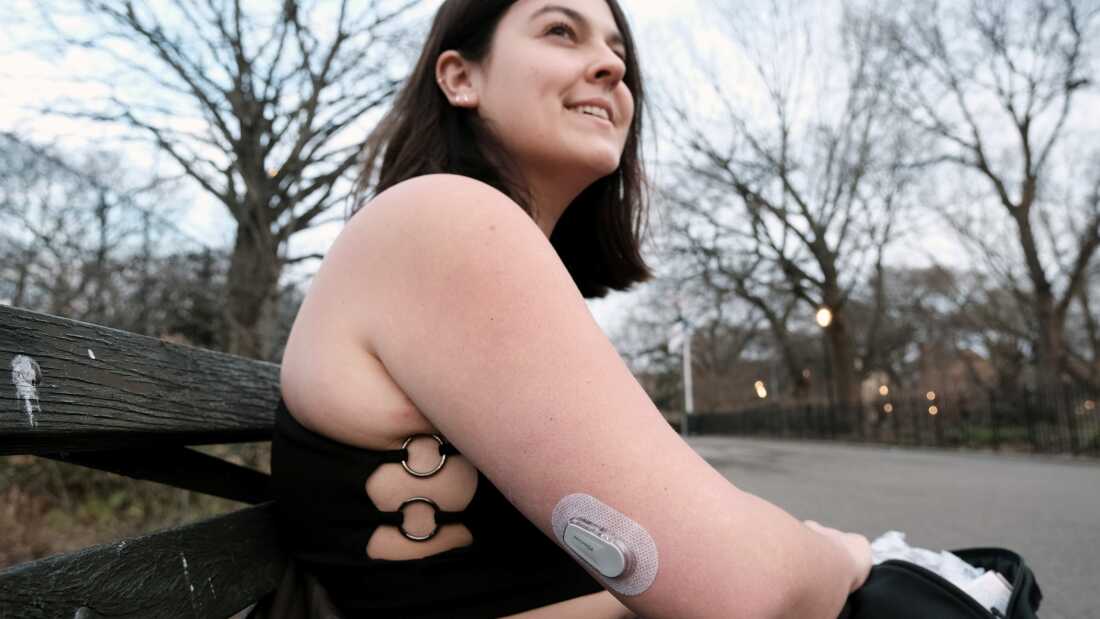
Taylor Jane Stimmler displays her continuous glucose monitor she wears on her arm on March 02, 2023 in New York City.
Spencer Platt/Getty Images
hide caption
toggle caption
Spencer Platt/Getty Images
Prediabetes is common in the U.S. — around 1 in 3 people have it. And many people may not know they have it.
For prediabetic people, their glucose levels are higher than people without diabetes – but not quite in the diabetic range.
“You may see higher glucose rises after certain meals,” says Dr. Sarah Kim is a diabetologist and professor of medicine at University of California, San Francisco. “And you might see it go up after you eat a cherry pie…. You may see bigger changes in your glucose, whether you’re sedentary versus active.”
The FDA approved the first over-the-counter continuous glucose monitor last year. Since then, more people who are prediabetic or without a diabetes diagnosis have started checking in on their blood glucose levels.
Kim says while these devices may not offer much insight for people without diabetes, they can be empowering for those looking to make lifestyle changes or better understand their bodies.
Interested in more science of the human body? Email us your question at shortwave@npr.org.
Listen to every episode of Short Wave sponsor-free and support our work at NPR by signing up for Short Wave+ at plus.npr.org/shortwave.
Listen to Short Wave on Spotify and Apple Podcasts.
This episode was produced by Rachel Carlson. It was edited by Rebecca Ramirez. Tyler Jones checked the facts. The audio engineer was Kwesi Lee.