
December 1, 2025
David Seifert
Director of College Scouting
The 2020 MLB Draft was short and bittersweet. Limited to just five rounds, the lack of evaluations and limited data resulted in college prospects being highly (over) valued early as eight of the top ten selections were from the collegiate ranks. This approach backfired as five of the top eight current WAR producers were from the high school ranks with Pete Crow-Armstrong (19th overall pick), Tyler Soderstrom (26th), Jordan Westburg (30th), Evan Carter (50th) and Masyn Winn (54th) currently leading the way.
Tennessee left-hander Garrett Crochet was a wild card at the time of the draft due to questions surrounding his arm health after being limited to just one start and 3.1 innings over the four-week college season. Spencer Strider was a sneaky good 4th round pick that started with astute area scouting after he missed the entire 2019 season recovering from TJ surgery before pitching 12 innings over four starts for Clemson in 2020.
The Top Ten Players:
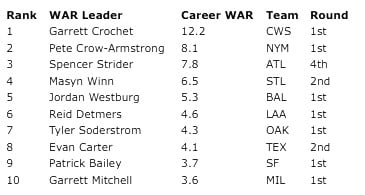
Meanwhile, the top ten overall selections have failed to live up to expectations. Robert Hassell III and Zac Veen were the top preps, selected 8th and 9th overall. Both have reached the Major Leagues, but the short-term results have been below league average. Spencer Torkelson (1st overall), Nick Gonzalez (7th) and Reid Detmers (10th) are the only three collegians selected in the top ten that have returned a positive career WAR to date. Other collegians selected in the top ten included Heston Kjerstad (2nd overall/-1.1 WAR), Max Meyer (3rd/0.0), Asa Lacy (4th/0.0), Austin Martin (5th/-0.3) and Emerson Hancock (6th/-0.7).
The pick of Lacy, who slid to 4th overall, is seen as the biggest bust of the 2020 draft. After pitching just 80 innings as a professional, he has not pitched since 2022. He missed all of the 2023 season with a back injury, as well as the 2024 and 2025 seasons after Tommy John surgery in March of 2024.
The Top Ten Teams + One:
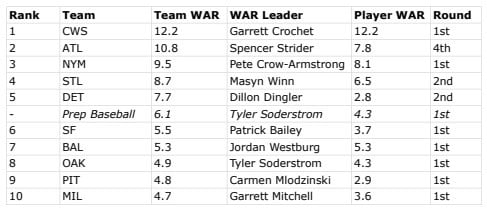
Although the White Sox currently sit alone at the top, 100% of their WAR has been produced by Crochet. He was traded to Boston around this time last year and the return has already netted the White Sox an everyday big leaguer in catcher Kyle Teel (1.9 WAR in half a season), potentially another in Double-A prospect Braden Montgomery, and role-playing Major Leaguers’ Wikelman Gonzalez and Chase Meidroth. The Braves also have excellent early returns with their selections of Spencer Strider in the 4th round and 2023 all-star Bryce Elder in the 5th.
Long-term, the Mets may end up in the top spot with their selection of PCA who is building towards a perennial all-star type of career, albeit in Chicago with the Cubs. The trade returns for PCA during the summer of 2021 were two months of Javier Baez and a year and two months of Trevor Williams.
The Tigers could also be in the running for numero uno over the long-term as four of their six picks have reached the Major Leagues. Of the two that have not, Trei Cruz still looks to have a chance to become a useful role player at the ML level. He would join Torkelson (1st round), Dingler (2nd), Gage Workman (4th) and Colt Keith (5th) as big leaguers.
And in the Bay Area, the Giants will likely ride Patrick Bailey, Casey Schmitt and $2.5M 3rd rounder Kyle Harrison to consistent WAR production over the long-term. The A’s may also see a future boost with Soderstrom who hit 25 home runs and played high-level defense in 2025 and 2nd rounder Jeff Criswell (traded to Colorado in 2022) who made his Major League debut in 2024, but missed 2025 with Tommy John surgery.
The Middle Ten Teams:
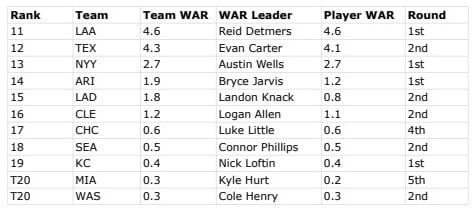
It’s the middle so meh, but noteworthy is the instant production the Angels received from Detmers who made his Major League debut in 2021 just one year after his selection. The 2023 playoff contributions from Carter for the Rangers were immense. And the D-Backs who have seen three of their five picks reach the Majors (Jarvis, Slade Cecconi-2nd round, Brandon Pfaadt-5th round), two with positive career WAR (Jarvis, Pfaadt).
The Bottom Ten Teams:
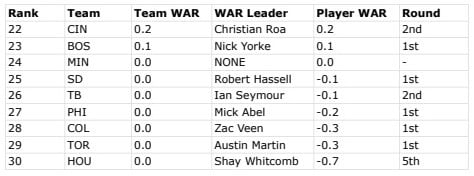
We are just five years removed from the 2020 draft, but seven teams have yet to receive any positive career WAR contributions from their draft class. Houston only had three total picks, one each in the 3rd, 4th and 5th rounds. Although Boston went well off the board at the time with the selection of Nick Yorke at 17th overall, they sold high after he batted .303 between Double-A and Triple-A in 2023 and flipped him to Pittsburgh for Major League rotation piece Quinn Priester who accumulated a 2.9 WAR for Boston in 2025.
EFFICIENCY RANKINGS:
And finally, draft efficiency and the Return on Investment. It’s not my money and the nature of the beast is oftentimes failure, but getting a strong return on one’s investment does have importance. Keep in mind that not all drafts are created equal – money matters and where a club picks in each round does as well. Below we rank clubs on the WAR produced per dollar spent on their 2020 draft.
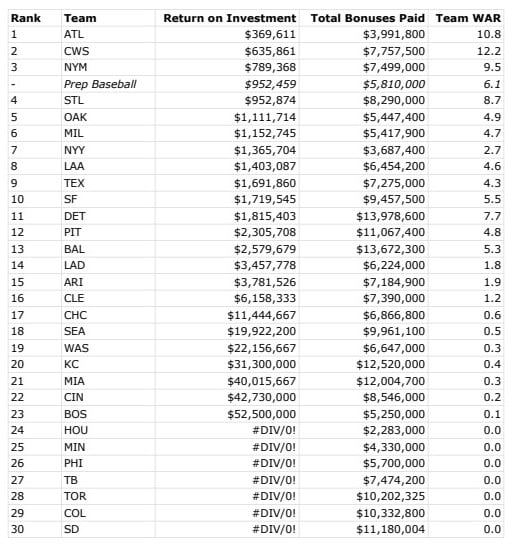
Atlanta currently occupies the top spot after placing sixth in 2019 and 20th in 2018. The White Sox currently rank second thanks to Crochet, but will see their returns in the trade package they received from Boston.
The Mets placed in the bottom ten for both the 2018 (22nd) and 2019 (23rd) drafts, but rebound to third in 2020 thanks to their selection of Crow-Armstrong. PCA was flipped for Baez and Williams, both of whom soon after became free agents and are no longer with the Mets.
After placing in the top ten in both 2018 and 2019, Kansas City and Arizona fall to the middle ten in 2020.
Currently, Miami is the lone club to finish in the bottom ten every year, 2018-2020, but the continued development of Meyer and the emergence of Zach McCambley (3rd round) could change their returns in a hurry.
Prep Baseball remains the only organization who has placed in the top ten of ROI all three drafts.