
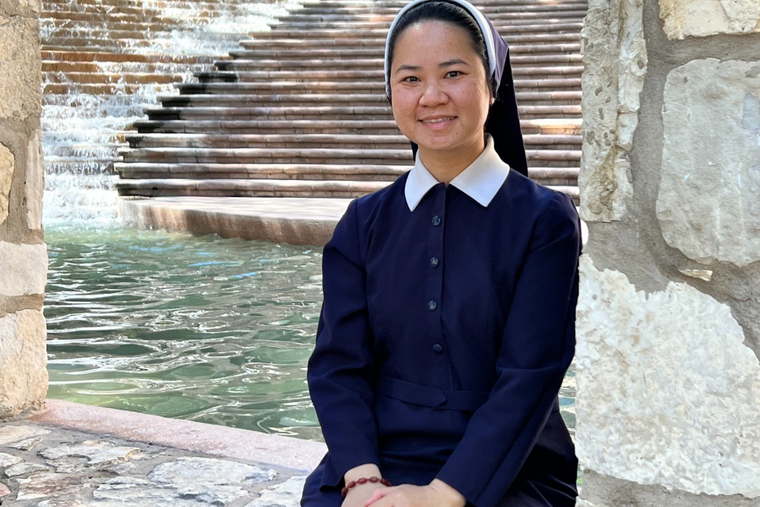
When Sister Theres Hong Phuoc Tran teaches mental health workshops at Catholic parishes, schools and religious congregations, she uses this Scripture quote — “You should love the Lord your God with all your heart, with all your soul, with all your mind, and with all your strength (Mark 12:30)” — to illustrate that wellness consists of four components: heart (connection with others, being loved and loving others), soul (intimacy with God, finding purpose in one’s life), mind (feeding the intellect with good thoughts, seeking counsel when uncertain), and strength (living a physically healthy lifestyle).
While a few people have serious emotional and psychological problems that require professional help, most can make use of the “good tools” outlined in her workshops to enjoy wellness and a happy, fulfilled life.
“Human life has a rhythm, but chaos can enter our lives and bring us problems out of our control,” Sister Theres said. “To know how to live well, we have to know how God intended us to live. To maintain wellness, we must learn how to trust in God and accept the rhythm of our lives with gratitude.”
Sister Theres was born in Saigon, Vietnam, and immigrated to the United States at age 11. In 2003, she joined the Lovers of the Holy Cross, a predominantly Vietnamese community whose motherhouse is in Los Angeles. As their charism includes social services, she became a licensed marriage and family therapist and began seeing patients pro bono. Today, she resides in Santa Ana, California, and offers mental health workshops in Southern California.
In addition to the eternal benefits, Sister Theres noted that faith and trust in God offer temporal benefits as well. Researchers, she asserts, have found that people of faith are less likely to harm themselves and others and heal more quickly from emotional and psychological wounds. Good psychological health, she continued, has many other perks as well, including better heart function, lower blood pressure, better sleep, mental clarity, emotional balance and less stress and anxiety.
But, as one cannot trust someone he does not know, “for us to trust in God we have to spend time to get to know him, just as we would in a human relationship. Spend time with him and stay in touch with him, and he will reveal himself to you.”
To live a life of gratitude, the religious sister continued, we must “accept the highs and lows of life and unite crosses [to Christ] and be thankful and practice self-giving.”
One benefit of giving to others, she added, is that it “will push your brain to release ‘happy hormones’: dopamine, oxytocin, serotonin and endorphins. It will give your life meaning and purpose, a sense of accomplishment and a healthy sense of control.”
Those habituated to giving, she believes, have improved mental and emotional well-being, lower levels of depression, stronger relationships and social connections, better heart health, and increased self-esteem and life satisfaction.
Follow the Great Commandments
In recommending self-care for the typical person, Sister Theres circles back to the central points found in Mark 12:30:
Heart: Are we following the two Great Commandments, love of God and love of neighbor? With regard to love of neighbor, she believes, we must first understand and accept ourselves and be grateful for our lives, before we can love others.
Soul/Spiritual: Are we attached to God? Do we stay close to those who can offer us good examples and lead us to “higher values, finding meaning and purpose in whatever we do”?
Mind: Do we feed our minds with good thoughts? Do we guard our senses from those things that might harm us? The sister-therapist explained, “Our brains lead us to believe what comes to them through our five senses. That is how we experience reality and how our brains draw conclusions. If we fill it with unhealthy things or expose it to unhealthy behaviors such as pornography and substance abuse, it is not good for our mental or physical health.”
Strength/physical: Are we eating healthy, sleeping well and engaging in healthy activities such as exercise? “Our bodies are naturally wired to be active. Many people are unhealthy because they are inside too much on electronic devices. We need to go outside and be active,” she counseled.
Sister Theres added that there are various practices Catholics can adopt to improve their mental health and specifically pointed to the tradition of fasting. Fasting benefits us psychologically, she believes, as it involves delayed gratification and requires us to tolerate discomfort. She continued, “It leads to a clarity of mind and self-control and develops our brains in a positive way. And, if we do it with others, it leads to greater solidarity within our community.”
Suicidal Ideation: Anyone Can Be Affected
When Sister Theres began seeing clients, she learned that mental health issues can affect anyone: men or women, priests and religious or laypeople, wealthy or poor, one ethnicity or another. She also became concerned about the increase in the suicide rate in the U.S. over the past generation: “Minimizing or eliminating that has become my focus.”
Citing Centers for Disease Control research, Sister Theres noted that one out of three high-school girls has seriously considered suicide. In the Asian community, she continued, it is the leading cause of death among those ages 15 to 24 in the U.S. She collaborated with two mental health professionals to launch a “Fully Alive” program in the Diocese of Orange to provide resources to deter suicide, as well as to teach life skills to help participants “thrive to be the best version of themselves and live healthier and happier.”
In her workshops, Sister Theres discusses signs of suicidal ideation — ongoing depression or anxiety, loss of interest in engaging in preferred tasks, sleeping and eating problems, thoughts of worthlessness and helplessness — as well as discussions of how to help others in crisis. When she encounters such a person, she said, “I try to create a safe space for them to feel free to express their thoughts and feelings without judgment, let them feel heard and understood. Then I try to explore with them some protective factors, which include faith in God and others, connections with someone, those who care for them or those for whom they care.”
Other support could include developing a safety plan that outlines self-care habits, grounding techniques, and ways to build connections with others, along with other meaningful activities and spiritual practices. Once the person has reached a level of stability, Sister Theres then works to “explore their goals in life and help them to learn other life skills to maintain their well-being, including effective communication, motivation and goal setting, stress management, healthy boundaries and relationships, and emotion intelligence.”
Should a person develop mental health issues, he or she should not hesitate to reach out for help and “work toward holistic wellness by knowing and accepting your gifts, talent and strengths as well as weakness and limitations. Forgive yourself and others for your flaws and accept life’s imperfections.”
“Learn from mistakes, and unite your crosses with Jesus Christ Crucified,” she counsels.
‘Opening Up a Dialogue’
Often working with members of the Vietnamese community, Sister Theres has observed a stigma against receiving mental health services. “In Asian culture, you don’t want to expose anything negative about your family,” she said. “If you are struggling and seek therapy, some perceive this as an embarrassment for your family, as if its members failed you.”
She continued, “Some also believe that if you seek professional help, you are ‘crazy.’ But going to therapy does not mean you are crazy, but that you need help with an issue.”
Nathan Nguyen, 18, of Garden Grove, California, for example, comes from a family with a history of obsessive-compulsive disorder (OCD) and found that he himself struggled with OCD. “I might perceive that my hands are dirty and excessively wash them,” he explained. “I was a perfectionist at school and obsessed about my grades.”
He participated in therapy with Sister Theres and has begun to improve. Even though he experienced anxiety and discomfort early on when attempting to modify his obsessive behaviors, he said: “You don’t give in; that’s how you improve.”
Carrie de Bever, principal of St. Bruno Catholic School in Whittier, California, invited Sister Theres to offer a one-day workshop to her middle-school students. She wanted to bring the religious sister to the campus because she was concerned about how students were being impacted by harmful elements of the culture, particularly the internet.
“When she arrived, I don’t think our students knew what mental health was,” de Bever recalled. “But as the day progressed, the students really began opening up.”
The students reinforced that it is normal to have fluctuations in emotions and that “everyone has times when they feel sad or afraid. She offered tools in dealing with strong emotions and reassured students that if they needed to, they could reach out for help,” the principal recounted.
As a result of the workshop, the school now has a part-time therapist available on campus with whom students can speak.
De Bever is grateful to Sister Theres for “opening up a dialogue” on mental health.
“Sister is a slight nun with a big heart and a big message,” she said. “She really captured our students’ attention, and it was a delight to have her on campus.”
LEARN MORE
Sister Theres welcomes email inquiries. Contact her at [email protected].