
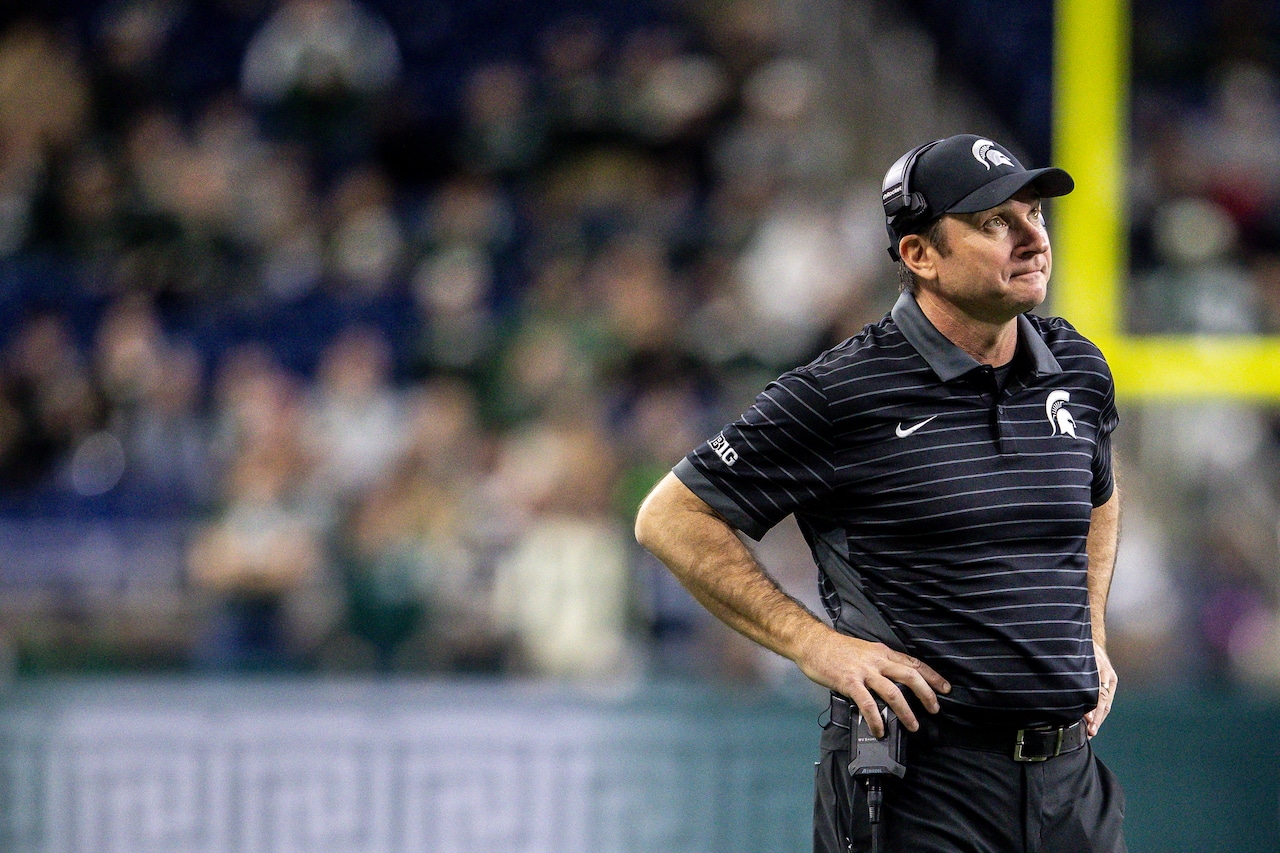
The last time I spoke with Jonathan Smith was at Big Ten Media Days in Indianapolis. It was 2023 and Smith had not yet lost a game at Michigan State.
Standing to the side of a ramp leading to the field at Lucas Oil Stadium, I asked how long the former Oregon State coach thought it would take to find success in his new job with the institutional mess he inherited.
He turned serious and, with a sober look, said, “It’s gonna take a while.”
College football coaches don’t get “a while” any longer. Not when millions of dollars are invested in the roster every single season. So, after going 9-15 in two seasons, with just four Big Ten wins in that span, Smith was unceremoniously fired on Sunday.
There is an impulse here to write about regret, or maybe schadenfreude. Smith had it good at Oregon State. So good. And he threw it away when the Beavers were drowning. His only stop on his way out of town was at Goodwill. This is karma, baby.
But the more I think about it, I’ve been struck by an even greater realization: Smith did Oregon State a huge favor when he bolted two Novembers ago.
I know, I know.
The two years that followed in Corvallis were miserable affairs. Trent Bray was not equipped to be a head coach and that certainly didn’t help. The 2-10 season that ended on Saturday in Pullman very well may have been, relative to expectations, the worst year in program history.
And yet, there is genuine excitement in Corvallis.
On Tuesday, the Beavers will introduce JaMarcus Shephard as the program’s new head coach. Fans and alumni, desperate for positive momentum, are celebrating the move.
The Alabama assistant may or may not succeed in the role, but he is coming into the job with eyes wide open. He is not trying to restore something that existed before the Pac-12 died, but instead will attempt to build something entirely new in a conference that is still taking shape. He is bringing a general manager and a true understanding of the modern landscape.
I’m doubtful that the Beavers would be as well positioned if Smith had stayed — if he had done the thing Beavers fans hoped he would do and the thing they hate him for not doing.
Smith was the perfect coach for an underdog operating with the fewest resources among peers. Shephard’s last two jobs have been right next to Kalen DeBoer at Alabama and Washington. He feels like a better fit for the Beavers to be at the top of the new Pac-12, both in terms of dollars and in wins.
It’s all speculative at this point, of course. It’s possible I am not giving Smith enough credit and he would have been able to quickly adapt to the new world order and his alma mater’s role in it. The results at Michigan State, however, make me doubt it.
Even if Smith had been able to keep much of that 2023 roster together for another season, reality was coming for OSU one way or another.
Without a conference and the resources to competitively pay coaches and players, the program Smith built would have atrophied and decayed.
And then what?
Smith and the Beavers would have been stuck in a marriage that no longer made sense.
Everything that happened under Bray would have played out under Smith, possibly just on a slightly different timeline.
The Beavers faced a reckoning this fall that they may not have encountered for another year or two with Smith still bailing water from the sinking ship.
Athletic director Scott Barnes would not have been eager to fire a celebrated alumnus who quarterbacked the Beavers to their most wins ever and coached them to their only other 10-win season, even as Smith would have continued to collect a paycheck that dramatically exceeded the Beavers’ actual budget.
Smith was set to earn $4.95 million in 2024, more than double what Bray was paid that year.
The situation might have more closely resembled the situation with OSU basketball, where Barnes rewarded Wayne Tinkle with a hefty contract but inadvertently made the coach too expensive to fire when the result took a nosedive.
In any case, it’s difficult for me to imagine that the Beavers would be entering the 2026 with an energetic first-year coach and a fresh perspective.
Even if his decision was rooted in self-preservation, Smith ripped the Band-Aid off and made OSU come to terms with its reality faster than the school would have if he had stayed.
His departure forced Barnes into the ill-conceived decision to hire Bray and Bray’s inevitable flameout this fall necessitated a comprehensive coaching search and ultimately led the Beavers to Shephard.
Barnes couldn’t have known that two years ago when he was working around the clock to keep Smith in Corvallis. Nor could fans who have cursed Smith’s name in the 24 months since.
On the day Smith left for Michigan State, I wrote that his departure was “an existential crisis” for the Beavers. I now believe the greater crisis would have been if he had stayed.
Coaches are always trying to see around corners when it comes to the profession and their own security. They want to leap at exactly the right time. Lane Kiffin believes he did. We’ll see about that.
Smith read the room correctly when it came to the future of Oregon State but chose the wrong landing spot. What not even he may have understood at the time is that it was also the right moment for the Beavers, too.
Folks didn’t realize it then, but over time it has become obvious.
It just took a while.