
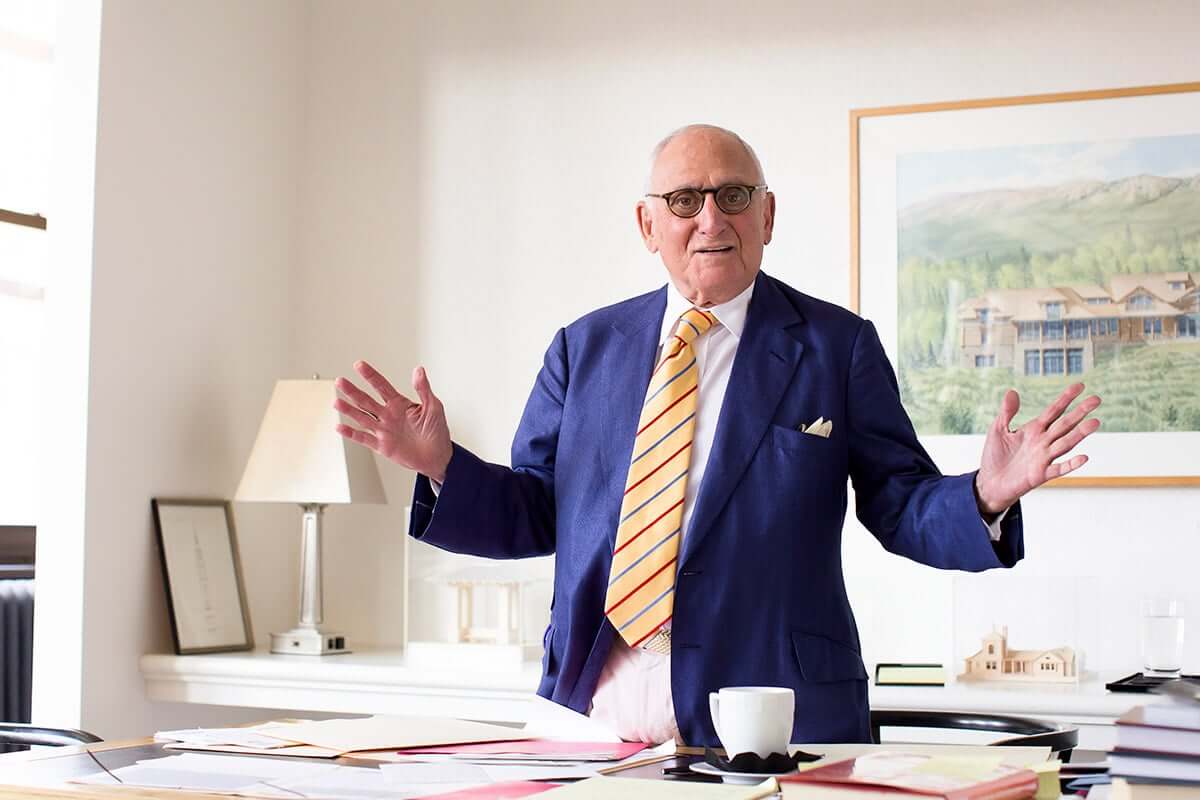
Robert A. M. Stern died November 27 in New York City at age 86. Stern’s son, Nicholas, told The New York Times his death came after a brief pulmonary illness. Stern served as dean of the Yale School of Architecture for 18 years, from 1998 through 2016. He founded his eponymous firm, Robert A. M. Stern Architects (RAMSA), in 1977.
A six volume series about New York City architecture co-edited by Stern features prominently on coffee tables and book shelves around the country. The latest installment, New York 2020, was recently published.
Writing in Queer Space, Aaron Betsky credited Stern with “queering modernism,” work that RAMSA continued with the commission to design the American LGBTQ+ Museum and its leading of queer history walking tours in Greenwich Village.
 The new Tang Wing for the New York Historical Society will house the American LGBTQ+ Museum. (Alden Studios for Robert A. M. Stern Architects)
A polymath, Stern will be remembered for his candidness. After alterations were approved for a postmodern lobby by his colleagues Kevin Roche and John Dinkeloo at 60 Wall Street, he told AN in 2023 that the planning commission responsible “should stick to traffic issues.” In 2017, Stern confided in former AN executive editor Matt Shaw that his clients think “I’m a man of steel and I’m really Clark Kent at heart.”
“Bob’s impact reverberates not just through RAMSA, but across the entire field of architecture,” said RAMSA partner Daniel Lobitz in a statement after Stern’s death. “His legacy will live on through the books he wrote, the students he mentored, and the people who inhabit his remarkable buildings. His vision, passion, and notoriously sharp wit became the foundation for a career that will not soon be forgotten, and a firm that is honored to continue the work he began.”
Deborah Berke, Stern’s successor as dean at Yale, affirmed for the Yale Daily News after his passing that “Bob was a good friend. We both loved great architecture as well as debating what that might mean,” Berke said. “Bob was also disarmingly frank and could be rather direct. He was principled, he was generous, and he was fun. For him, nothing was more important than architecture and architectural education, and nothing was more fun than talking about design with a martini in hand.”
In a remembrance shared by The Architectural League of New York, former executive director Rosalie Genevro recalled when she had “the privilege of interviewing Bob several times in the summer and fall of 2023. His wide-ranging knowledge; his remarkable memory and delight in knowing personal histories, foibles included; his unbounded affection for New York, and for architecture as art, business, intellectual pursuit, and all-consuming interest, were all on display. Robert A. M. Stern was a remarkable, infuriating, endearing, one-of-a-kind man. He will be profoundly missed.”
A Journey in Architecture
Robert Arthur Morton Stern was born in 1939 in Brooklyn. He earned an undergraduate degree from Columbia University in 1960, and then a MArch from Yale University in 1965. Stern founded an office, Stern & Hagmann, four years later with architect John Hagmann. RAMSA was established in 1977, after eight years in practice with Hagmann. In 1980, Stern partook in the Venice Architecture Biennale’s Strada Novissima.
Major commissions for RAMSA followed, from Walt Disney Company, where Stern served on the board, and developers like the Zeckendorfs and Hines. He went on to design residential towers throughout Manhattan, many of which line Central Park; and controversial projects like the George W. Bush Presidential Library in Texas.
In 1986, Stern hosted a PBS series, Pride of Place: Building the American Dream that introduced the American public to architects like Philip Johnson, Frank Gehry, and Peter Eisenman.
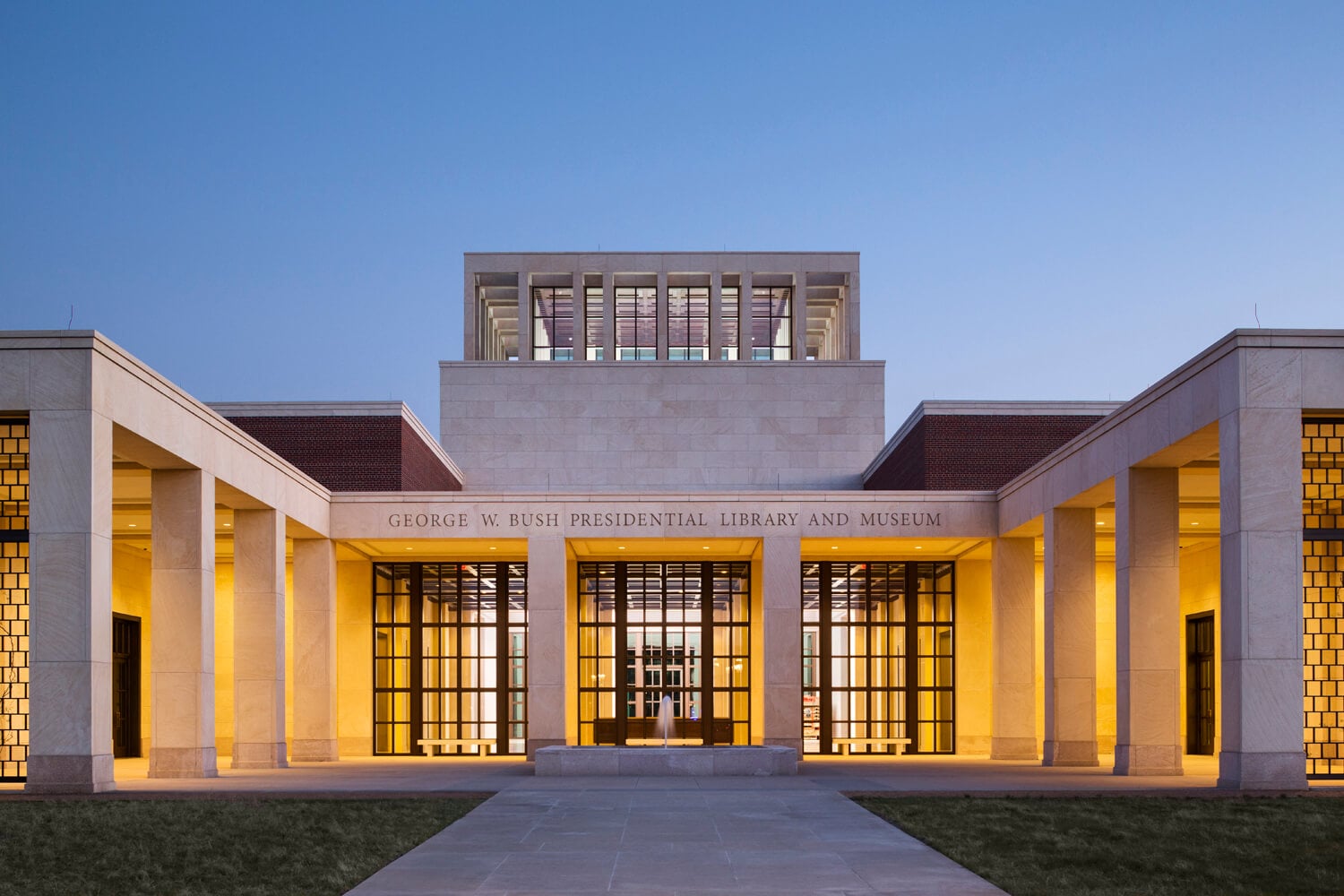 George W. Bush Presidential Library and Museum in Dallas, Texas (Courtesy Robert A. M. Stern Architects)
Stern served as inaugural director of Columbia GSAPP’s Buell Center from 1983 to 1988 and then directed the Graduate Program in Historic Preservation from 1992 to 1998. That year, Stern took over the Yale School of Architecture as dean. George Knight, a former RAMSA employee and Yale educator, said the “school flourished and attracted a huge variety of professionals” under Stern’s tutelage.
Some female students remember things a bit differently: An anonymous signatory of the Shitty Architecture Men list recounted Stern “frequently and publicly” making racist and sexist comments about women and pregnancy. He was also “openly classist,” the signatory said.
Stern continued to teach at Yale before stepping down in 2022. Beyond his acclaimed New York series, RAMSA’s work was documented in myriad monographs, and Stern contributed to other books. In helming a career that was built on courting power and promoting postmodernism, Stern took after his mentor, Johnson; their interviews were published in a dedicated book in 2008.
Stern published a memoir in 2022: Between Memory and Invention: My Journey in Architecture, co-written with Leopoldo Villardi. In the memoir’s conclusion, Stern noted:
“In my belief that architecture is a never-ending obsession, I regret that the buildings could not have been a little better, that the books could not have been a little clearer. But I pride myself in sticking to principles—I have no regrets over staying true to my conviction that architecture cannot flourish so long as architects believe they stand before a tabula rasa, so long as they believe that architecture is just the product of an individual program, individual talent, and individual personality. It is much more—architecture is part of a continuum. Although the inescapable facts of historical circumstance compel us to be modern, to make a building only about its own moment is to doom it to be forgotten in another. Architecture is the artful synthesis of time-honored traditions and immediate circumstance—it is a guardian of cultural continuity; not a lithic seismograph measuring civilization’s every tremor […] The dialogue between old and new, between what was and what is and what will be, is the conversation across time that I have continuously sought to advance. Continually mindful of Jay Gatsby’s quest, ‘we beat on, boats against the current, borne back ceaselessly into the past.’”
Stern’s death came as a surprise, as he had planned to retire from RAMSA in January. Over the Thanksgiving holiday weekend, tributes were shared online from former students, employees, and colleagues.
RAMSA will continue its operations: Today the firm numbers 18 partners and 250 people. At the close of its online remembrance, the office shared that “at RAMSA, we grieve the loss of our founder, mentor, and friend, and remain committed to carrying forth his ideals.”
This article was updated on December 1, 2025.