
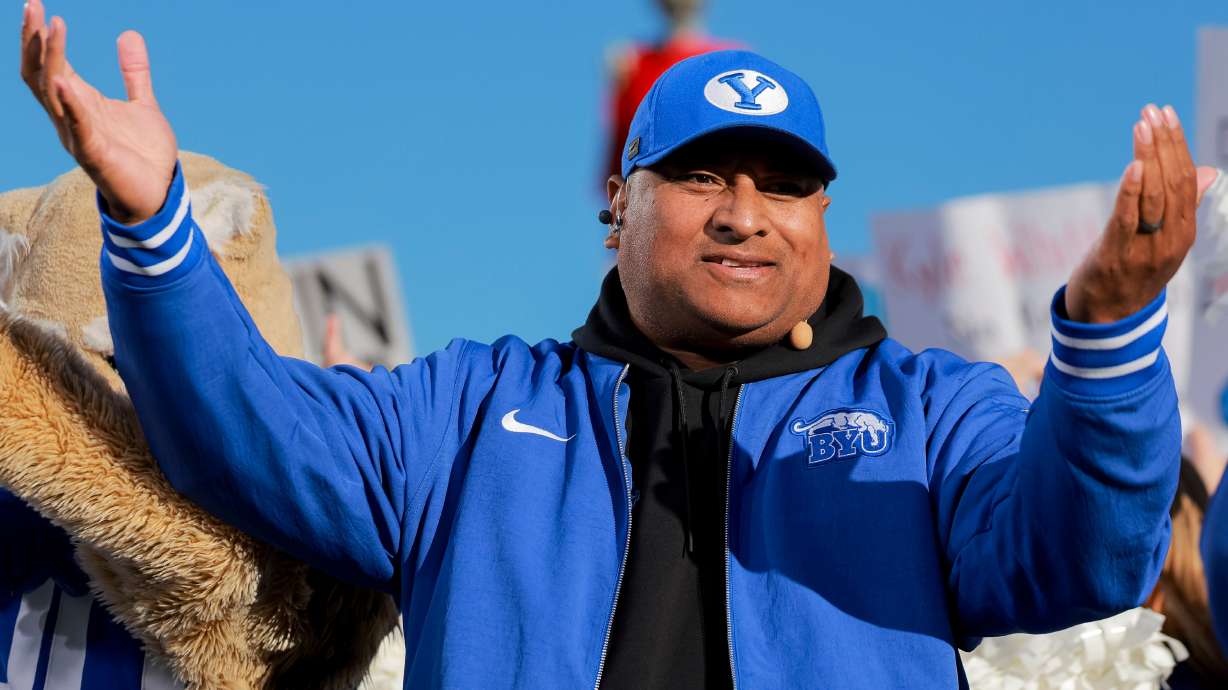
PROVO — In a week when BYU football should be focused on one of the biggest games in program history, a contest with real College Football Playoff implications, the conversation in Provo has shifted somewhere entirely different.
Kalani Sitake has emerged as Penn State’s top choice to be the program’s next coach, according to several national reports.
Addressing the swirl of national speculation earlier Monday, Sitake attempted to bring the focus back to football, saying: “I’m all about the Big 12 championship and keeping our team focused on that. We’re going to avoid all of the distractions.”
The distractions, however, are impossible to ignore.
Instead of celebrating an 11-1 season, a top-15 ranking and a coach who has guided the Cougars to sustained national relevance, BYU fans, donors and administration are reacting to reports that Penn State is making a serious push to hire Sitake.
The timing reveals a larger problem in the sport: The calendar is broken.
Championship week overshadowed by coaching market
Championship weekend is here and early signing day begins Dec. 3. In the short window between these events, schools are firing, hiring, negotiating and restructuring coaching staffs.
Programs preparing for their biggest games are pulled into contract talks, staffing decisions and recruiting pressure all the while their opponents may be locked in only on football.
The most recent example shows how damaging this timing can be. During a potential College Football Playoff run at Ole Miss, Lane Kiffin has accepted the LSU job and has taken much of his offensive staff with him.
Ole Miss could see its CFP positioning affected, as the committee must evaluate a team whose coaching structure and personnel changed right before the final rankings.
The problem for many is not the decision itself but the timing that forced it. BYU now faces a similar dynamic at the height of its season.
Prominent figures outside of college football recognize the dysfunction. Hall of Fame basketball coach Rick Pitino said this week, “I’m not knocking football, but there’s something wrong with their calendar. I’m at SJU and we are potentially a one seed and can win a national hampionship this year, and I leave in March? What’s going on here?”
His comments perhaps encapsulate what BYU’s fan base is experiencing right now. The competitive college football calendar and the employment calendar do not align.
Kalani Sitake is doing what any professional would do
The conversation surrounding Sitake often misses a key point: He is acting like a professional in a flawed system.
He has a responsibility to listen, to evaluate and to negotiate fair market terms for himself, his assistants and the NIL support his players need. No coach at this level would behave differently.
Sitake has been up front with his players while the rumors swirl and speculation ensues. He said earlier Monday that “I have to address it, because the world is small now and people can see stuff on social media and everything. This is a good sign that things are going well.”
In the past, Sitake has emphatically stated his desire to be the “Polynesian LaVell Edwards.” I don’t believe his recent actions of engaging in talks with Penn State contradict that desire. Loyalty does not override market forces, especially for a coach with his record.
Since 2020, Sitake’s season records:
It’s a 56-19 record, with a winning percentage of 74.7%, which is seventh best among all FBS coaches in that time span.
A coach who wins at this level attracts offers; this is not disloyalty, it is the nature of the business. Fielding calls and negotiating should not be deemed as disloyal. Even Lavell Edwards was offered jobs and took interviews during his illustrious tenure at BYU. It is part of the process.
What exactly is fair market value and is BYU fair in its dealings?
This is the central question.
How should BYU define a fair market rate for a coach who has delivered multiple top-20 finishes, guided the school successfully into the Big 12, maintained a top 10 winning percentage and placed BYU on the edge of the College Football Playoff?
Is fair market value the average Big 12 head coaching salary? Is it the average head coaching salary across the Power Four conferences? Or is it the compensation level at programs that regularly finish in the top 20?
According to USA Today salary data, the average head coach salary across the Power Four conferences is $7.59 million per year. That includes the SEC, Big Ten, Big 12, ACC and Notre Dame. That number provides useful context as BYU evaluates what fair market value looks like for a coach who has produced top 20 seasons and a potential playoff run.
Because BYU is a private institution, the details of any negotiation and BYU’s offering may never be known. What is clear though by the timeline of events, is that coaches may need competing offers and leverage to understand their market value especially at BYU.
Sitake’s 2024 extension and what we still don’t know
BYU announced a long term contract extension for Sitake after the 2024 season, a year when he was named AFCA Region 4 Coach of the Year and was a national finalist following a 10-2 regular season and a share of the Big 12 title race. The extension piggy-backed off his existing deal that had previously run through 2027.
What remains unclear is whether the extension included a pay raise, expanded staff resources or enhanced NIL support for the roster. BYU historically avoids contracts longer than five years, so the agreement signed in 2024 may extend only through 2029-30.
Sitake may now be seeking the financial and structural backing that aligns with his program’s performance or a longer term deal that would allow him to lead BYU for 8-10 years and allow him to stay in his associate athletic director role within the department after he is done coaching football, akin to what Kyle Whittingham has in place at Utah.
There is also a fair question about timing. Should BYU have been more proactive instead of reactive as Sitake guided this team into a Big 12 championship and playoff contention?
Other programs did not wait for end of season leverage to build. On Oct. 16, Indiana announced a new eight-year contract worth $93 million for coach Curt Cignetti. They locked in their leader during the season.
Could BYU have chosen a similar path? An extension or announcement earlier in the year may have controlled the narrative and reduced outside pressure now facing the program.
The basketball and football comparison
Another dynamic deserves attention.
BYU basketball appears to operate with a budget and NIL support that mirrors top-25 programs in the competitive landscape. The department invested heavily, modernized quickly and saw immediate results last year.
A robust NBA-like staff has been structured and in turn, has attracted future NBA and professional talent on the court and retained existing talent through NIL support.
Football, as described by Brian Santiago as the program that “drives the ship,” could be argued is not receiving a similar level of investment.
Kevin Young’s contract may further highlight the contrast. In 2024, BYU offered Young a deal reported at roughly $30 million over seven years, about $4.3 million per year. He has since signed an extension after a 26-10 season that included a 14-6 Big 12 record.
With BYU committing that level of support to basketball, a direct question follows: If the basketball coach earns more than $4 million per year, what should the head coach of BYU football be making?
Football is the revenue engine of BYU Athletics and delivers national relevance on a scale no other sport matches year over year. A reasonable standard is that BYU’s football coach should be compensated significantly above the basketball coach and near the power four average if the program expects to retain and maintain coaching talent.
What happens if Sitake leaves his dream job?
Why would he leave his dream job? There’s a few options:
He may be looking for that next challenge due to his competitive nature. He has brought this team to its peak and potential and seeks the next adventure and competition.
He’s been offered generational money that impacts his family forever. You can’t criticize a man for thinking of his posterity and their well-being.
He feels undermined or disrespected by the institution and doesn’t have the autonomy to execute his vision that he sees fit for the program.
Remember, Sitake is relationship oriented, anyone who has ever interacted with him knows this. He values human interaction and synergy above all else.
For Sitake, BYU is a dream job and he’s stated that time and time again. If this were just about chasing the filthy lucre, he would have left for greener pastures long ago. From my vantage point, the respect he’s looking for is akin to what the BYU basketball team has received, robust resources, speciality staffing and autonomy.
However, if Sitake accepts the Penn State job, BYU enters one of the most important coaching searches in school history.
Potential candidates could include:
Jay Hill: Current assistant head coach and defensive coordinatorKelly Poppinga: Special teams coordinatorJason Beck: Rising offensive coordinator with BYU tiesBronco Mendenhall: Former BYU head coach currently at Utah StateKellen Moore: Current NFL head coach of the New Orleans SaintsKen Niumatololo: Successful program builder in the twilight of his career?
The stakes increase if Sitake brings much of his staff and players that are loyal to him to Penn State. That is common practice in modern day college football.
At the end of the day, this situation is less about Penn State’s pursuit and more about BYU’s willingness to step up, compete and invest to the level and commitment Kalani is pleading for.
Two stories being told
Over the last 24 hours, I have been told two stories from reputable sources, one that should make BYU fans elated and optimistic about the future and the other that will cause perhaps a weeping, a wailing and a gnashing of teeth.
The first is that Sitake has met with the BYU brass and they came to an accord. This plan still needs to be approved by the upper campus and the board of trustees. The agreement would make Sitake the ambassador and leader of BYU football for the foreseeable future and would buoy him and his staff to compete at a top 25 level.
The second is one of dire straits. Penn State has almost unlimited resources to attract Sitake and help him attract and retain a talented staff and some of the best players in the country through NIL offerings.
Penn State thinks they got their guy, it’s all but certain. BYU won’t be able to compete with the offering laid before Sitake. It’s only a matter of time before Sitake signs on the dotted line.
The Key Takeaways for this article were generated with the assistance of large language models and reviewed by our editorial team. The article, itself, is solely human-written.