
Madison muralist Amy Zaremba was excited to be one of nine artists to participate this past June in Mural Fest in Sun Prairie, an homage — at least in part — to Georgia O’Keeffe, the legendary modern artist born in Sun Prairie.
Zaremba wasn’t expected to imitate O’Keeffe’s style. Instead, the entry form — which more than 100 artists submitted — included a question about how O’Keeffe inspired her.
O’Keeffe had stirred her. She’d seen O’Keeffe’s work while visiting the Art Institute of Chicago as a young girl and, more recently, was struck by this O’Keeffe quote: “I had to create an equivalent for what I felt about what I was looking at — not copy it.”
Zaremba’s 13-by-16-foot mural on the side of the Washington Mills building in Sun Prairie portrays a young girl in the forest.

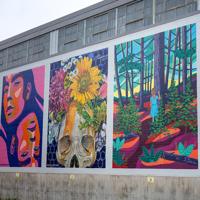
Photo by Larry Chua
“I wanted to capture the feeling of being in the forest without the specific details, breaking it down in a more abstract way with bright colors,” Zaremba says.
The nine artists worked simultaneously across about eight days in June, and Mural Fest included several ancillary events, among them a curated exhibit titled “Beyond O’Keeffe: Contemporary Artists in Wisconsin.”
The festival was “very well received by both residents and visitors,” says Katie Scanlan, director of the Sun Prairie Historical Library and Museum.
Yet — and perhaps inevitably, because this is Georgia O’Keeffe and Sun Prairie — there was at least one prominent dissenting voice.
“I don’t want to paint it in a negative way,” says Joe Chase, “but there’s only one of the nine panels that reflects in any way Georgia O’Keeffe and her artwork.”
Chase is a former mayor of Sun Prairie and the city’s most passionate and enduring proponent of O’Keeffe’s art and local connection. He’s even related to the artist — second cousin, twice removed — and as far back as 1978 secured a mayoral proclamation naming Nov. 15 “Georgia O’Keeffe Day” in Sun Prairie.

Photo by Larry Chua
Of June’s curated art exhibit, Chase says, “Don’t say ‘Beyond O’Keeffe,’ unless you’re going to educate people about O’Keeffe.”
Questions about whether Sun Prairie appropriately appreciates Georgia O’Keeffe, and how the artist felt about her hometown, are not new. They matter because O’Keeffe mattered, significantly, in 20th-century America.
“The undisputed doyenne of American painting,” The New York Times noted in O’Keeffe’s 1986 obituary, calling her “a reclusive but overwhelming personality” and “a woman in what was for a long time a man’s world.” Of her art, The Times wrote: “Her colors dazzled, her erotic implications provoked and stimulated, her subjects astonished and amused.”
O’Keeffe was born in Sun Prairie in 1887, stayed in the area until she was 15, but eventually moved to Virginia, where her family had moved.
Sunshine Anderson, programming and design coordinator at the historical library and museum, thinks Sun Prairie’s ambivalence about fully embracing the artist may date back more than a century, when O’Keeffe met famed photographer Alfred Stieglitz, who became her husband.
“In the 1910s, he took photographs of her that were quite risqué and scandalous,” Anderson says. “At the time, that’s not something the people of Sun Prairie would have embraced.”
Anderson also notes that since O’Keeffe never again lived in Sun Prairie, it was natural for the relationship with her birthplace to “peter out — [but] it doesn’t necessarily mean there’s any bad blood.”
O’Keeffe did return more than once — one of her sisters, Catherine, lived in Portage — including for a 1942 visit to receive an honorary doctor of letters degree from the University of Wisconsin.
The episode that most conveys acrimony between the artist and her hometown occurred in the 1970s, when O’Keeffe Park — named for the artist — became instead Sheehan Park, renamed for two brothers, longtime Sun Prairie educators and coaches.
“I don’t think Georgia O’Keeffe warrants having a park named after her,” Sun Prairie Park Commissioner Charles Hoffman told the Wisconsin State Journal in November 1976. “The only thing she wanted to do is charge the city for one of her paintings.”
Chase says New York Times writer Edith Evans Asbury (who eventually penned O’Keeffe’s Times obituary) later visited Sun Prairie and inquired about the city’s ill will toward the artist.
“She said she stopped and asked at a gas station,” Chase says, “and the attendant said, ‘I don’t know no George O’Keeffe.’ ”
One of Sun Prairie’s favorite sons, former U.S. Ambassador to Norway Tom Loftus, cautions against making too much of the park imbroglio.
Loftus says Curtis and Francis Sheehan were “legendary teachers” deserving of having a park named for them. “Honoring teachers happens too seldom.”
Of O’Keeffe, Loftus says, “She’s a history lesson for kids, and that’s great, too. Her historical marker is right at the municipal building. I think people are quite proud of it.”
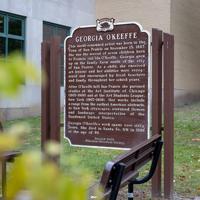
Photo by Larry Chua
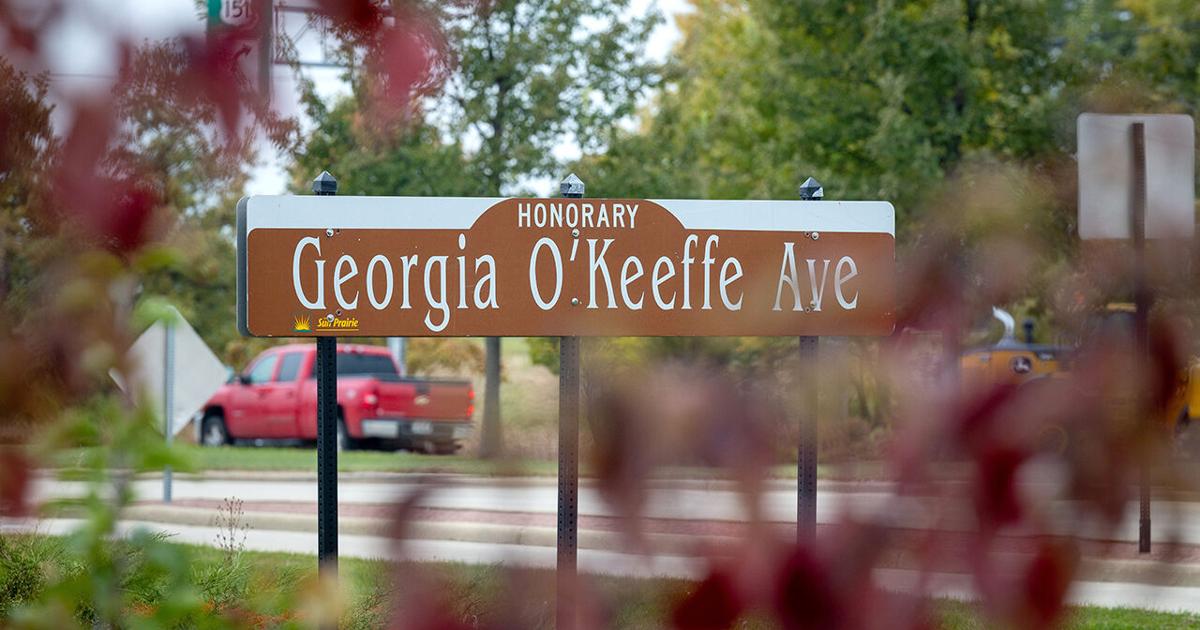
Beyond the historical marker, O’Keeffe Avenue on the city’s south side is named for the artist, and, according to museum director Katie Scanlan, “about a third of our exhibit space is dedicated to Georgia O’Keeffe.”
Chase, O’Keeffe’s indefatigable advocate in Sun Prairie, appreciates what has been done, but hopes for more. Chase has given numerous talks about the artist — including one by invitation in Ireland — and maintains a library of more than 380 books about O’Keeffe and Stieglitz.
Chase notes that a new $75 million Georgia O’Keeffe Museum is scheduled to open in 2028 in Santa Fe — the artist lived and worked in New Mexico for many years.
“Why can’t we put up something smaller here?” Chase says. “A dedicated museum? We should be capitalizing on ‘the birthplace of Georgia O’Keeffe.’ Santa Fe will work with us.”
The festival in June did bring O’Keeffe’s name again to the fore, while providing the artists a chance to find their own inspiration in her life and work.
“It was really exciting and kind of terrifying to have that kind of freedom,” Zaremba, the Madison muralist, says.
The people of Sun Prairie came out in large numbers in June — braving rain and heat — to watch the artists.
“That was amazing,” Zaremba says.
The mural wall is meant to be a permanent addition to the Sun Prairie downtown, taking its place in the complex history of a legendary artist and her hometown.
“It’s a nod to Georgia,” Sunshine Anderson says, “and it contributes to the quality of life of people who really have built their lives in this community.”
Doug Moe is a Madison writer and a former editor of Madison Magazine. Find more by Moe in his web-exclusive blog at madisonmagazine.com/dougmoe.
COPYRIGHT 2025 BY MADISON MAGAZINE. ALL RIGHTS RESERVED. THIS MATERIAL MAY NOT BE PUBLISHED, BROADCAST, REWRITTEN OR REDISTRIBUTED.