
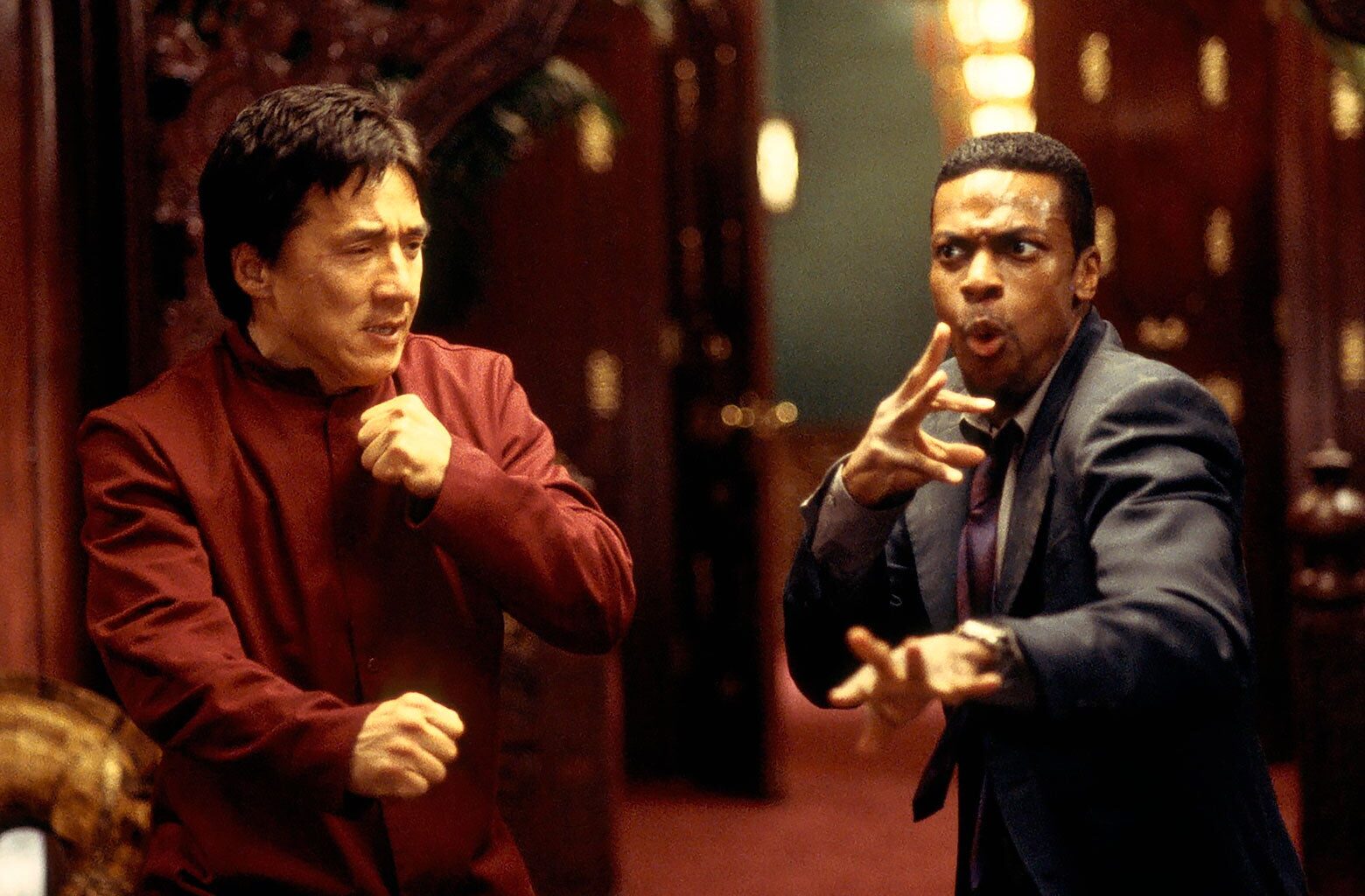
When you think about how the second Trump administration has left an imprint on culture, a few big things come to mind. It’s not been a good time to be Stephen Colbert, Jimmy Kimmel, or CBS News, for instance, but business is booming for the South Park guys. Well, now we can add two more names to the list of Hollywood types who are having their fortunes shifted in the Trump economy: Jackie Chan and Chris Tucker.
On Tuesday, news emerged via Puck that Paramount—and its new CEO, the Trump-friendly David Ellison—is going to produce a fourth installment of the Rush Hour franchise, after Trump personally pushed Ellison to make another one of the action comedies. When Trump’s wish came true, Puck’s man in Hollywood, Matthew Belloni, wrote that the president deserved an executive producer credit for making this all happen. “Get ready for the dumbest possible state-controlled media,” Belloni added.
There are a few obvious reasons why Trump might fancy himself Jack Warner when it comes to this particular franchise. To start, the Ellison family is looking to keep Trump happy as it bids to take over Warner Bros. Discovery, a move that, like its acquisition of Paramount earlier this year, will ultimately require Federal Trade Commission approval. Larry Ellison, David’s father, has even reportedly teased the White House about the possible firing of certain CNN anchors should he win control of the network, as he did with CBS, which is owned by Paramount.
Then there’s the Brett Ratner of it all. The director of all three Rush Hour movies (as well as 2006’s X-Men: The Last Stand, among others) became persona non grata in Hollywood during the #MeToo movement, after an actress accused him of forcing her to perform oral sex on him and five other women accused him of sexual misconduct, allegations he denied. But amid the election last year, Ratner was quick to attach himself to the Trumps by directing a documentary about returning first lady Melania Trump that Amazon snapped up for the eye-watering reported sum of $40 million. (Get ready—that’s due out in January!) Having himself been repeatedly accused of and found civilly liable for sexual misconduct, Trump surely relishes the chance to effectively culturally pardon Ratner using his anti-woke powers as president.
But when I read the news of the return of Rush Hour, I also figured there must be more to the story. Why this franchise? Why these action stars? I remember enjoying the first movie as a 10-year-old boy (arguably its target audience), but I confess I mostly forgot there had been a second installment, let alone a third. Why was Trump so keen to return to this world? I decided to find out by doing the only thing that seemed right: mainlining all three Rush Hour movies in 24 hours.
Now that I’ve reemerged from this world of clumsy racial stereotypes, extravagantly objectified women, and more gong sounds than I ever imagined, I’ve arrived at a theory: The universe of Rush Hour just makes sense to Trump. Although the films span 1998 to 2007, their vibe (and views on men’s suiting) remains firmly in a bygone era when cops felt free to wave their guns in suspects’ faces to get information, when Jackie Chan saying the N-word to a Black bartender was the height of comedy, and when Brett Ratner could harass famous women in peace. With his teenage-boy tendencies, fuzzy sense of the law, and preschool-level conception of police work, Trump must feel right at home when he pops on Rush Hour. Hell, each one of these movies features a blooper reel during its credits, a feature that transported me back to a time long before I had to think about things like A.I. or the downfall of democracy. It’s very likely that Rush Hour is simply to Trump what 2009’s Julie & Julia is to my gay ass: a comfort movie that I have no problem returning to repeatedly. If ever somehow given the power of the executive branch, I would absolutely force a sequel. Isn’t that what the presidency is for?

Christina Cauterucci
The Most Humiliating Failure of the New Trump Administration Has Come to a Sad, Fitting Close
Read More
The premise of the Rush Hour movies is simple: It’s an East-meets-West, fish-out-of-water buddy-cop series wherein Chan must join forces with Tucker to stop the bad guys and save the day. In the first installment, set in the shadow of Hong Kong’s return by the British to China, Chan’s Detective Inspector Lee travels to Los Angeles when the daughter of a top Chinese diplomat is kidnapped by the members of the Chinese crime syndicate network known as the Triads. (I gasped when I realized that a key henchman is played by a young, blond-buzz-cut-sporting Ken Leung, now best known for portraying Eric Tao on HBO’s Industry.) As a form of punishment because none of his colleagues or superiors can stand him, LAPD Detective James Carter (Tucker) is assigned to babysit Lee to clear the way for the FBI to really lead the investigation. But Lee’s determinedness and Carter’s ego push them to play hero, save the girl, break up the syndicate, and expose a British diplomat (played by Tom Wilkinson) as its mysterious boss.
Much like Trump can be, the film is occasionally funny. It works—just barely—because of the chemistry between Chan and Tucker, and their wildly different personalities, each of which is admittedly rooted in lazy racial stereotypes. Lee is quiet, deferential, and bound by honor, whereas the larger-than-life Carter is like a 7-Eleven, a character says in the 2001 sequel, because his mouth never closes. Much of the humor involves racist jokes that wouldn’t fly today but serve to expose Carter’s American ignorance. In the first movie, he calls Lee “Mr. Rice-A-Roni,” for instance, and says he’s been looking for his “sweet-and-sour-chicken ass.” In the second, he jokes about them eating dog for dinner. Crucial to this, though, is how clear it is that no one around Carter actually likes him. Lee may be the one on foreign soil, but Carter is just as much of an odd one out in this world.
The two sequels take this concept and expand on it: In the second, it’s Carter who is now the fish out of water as the pair run around Hong Kong, investigating the Triads and their counterfeit-currency operation. In the 2007 third movie, both men are pushed out of their comfort zones when the action transports them to France, where they continue to fight Triad assassins. By this point in the trilogy, the pair have become best friends, with Carter now comfortably ordering moo shu pork and Lee ringing up room service at his Paris hotel for some fried chicken and sweet potato pie. (I told you the stereotypes were lazy.) But this is also where the films stop working. For one, we lose the tension between the pair that made their relationship somewhat charming. But more than that, watching Carter and his casual sexism rub off on Lee is a little depressing. When, in the second movie, Lee hogs a pair of binoculars to spy on a beautiful woman undressing, it feels out of character, and the audience is clearly supposed to laugh along.
Indeed, if these movies were made and marketed to teenage boys (and our teenage-boy president), then their puerile treatment of women is instrumental to that mission. In the first movie, Carter sexually harasses his bomb squad colleague Tania (Elizabeth Peña) by spreading rumors that they slept together and asking her about the color of her underwear. In the second, when they visit a massage parlor, a group of lingerie-clad Asian women are put in a showcase for Carter to select from. (He chooses about five of them.) In the third movie, Ratner apparently decided to go for broke by inviting—I kid you not—Roman Polanski to cameo as a French detective. At one point, Carter pretends to be a costume designer for a Moulin Rouge–like establishment so that he can con his way into the dressing room and offer his opinions on the women’s breasts. Maybe Trump, who allegedly used to barge into the changing rooms at beauty pageants and would personally inspect contestants, saw a little part of himself on-screen.
The Big Reveal of This Season of Stranger Things Was Years in the Making
There could just be a simple answer for Trump’s affinity for these movies. As we know from his decision to host a UFC match at the White House next year, the president does enjoy watching guys beat the crap out of each other. But it’s hard to watch the movies’ broad swipes at Chinese and Black American cultures, their insistence that sexism is charming, their often juvenile and crass punch lines, and their elevation of shoot-first-ask-questions-later policing without wondering if there’s something bigger going on here. I left the movies doubtful that Rush Hour 4 will find new generations of fans almost three decades on, but if Ratner completes it before Trump’s term ends, then it will probably have its premiere in the new White House ballroom, and the series will become a different kind of cultural flash point. After all, if we see Carter as a manifestation of Trump’s id, then one of his lines from the first movie is extremely revealing: “This isn’t a democracy!” he tells Lee. “This is the United States of James Carter. I’m the president. I’m the emperor. I’m the king.”
Get the best of movies, TV, books, music, and more.