
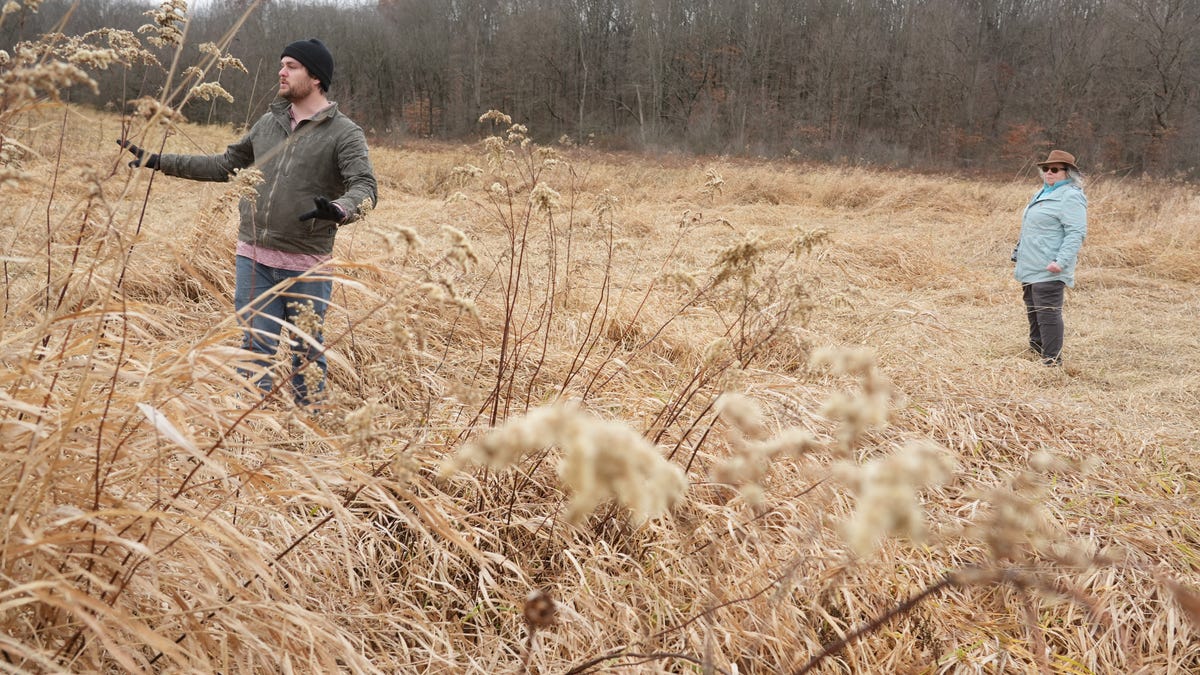
SUGAR CREEK TWP. − Jeanne Gural and Dan Volk hiked a newly acquired former farm property on Foxfield Street NW in Sugar Creek Township.
The Wilderness Center purchased the 36-acre parcel at a recent land auction of the 153-acre Soehnlen family farm. The deal closed Nov. 12.
Gural, executive director, and Volk, director of conservation and land management, are still noticing features of the land.
“We haven’t been able to explore the whole property yet because we just signed the paperwork,” Gural said.
She took interest in an area where water had accumulated, deciding it would likely become a shallow seasonal wetland habitat called a vernal pool.
Volk examined the soil, raking his hands through an unexpected sandy area that he hadn’t noticed previously.
“This is what gets nerds like me excited is looking at the soil,” he said. “How cool is that? There might even be some clay down here.”
The land will undergo a habitat assessment before being transformed into a wildlife habitat and trail. The trail will connect to the nature center through Sigrist Woods and Foxfield Preserve.
Additional plans include planting native trees and seeds to support pollinators and building nesting boxes for bluebirds. The land will also be used for Tree of Life, a program that supports conservation while planting memorial trees for loved ones.
The nonprofit had about a month to act on the land auction, which happened unexpectedly after former owner Patricia Soehnlen passed away. Gural said she believed in the mission of conservation.
The parcel is across the road from Foxfield Preserve, a Wilderness Center cemetery for green burials that is connected to its trail system. The new parcel contains former farmland, wooded areas and an unnamed creek.
“We call it ‘a tributary of the middle fork of Sugar Creek,'” Volk said.
Gural didn’t think that name would do.
“That’s a very long name for a very short creek,” she said. “Let’s call it the Soehnlen Creek.”
“The Soehnlen Creek on the Soehnlen Preserve.”
Wilderness Center continues to grow
Portions of the land were active farmland as recently as last growing season, so it’ll take considerable restoration work to be transformed to the natural prairie.
The first step is the habitat assessment, which will give the Wilderness Center a full picture of existing habitats, including plants, trees and brush. It’ll also look at habitats within the creek, including sediments and rocks.
Growing native plants will take at least three years, Volk said.
“They sleep, then they creep, then they leap, is the saying,” he said. “First year, they’re just getting their roots established, second year, they’re starting to grow a little bit more but not a ton, third year is when they really start to take off.”
Gural hopes the new habitat will become a part of the “mosaic” of conserved lands that wildlife like migratory birds depend on.
Natural ecosystems need protecting, Volk said. Growing and preserving diverse habitats like prairies improves the local environment.
“[Prairies] are shrinking in size and variety and quality,” he said. “By bringing some of those features back to the landscape, you’re increasing diversity of the environment.”
The Wilderness Center protects over 3,000 acres of land in seven counties across the state. Gural said they’ve seen success in conserving wildlife habitats to attract native species.
“If you build it, they will come,” she said.
Land purchased from private donations
The Wilderness Center quickly raised over $430,000 toward the $966,265 land purchase.
Funds came from private donations and the center’s fund for emergency acquisitions.
Gural said the land will eventually have a variety of uses at the Wilderness Center, including for education with school groups and landscapers.
“Every single department came out and looked at the property and assessed it from their program-specific needs,” she said. “Think of everything we could teach.”
Reach Grace at 330-580-8364 or gspringer@usatodayco.com Follow her on X @GraceSpringer16.