
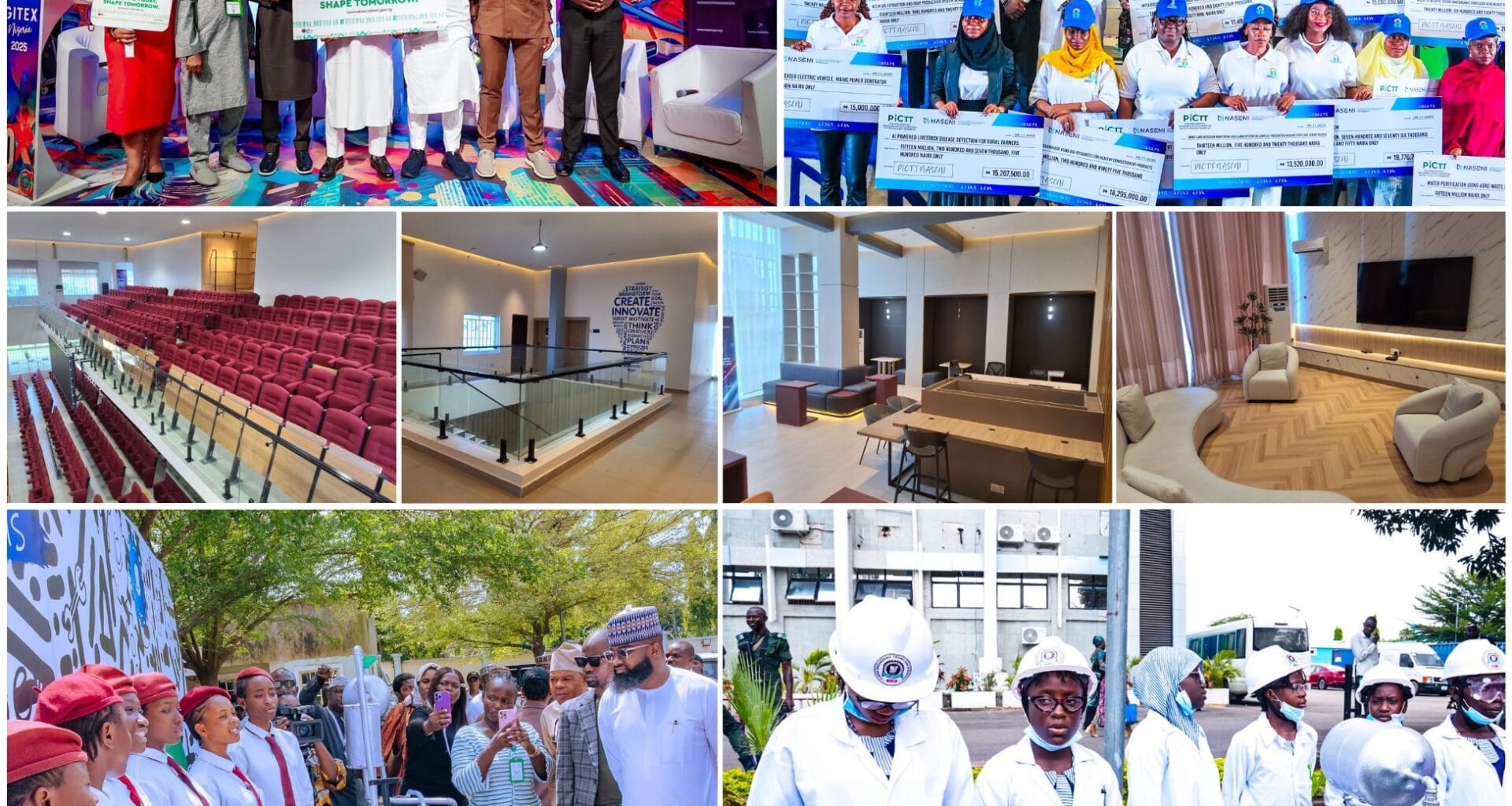
In the last few years, the conversation around Nigeria’s future has increasingly centred on the youth. With more than 60 per cent of the country’s population below the age of 35, the nation’s human capital strength lies overwhelmingly in its young people. Yet for decades, this demographic advantage has been threatened by unemployment, underemployment and an education–industry gap that has left millions unable to translate their talents into meaningful livelihoods.
It is against this backdrop that the National Agency for Science and Engineering Infrastructure (NASENI) has emerged as one of the most visible government agencies seeking to reverse these trends through a mix of innovation-targeted programmes, skills development, entrepreneurship support, and technology-driven opportunities designed to empower young Nigerians.
From its Innovate Naija challenge to DELT-HER for female innovators, to the nationwide Skill Acquisition Centres, NASENI is striving to change the narative of youth unemployment in the country.
SPONSOR AD
A month ago in Abuja, NASENI hosted the “Abuja’s Biggest Founders’ Mixer”—an innovation and networking event that attracted startup founders, entrepreneurs, investors and ecosystem enablers from across the capital. The programme, held at NASENI headquarters, provided a window into the agency’s new, intensifying commitment to nurturing ideas and commercialising homegrown technology solutions.
Representing the Executive Vice Chairman/CEO, Khalil Suleiman Halilu, the Special Adviser on Research Commercialization and Efficiency, Engr. Dr. Anas Balarabe Yazid, told participants that NASENI is deliberately shifting Nigeria’s innovation landscape. He emphasized that leadership vision must blend with technological creativity and strong business acumen if the country’s youths must transform society with their ideas.
He encouraged them to consider NASENI as a home, noting that the Agency offers immense opportunities for innovators. The EVC encouraged participants to ensure that their inventions are geared toward solving societal challenges. “Design your products to solve customers’ problems,” emphasizing that there are two perspectives to innovation-the technology aspect and the business aspect.
He further added that in order to succeed in their noble course, they must have the right team to work with their vision. “Make NASENI your home because there are a lot for you to get from the Agency,” he urged. The event also became an avenue for the NASENI Innovation Hub to introduce its suite of programmes.
The Programme Manager, NASENI Innovation Hub, Mrs. Woka Philips-Ayinu, introduced the Hub as a flagship initiative of the Agency established to support Nigerian innovators and startups by providing comprehensive support systems, facilitating effective partnerships and nurturing ideas from conceptualization to commercialization.
She revealed ongoing interventions like InnoGov, DELTHER, DELTA-2 and the popular Innovate Naija Challenge, while unveiling upcoming ones such as Future Makers, NASENI Xceler8, the Reverse Japa Programme, and a new incubation scheme aimed at helping young innovators grow from idea stage to commercially viable enterprises.
Participants from the wider startup community including members of Founders’ Friday, Desire Collins and Okoli Valentine, expressed appreciation for what they described as a transformative opportunity to connect and learn, they praised NASENI for making itself accessible to young innovators.
Though only a single event, the Founders’ Mixer signified NASENI’s evolving posture: a shift from conventional government bureaucracy to a facilitator of innovation, partnerships and youth participation.
Perhaps the most visible expression of NASENI’s youth-focused agenda is the Innovate Naija Challenge, a national platform designed to identify, celebrate and support Nigerian innovators who create solutions for real-world problems. The challenge has quickly gained national attention for spotlighting young Nigerians whose prototypes and ideas require visibility, mentorship and funding.
Through this programme, the Agency is tackling a long-standing problem: young Nigerians are talented but often lack an ecosystem that helps them grow. Also, NASENI’s DELT-HER Program, targeted at encouraging and showcasing innovations by female engineers, scientists and technologists. By promoting gender inclusion in technology and innovation, NASENI is aligning Nigeria with global best practices, where women-led innovations are increasingly recognised as drivers of economic transformation.
While its innovation programmes attract headlines, NASENI’s quieter but equally impactful investment is the building of Skill Acquisition Centres across several states. These centres represent one of the most practical approaches to tackling youth unemployment and boosting technical capability nationwide.
Many communities, especially in rural areas, lack access to institutions that teach hands-on technical skills. NASENI’s centres aim to fill this gap by equipping young Nigerians with skills that are immediately useful, locally demanded and globally relevant.
Beyond permanent centres, NASENI has continued its traditional Skill Acquisition Programmes delivered across various state capitals. In these mobile programmes, the agency deploys equipment, trainers and technical teams to host states for short-term intensive training sessions.
Thousands of young Nigerians have benefited, learning trades that help them start small businesses, acquire income-generating skills and transition from unemployment to self-employment. One of the biggest criticisms of Nigeria’s innovation space is that brilliant ideas rarely make it into the marketplace. Many prototypes and inventions fail due to lack of commercialization pathways.
NASENI officials, during the Founders’ Mixer, acknowledged this challenge. The Agency now prioritizes incubation, startup accelerators like NASENI Xceler8, and partnership-driven programmes to help young Nigerians turn their inventions into viable, market-ready products.
Nigeria’s current socio-economic landscape underscores the urgency of NASENI’s interventions. Large numbers of graduates cannot find jobs, employers complain about skills gaps, and foreign exchange shortages make import dependence unsustainable. In this environment, empowering young people with technical skills, entrepreneurial capabilities and innovation opportunities is essential.
With the launch of the NASENI Innovation Hub, the agency has taken another deliberate step toward ecosystem building. The Hub envisions itself as a connecting point between young innovators and investors, research institutions, development partners, industry players and government agencies. Upcoming programmes like Future Makers and the Reverse Japa Programme show that NASENI’s ambition extends beyond immediate interventions.
Although still evolving, NASENI’s programmes are beginning to reshape how young Nigerians engage with science and technology. Startup founders now turn to NASENI for mentorship and support. Young artisans in rural communities are learning scalable, income-generating skills. Female innovators are receiving targeted support through DELT-HER. Youth networks and innovation communities now include NASENI as a regular collaborator.
For NASENI to sustain and expand its impact, several factors will be crucial; such as adequate funding, private sector collaboration, adoption of local innovations and effective monitoring and evaluation. Consistency will also be essential, as young innovators need to trust that programmes will not disappear after one cycle.
Nigeria is at a critical juncture where the old economic model of import dependence and limited manufacturing can no longer sustain national aspirations. The country’s survival and growth will depend on its ability to innovate, manufacture and compete globally. The youth are central to this shift.
What NASENI is doing—through Innovate Naija, DELT-HER, innovation hubs, founders’ mixers, nationwide skill acquisition centres and mobile programmes—is to light a path for young Nigerians who refuse to be limited by circumstances.
While the journey ahead is long, the Agency’s expanding engagement with youth provides a glimpse of what Nigeria can become when its most populous demographic is empowered: a nation driven by ideas, fuelled by technical skills and strengthened by innovation. NASENI’s efforts may well help unlock the greatest resource Nigeria has always possessed—not oil, but its people.
SERIOUS ADVICE:
As a Nigerian living here or in the diaspora, DO YOU HAVE A PLAN B? Just in case anything goes wrong, is there a side business you can fall back on? We show you step by step how you too can start earning US Dollars consistently. Nigerians can now make as much as $20,000 to $35,000 with premium domains. Ideal for business owners, entrepreneurs, and workers.
Click here to find out how it works