
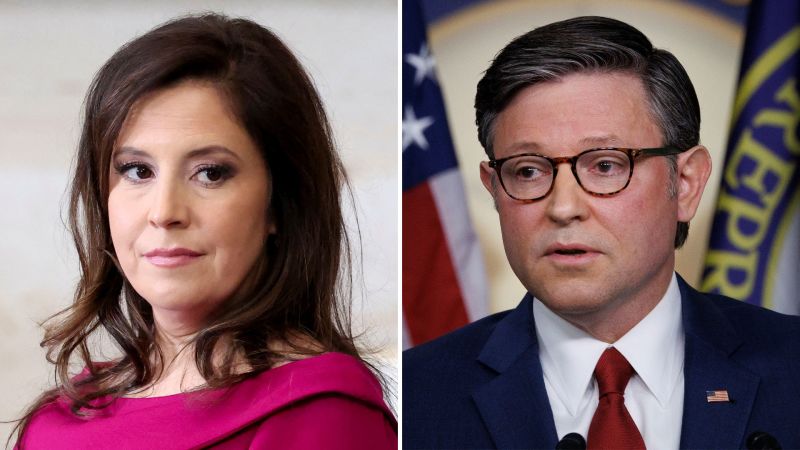
A new headache is emerging for House Speaker Mike Johnson.
For years, GOP Rep. Elise Stefanik, one of President Donald Trump’s most vocal allies in Congress, had been trying to pass legislation in response to the FBI’s investigation into Trump’s 2016 presidential campaign and Russia. With Republican control of Congress and Trump in the White House, Stefanik saw this as her only opportunity to pass the legislation and deliver a win for the president and his allies, who have spent years trying to denigrate the Russia investigation.
The provision would require the FBI to notify Congress when opening a counterintelligence investigation into presidential and federal candidates seeking office, and some Republicans were trying attach it to the must-pass annual defense bill that lawmakers are trying to approve by the end of the month.
But Stefanik announced Monday that congressional leaders were keeping her provision out of the sweeping defense policy bill known as the National Defense Authorization Act.
With the provision stripped out, Stefanik, a senior member of both the House Intelligence and Armed Services committees, said she would vote against the NDAA for the first time in her political career.
“I just walked out of a briefing on this issue this morning CONFIRMING everything I posted yesterday. That yes, in fact, the Speaker is blocking my provision to root out the illegal weaponization that led to Crossfire Hurricane, Arctic Frost, and more,” the congresswoman wrote on X.
She added that “this is an easy one. This bill is DOA unless this provision gets added in as it was passed out of committee.”
Stefanik’s withdrawn support could pose a problem for Johnson should more Republicans follow suit. At present, the speaker can only lose two Republicans on any party-line vote with his razor-thin House majority.
On Tuesday, Johnson denied and downplayed Stefanik’s claims.
“All of that is false. I don’t exactly know why Elise won’t just call me. I texted her yesterday. She’s upset one of her provisions is not being made I think into the NDAA. I explained to her on text message since I heard this yesterday, I was campaigning in Tennessee, and I wrote her and said, ‘What are you talking about? This hasn’t even made it to my level,’” the speaker told reporters Tuesday.
Johnson said the ranking members in both chambers didn’t agree with the measure, leading to its removal, but he argued that “it doesn’t mean it can’t become law or even that that is a final decision.”
The speaker added that he supports the provision. “I mean, I would vote for it. I think it’s smart, and I’m not sure exactly why it wasn’t included, so I don’t know why she’s frustrated with me. I literally had nothing to do with it, but I’m happy to roll up my sleeves and help her,” he said.
But Stefanik only doubled down on social media — and even quoted the text message she said she had received from the speaker.
“Just more lies from the Speaker,” Stefanik said in response to Johnson’s comments. “The Speaker texted me yesterday claiming he ‘knew nothing about it.’ Yeah right. This is his preferred tactic to tell Members when he gets caught torpedoing the Republican agenda. It wasn’t on your radar? This is the ONLY provision in the bill to root out the deep state rot. This is not regular order.”
The spat speaks to the broader frustrations brewing between Republican lawmakers and Johnson.
The speaker is facing a growing list of issues as morale in the House GOP conference reaches a new low. Party infighting has increased in recent weeks as Johnson and his team has struggled to maintain control of the floor and members have felt more emboldened to buck party leadership and force votes on their own priorities, including a spate of votes to attack their colleagues. Then there’s the shocking resignation announcement from a vocal Trump ally-turned-critic, Rep. Marjorie Taylor Greene, who has made clear she won’t be quiet on her way out in January.
Stefanik and Johnson have a long history of working together.
They both served on Trump’s defense team during the president’s first impeachment trial, where Trump was ultimately acquitted by the Senate. And in their early years in the House, they often found themselves on the same side of an issue. Stefanik was in House GOP leadership when Johnson became speaker.
But when the White House pulled Stefanik’s nomination to be US ambassador to the United Nations in March amid concerns over slim margins in the House, the relationship between the two GOP leaders grew more contentious.
Stefanik is now running for governor of New York. With more than a combined $13 million cash on hand, Stefanik has tapped a number of former Trump advisers and longtime aides who worked in finance, communications and operations roles to help launch her campaign.
This story has been updated with additional details.