
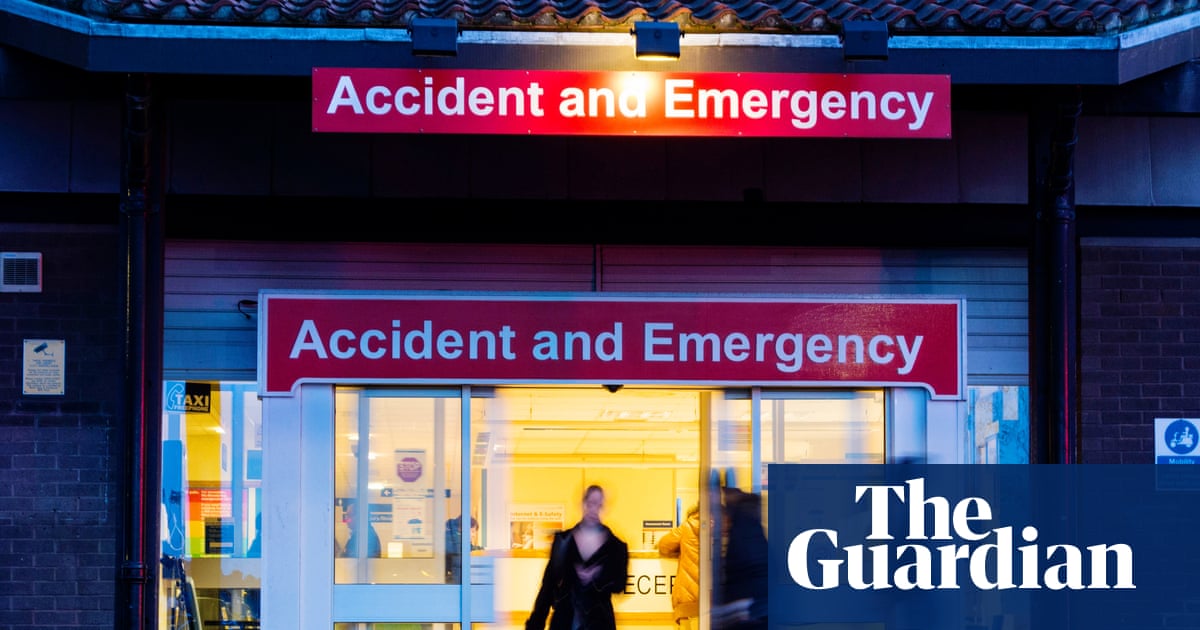
The number of people in England walking out of A&E without treatment has tripled in the past six years, new figures show.
Analysis of NHS data by the Royal College of Nursing shows soaring demand for urgent hospital care and long waits has led to what it describes as a “shocking” rise in the number of patients leaving emergency departments untreated.
Between July and September 2025, more than 320,000 people left A&E without being treated – a more than threefold increase from the same period in 2019, when just under 100,000 people walked out untreated.
Most left in frustration at waiting so long. The RCN’s analysis also found that over the same period, there was a 90-fold increase in the number of patients waiting in excess of 12 hours, from 1,281 in 2019 to 116,141 in 2025.
RCN’s general secretary and chief executive, Prof Nicola Ranger, said the lack of urgency in tackling the crisis was unacceptable. “Skyrocketing numbers leaving emergency departments without treatment is dangerous and a sign of a broken system,” she said.
“The reality is that the failure to deliver proper, well-resourced primary and community care services leaves people with no choice but to go to A&E, meanwhile those in hospital and ready to be discharged cannot leave because of that same lack of support available closer to home. The net result is acute services totally jammed up, staff at breaking point and patients leaving frustrated, only to possibly return in even worse health.”
A separate report by private healthcare analysts LaingBuisson found that the pressure on the NHS could be made worse as fewer patients can afford to go private.
While NHS-funded care carried out by independent acute hospitals reached a record £2.2bn in 2024, Tim Read, LaingBuisson’s head of research and the author of the report on the private acute healthcare market in the UK, said that the number of people paying to be treated privately grew just 0.1% in 2024.
While the market for cheaper private diagnostic services was “relatively robust”, “wider concerns over the economy and the impact of the rising cost of everyday living means that people are choosing to rely on the NHS – even if it means a delay in treatment – for more high-cost surgical options,” he said.
“Should self-funders begin to turn away from private healthcare towards NHS services, it will place even more strain on the NHS.”
But Dr John Puntis, the co-chair of Keep Our NHS Public, said NHS contracts with private providers were a false economy. “The private sector isn’t a pressure valve for the NHS. Private hospitals rely on the same overstretched staff, so shifting more NHS money their way only pulls people out of an already thin workforce.
skip past newsletter promotion
Get the day’s headlines and highlights emailed direct to you every morning
Privacy Notice: Newsletters may contain information about charities, online ads, and content funded by outside parties. If you do not have an account, we will create a guest account for you on theguardian.com to send you this newsletter. You can complete full registration at any time. For more information about how we use your data see our Privacy Policy. We use Google reCaptcha to protect our website and the Google Privacy Policy and Terms of Service apply.
after newsletter promotion
“The answer isn’t outsourcing; it’s investing in NHS staff, services and capacity so people don’t feel they have to go private in the first place.”
Responding to the findings, a Department of Health and Social Care spokesperson said: “No one should receive care in a corridor in a chair or trolley – it is unacceptable and undignified. We are determined to end this, which is why we’re publishing corridor waiting figures so we can take the steps needed to eradicate it from our health service. Sunlight is the best disinfectant to stop this practice.
“This winter, we are investing almost £450m to expand same-day and urgent care services, upgrading up to 500 ambulances, delivering new mental health crisis centres, and giving NHS leaders more power to deliver local solutions.”