
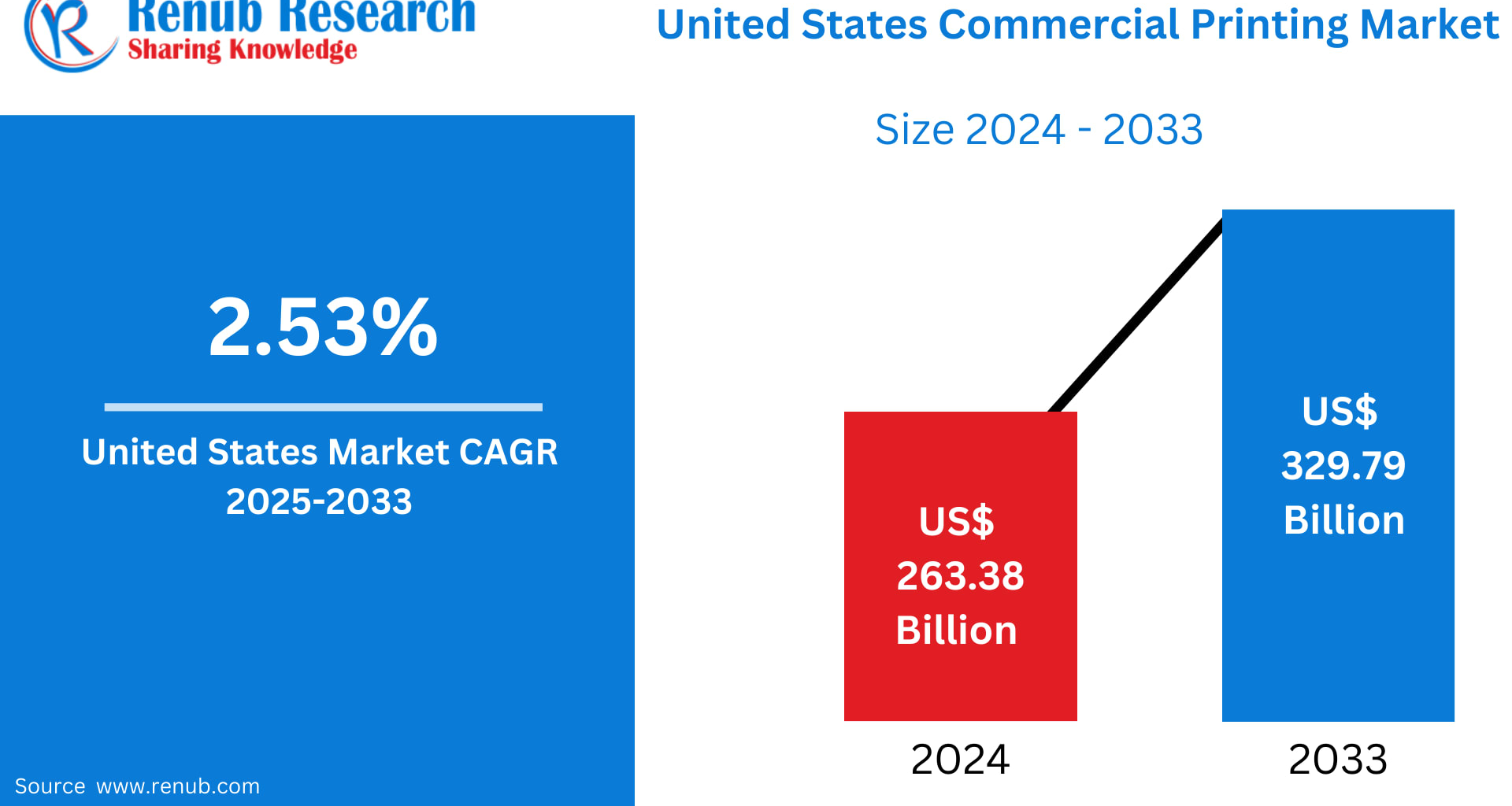
The United States Commercial Printing Market is entering a decade of measured but meaningful expansion—despite structural challenges and evolving communication habits. According to Renub Research, the market is projected to rise from US$ 263.38 billion in 2024 to US$ 329.79 billion in 2033, reflecting a CAGR of 2.53% between 2025 and 2033. While modest at face value, this trajectory highlights how print remains integral across packaging, marketing, compliance, and décor—even as digital communication accelerates.
Commercial printing today is no longer defined merely by brochures, catalogs, or business cards. It has evolved into a multifaceted ecosystem blending digital print, variable data capability, sustainable production, short-run agility, and brand-level customization. From e-commerce packaging to programmatic direct mail and hyper-personal marketing materials, print continues to adapt, proving its relevance in an increasingly digitized commercial landscape.
United States Commercial Printing Market Outlook
Commercial printing encompasses the production of printed materials such as packaging, posters, flyers, manuals, labels, business cards, catalogs, and promotional kits. The U.S. market serves a diverse matrix of industries including retail, publishing, pharmaceuticals, education, logistics, and entertainment.
While digital communication has transformed how businesses interact with customers, print maintains a distinctive advantage: tangible impact. Brands continue to rely on print for:
Product launches
Retail promotions
Educational materials
Corporate communication
Regulatory documentation
Packaging and labeling
Direct mail and omnichannel marketing
Modern commercial printing embraces digital workflows, AI-led design, on-demand print, variable data personalisation, and automated finishing—allowing brands to deliver targeted messaging with speed, accuracy, and creative variety.
Key Growth Drivers in the U.S. Commercial Printing Market
1. E-Commerce Packaging & Short-Run Flexibility
E-commerce remains a force reshaping the U.S. printing landscape. Unlike traditional mass-run packaging, online-selling brands require frequent, rapid-turn, low-volume print formats such as:
Mailers & shippers
Insert cards
Branded tissue
Labels & belly bands
Influencer kits
Short-run prototypes
Digital and inkjet printing have become essential, enabling micro-batch packaging that changes weekly—or even by region or influencer.
Automation is at the heart of this growth. Cloud-based RIPs, imposition bots, and web-to-print storefronts allow small merchants to order packaging without holding inventory. August 2025 developments like McKernan Packaging Clearing House’s new e-commerce platform show how the supply chain is becoming increasingly customer-driven and efficiency-focused.
Sustainability compounds this shift. Right-sized cartons, recyclable labels, recycled content fiber, mono-material structures, and water-based inks help brands meet environmental commitments while reducing DIM weight shipping costs.
2. Direct Mail Delivers Measurable ROI in Omnichannel Campaigns
As digital ads saturate consumer attention, marketers in the U.S. are rediscovering direct mail’s potency—especially when powered by data-driven personalization.
Modern direct mail uses:
Variable images
Customized offers
QR-to-digital bridges
Geo-contextual messaging
Programmatic print triggered by online behaviour
“Programmatic mail” has emerged as a powerful tool. Actions such as cart abandonment or product browsing can trigger an automatically printed and mailed piece—timely, personalized, and trackable via QR codes and PURLs.
Printers who integrate with marketing clouds and CDPs have shifted from vendors to strategic partners, offering full-service capabilities including:
Data hygiene & deduplication
Audience segmentation
Automated A/B/C creative
Postal optimization
Commingling services
Tactile enhancements—soft-touch lamination, raised UV, cold foil—boost print memorability in ways digital screens cannot replicate.
3. Compliance, Security & Domestic Reliability
Regulated sectors such as pharmaceuticals, medical devices, cosmetics, and food & beverage require highly controlled printed materials. These include:
Multi-panel labels
UDI/GS1 barcoded inserts
Tamper-evident components
Serialization
Microtext & braille
Multilingual IFUs
Such work demands precision, secure prepress, and validated production environments. As global logistics uncertainties and counterfeiting risks grow, U.S. brands increasingly prefer on-shore printing partners capable of certified compliance and FDA-aligned documentation.
Security printing is also rising. Hidden inks, taggants, forensic substrates, and serialized QR codes help brands fight product diversion and fraud.
A notable development came in November 2024, when Nelipak opened its first North American flexible packaging site in North Carolina—signaling continued investment in U.S.-based regulated print capacity.
Challenges Facing the U.S. Commercial Printing Market
1. Volume Declines in Legacy Applications
Traditional print categories such as newspapers, mass catalogs, directories, and transactional mail continue to contract. This affects:
Press utilization
Unit economics
Inventory forecasting
Labor optimization
Paper mill consolidation and longer lead times amplify difficulties. Logistics—fuel prices, driver shortages, transit delays—introduce further planning complexity.
To survive, many printers diversify into:
Packaging
Labels
Large-format
Direct mail
Specialty décor
Success depends on crew retraining, investing in digital/inkjet technologies, and reengineering estimating models to reflect the value of speed and complexity.
2. Input Cost Volatility & Rising ESG Compliance Pressure
Paper remains the highest-cost input, with frequent fluctuations. Beyond paper, costs rise across:
Inks
Coatings
Plates
Energy
Logistics
Skilled labor
Meanwhile, customers increasingly demand strong sustainability performance:
FSC/PEFC chain-of-custody
Recycled content verification
VOC compliance
Scope 1–3 emission reporting
Waste reduction
Circular design options
Investments in LED-UV curing, water-borne inks, heat recovery systems, electric forklifts, and solvent capture are necessary—but costly.
Operators best positioned are those who combine procurement hedging, smart energy monitoring, waste dashboards, and real-time stock-linked estimating tools.
Segment-Specific Market Overviews
United States Commercial Image Printing Market
The image printing category includes photo books, wall décor, canvas prints, metal prints, acrylic displays, calendars, and personalized gifts. Driven by life events and home refresh trends, this segment has grown through:
Mobile-first ordering
AI-powered image curation
Automatic upscaling & layout tools
On-demand printing
Premium substrates (metal, fabric, acrylic)
B2B expansion is strong across hospitality, museums, retail spaces, and corporate décor. Color consistency, scratch resistance, drop-ship logistics, and mass personalization workflows are competitive differentiators.
United States Commercial Pattern Printing Market
Pattern printing spans textiles, soft signage, apparel, upholstery, and interiors. Digital roll-to-roll inkjet (dye-sub, pigment, reactive) is rapidly replacing rotary screen printing, driven by fashion’s need for quick collection cycles.
Brands now demand:
Zero-setup digital workflows
High fidelity across fabrics
3D garment simulation
Compliance with flame resistance & wash fastness
Custom wallpaper & commercial interiors
Print-on-demand marketplaces link designers with micro-factories, helping avoid overproduction and long freight cycles.
United States Commercial Packaging Printing Market
Packaging printing is the fastest-growing commercial printing segment, led by:
Labels and shrink sleeves
Folding cartons
Flexible pouches
Corrugated packaging
Digital hybrid presses enabling inline embellishment (tactile varnish, cold foil, metallization) dominate short-to-mid production runs.
Additionally:
E-commerce accelerates the need for protective, right-sized materials
Food & pharma packaging require migration-safe inks
Smart packaging (QR, NFC, traceability) is becoming mainstream
Sustainability creates demand for mono-material, PCR, and recyclable structures
Printers offering LCA (life cycle assessment) tools and VMI (vendor-managed inventory) gain additional advantage.
United States Commercial Books Printing Market
The U.S. book printing sector has migrated to short-run and print-on-demand models. High-speed inkjet enables economical production for runs ranging from dozens to thousands.
Publishers optimize inventory by printing “to signal”—triggered by real-time sales data. POD supports backlist titles, self-published authors, and academic coursepacks.
Critical capabilities include:
Offset-like inkjet quality
PUR binding & sewn binding
Lamination, foil, and specialty finish
Automated metadata & ISBN management
United States Commercial Newspapers Printing Market
Newspapers face long-term circulation declines, but contract printing and diversified products create stability.
Industry trends include:
Reduced publication days
Consolidated regional print hubs
Improved coldset quality
Glossy wraps for retail advertisers
Special edition “collectible” publications
Logistics optimization remains essential for accurate in-home delivery timing.
State-Level Market Snapshots
California
A blend of tech, entertainment, lifestyle, and agriculture creates demand for:
High-end event collateral
Studio promotional kits
Luxury OOH printing
Wine labels & food packaging
FSC-certified, low-VOC printing
Strict environmental regulations make California a leader in green printing technologies.
New York
Fast-paced industries—finance, fashion, media—dominate New York’s printing demand.
Typical requirements:
Overnight pitch books & lookbooks
Boutique, color-perfect fashion prints
Secure financial documents with chain-of-custody
Union & MWBE-certified suppliers
Pop-up event graphics & installations
Space constraints foster hybrid models with city-based digital shops supported by suburban offset facilities.
New Jersey
One of the nation’s strongest hubs for pharmaceutical and CPG printing, New Jersey excels in:
Validated IFUs
Camera-inspected labels
Folding cartons
Retail POS materials
Kitting & fulfillment
Port access and skilled labor create major competitive advantages.
Market Segmentations
Print Type
Image
Painting
Pattern
Others
Application
Packaging
Advertising
Publishing
Books
Magazines
Newspapers
Other publishing
Other applications
Top States Covered
California, Texas, New York, Florida, Illinois, Pennsylvania, Ohio, Georgia, New Jersey, Washington, North Carolina, Massachusetts, Virginia, Michigan, Maryland, Colorado, Tennessee, Indiana, Arizona, Minnesota, Wisconsin, Missouri, Connecticut, South Carolina, Oregon, Louisiana, Alabama, Kentucky, Rest of U.S.
Key Companies (5 Viewpoints Each: Overview, Key Person, Developments, SWOT, Revenue)
ACME Printing
Cenveo Worldwide Limited
R.R. Donnelley & Sons Company
Vistaprint (CIMPRESS PLC)
Toppan Co. Ltd (Toppan Inc.)
Transcontinental Inc.
LSC Communications US LLC
Quad/Graphics Inc.
Dai Nippon Printing Co. Limited
Quebecor World Inc.
Final Thoughts
The United States commercial printing market is not merely surviving a digital world—it’s reinventing itself. Powered by e-commerce, personalized marketing, sustainable materials, and short-run digital agility, the industry continues to expand into high-value sectors such as packaging, security printing, and regulated labeling.
While legacy print faces decline, new categories—smart packaging, on-demand books, programmatic direct mail, custom décor, and digital textiles—are thriving. With a projected value of US$ 329.79 billion by 2033, commercial printing remains an indispensable force across American business.