
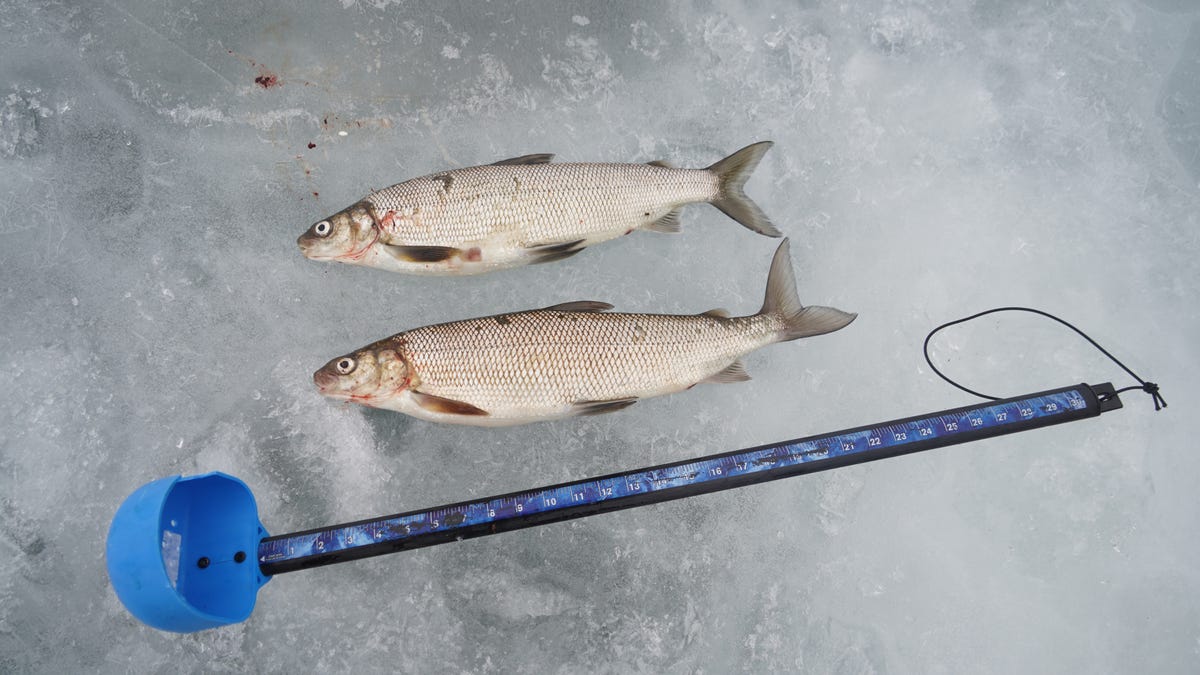
The Department of Natural Resources is recommending a 39% reduction in the lake whitefish quota for commercial fishers in the Wisconsin waters of Lake Michigan but no change in Green Bay.
In the wake of continued declines in the population and catches of lake whitefish in the Wisconsin waters of Lake Michigan, the Department of Natural Resources has recommended a 39% reduction in the commercial fishing quota for the species.
Meanwhile in the more productive waters of Green Bay, where whitefish in recent decades have fared better but are also generating concerns among fisheries biologists, the DNR has recommended no change in the commercial quota.
The DNR’s plans, which would take effect in 2026, are scheduled to be presented Dec. 10 to the Natural Resources Board in Madison.
Lake whitefish is native to the Great Lakes and has historically been one of the most important species netted in Lake Michigan.
However the population in the main lake has declined markedly in recent decades due to invasive zebra and quagga mussels, according to most scientists. The filter-feeding mussels are responsible for drastic reductions in plankton and other organisms that served as food for lake whitefish.
There has not been a good year-class of lake whitefish in the Wisconsin waters of Lake Michigan since the early 2000s, said Scott Hansen, DNR fisheries biologist at the Oct. 15, 2025 meeting of the Lake Michigan Commercial Fishing Board.
The DNR estimated the main lake had about 60 million lake whitefish in 2000 and it now has about 2 or 3 million.
“It’s really low in the grand scheme of things,” Hansen said.
A similar severe drop in lake whitefish numbers has been observed in the Michigan waters of Lake Michigan.
The lake whitefish population in Green Bay is stronger in large part due to a substantial year class produced in 2015, according to DNR data. Hansen estimated about 15 million lake whitefish are present in the Green Bay population.
However with little recruitment since 2015, scientists are becoming increasingly concerned about the future of the Green Bay lake whitefish, too, Hansen said.
Fluctuations in the Lake Michigan lake whitefish population have been seen for more than a century. In his 1983 book “Fishes of Wisconsin,” George Becker wrote: “The history of lake whitefish production is a study of highs and lows.”
Becker noted the highest commercial harvest of lake whitefish in the Wisconsin waters of Lake Michigan since 1940 was 1,806,174 pounds in 1947, but fell to an all-time low of 9,219 pounds in 1958. Production then gradually increased until 1974, when it was 1,174,208 pounds.
Invasive species, including the alewife, sea lamprey and rainbow smelt likely played a role in the mid-1900s variations.
The zebra and quagga mussels, arrivals in the late 1900s, have arguably had an even larger impact on the Lake Michigan ecosystem.
In 2024, commercial fishers landed only about 150,000 pounds of lake whitefish in the Wisconsin waters of Lake Michigan. The netters have not come close to catching their quota in Lake Michigan in more than a decade.
Wisconsin administrative code calls on the DNR to recommend and the Natural Resources Board to establish commercial whitefish harvest quotas at least once every three years.
For 2025 the total allowable commercial catch or harvest (TAC) of lake whitefish in the Wisconsin waters of Lake Michigan was 2,016,919 pounds of dressed whitefish, including 1,142,534 for Green Bay and 874,385 for Lake Michigan.
For the 2026 quota year, the DNR is recommending a TAC for commercial netters of 1,142,534 pounds for Green Bay (no change) and 534,955 pounds for Lake Michigan (a reduction of 339,430 pounds, or 39%).
Since the Green Bay fishery is split 50/50 between commercial and sport, the proposal would also set a 1,142,534 pound quota in Green Bay for sport anglers. The daily bag limit of 10 lake whitefish would be unchanged for sport anglers. Sport anglers also typically fall far short of their quota, especially in years of poor ice and low effort by ice anglers.
The proposed quota allotments would be slated to remain in effect for three years, but the DNR said it will “continually monitor the whitefish population annually” to determine if an adjustment is needed prior to 2028.