
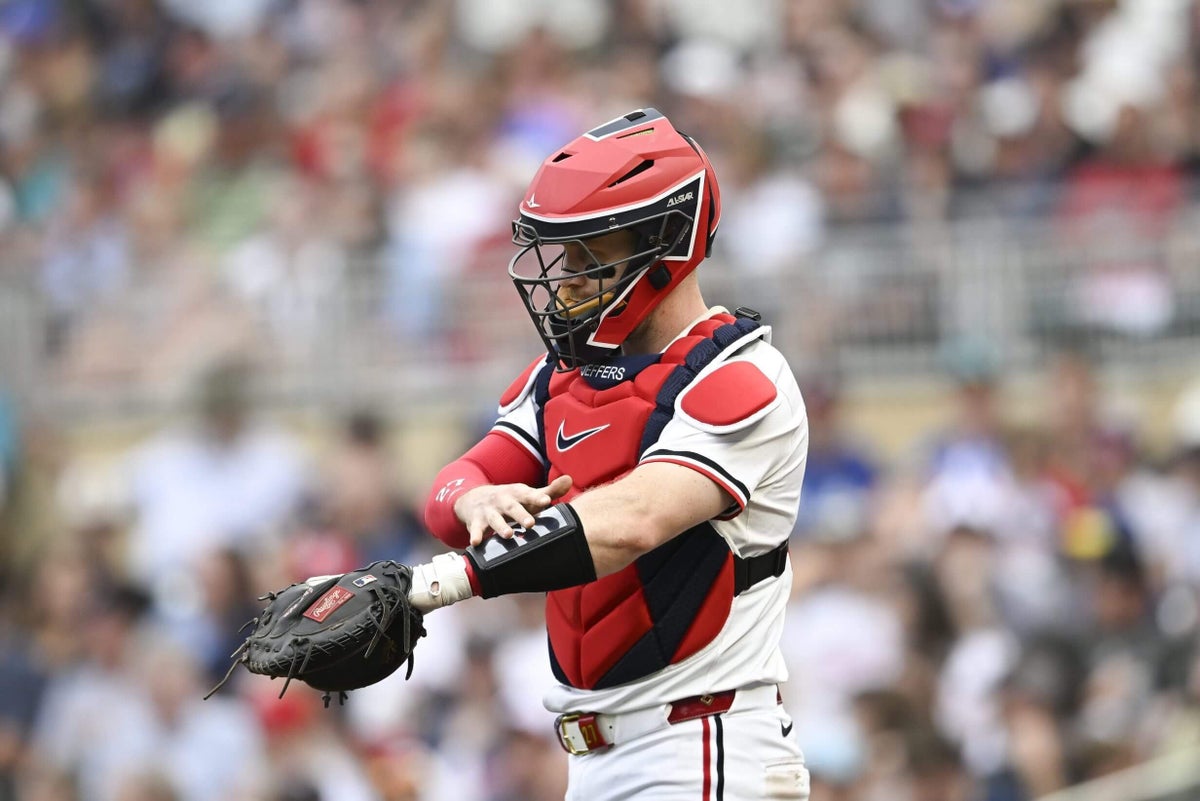
If it holds, the plan calls for Ryan Jeffers to handle the bulk of the Minnesota Twins’ catching duties for the 2026 season.
Last month, Twins president Derek Falvey identified Jeffers as the team’s starting catcher for the upcoming season after the veteran evenly split the role with Christian Vázquez the previous three years. With Vázquez a free agent, the Twins appear ready to increase Jeffers’ playing time and make him more of a traditional catcher.
Of course, the plan could be dashed were the Twins to trade Jeffers, who becomes a free agent after 2026. For now, though, he is the team’s clear-cut No. 1 catcher, and he couldn’t be more excited.
“It’s what I’ve been waiting for my whole career,” Jeffers recently said by phone. “You’ve got to earn everything, and you’re not handed anything. But I felt like I was pretty clearly a starting-caliber catcher (previously) and wasn’t given starting-caliber catcher playing time. I’m very excited for it.”
Though the offseason is barely underway — baseball’s winter meetings start Monday in Orlando, Fla. — the Twins already have attempted to address a big hole at catcher when they acquired potential backup Alex Jackson from the Baltimore Orioles on Nov. 21 for minor-leaguer Payton Seles. A career 46 OPS+ hitter, Jackson produced an above-average offensive season in 2025 with five homers in 100 plate appearances for the Orioles.
Jackson, 29, is still relatively inexperienced with only 160 major-league games caught. However, his resume leaves him as the second-most experienced catcher on the team’s 40-man roster, with additional options in veteran Johnny Pereda and utility man Mickey Gasper.
A former first-round pick of the Seattle Mariners (2014), Jackson’s career high for games played is 58, with 46 at catcher in 2024. Were Jackson to take over as the backup, he’d likely be expected to handle 50 games with the rest going to Jeffers.
Adding Jackson, who MLB Trade Rumors predicts will earn $1.8 million in arbitration, aligns with what Falvey said during the general managers’ meetings in Las Vegas.
“We’ll intend for (Jeffers) to take down a lot of the games, and we’ll probably have a more traditional backup,” Falvey said at the time. “I know when Vasky came on, the idea with Vasky and RJ was they were going to play a lot each. This might look a little more like a traditional starter and backup role.”
Though he’s played an average of 121 contests the past two seasons, Jeffers has never caught more than the 88 games he was behind the dish last season. He recognizes his body can’t be tested on the jump in games caught until he experiences it daily.
He has a sense for what he’s up against. With Vázquez missing nearly two months after the trade deadline because of a right-shoulder infection, Jeffers was nearly an everyday catcher down the stretch. He liked how his body felt despite the increased workload.
Jeffers batted .266/.356/.397 with nine home runs and 47 RBIs in 464 plate appearances last season. He was even better from Aug. 1 on, hitting .290/.378/.395 in 143 plate appearances.
“I was catching almost every single day, and my body responded really well,” Jeffers said. “Yeah, it’s a long season, but I feel like I’ve prepared my body to handle that workload. Now, I’ve never done it before, so I don’t really know how it’s going to feel over 162 when I start doing it in March and how I’m going to feel in September. We’re going to find out. But I prepare my body to be able to handle that load.”
Jeffers is also prepared for the possibility he might not make it to camp with Minnesota. At the deadline in July, the Twins traded 10 players off their major-league roster, an exodus which suggests the team could be rebuilding, even if nobody at 1 Twins Way wants to say it. Given Jeffers is an impending free agent, it’s easy to wonder if the front office would try to cash in on his final year of service time by trading him to a contending team.
With two new limited partners joining ownership, potential payroll constraints ahead, and trade speculation about Byron Buxton, Pablo López and Joe Ryan soaring, it doesn’t seem far-fetched to think the Twins front office would continue tearing down the roster, even though Falvey made it clear he wants to build up. Still, the Twins have no other major-league-ready catchers, and Falvey didn’t shy away when asked about Jeffers’ future in Las Vegas.
“We view RJ as part of this team,” Falvey said. “We know where he’s at in terms of service time, approaching free agency. We have some guys we like a little bit defensively in our system who probably have some more development to come. We like (prospect Eduardo) Tait, who we traded for. He’s still a little further away, a little younger. We’re going to need to find some gaps to fill for sure.”
If he indeed heads to Fort Myers, Fla., in February, Jeffers is excited about the possibility of taking over as the lead catcher. He’s amped at the chance to build more rapport with what potentially could be a talented, deep starting rotation.
“That’s an important part, the continuity of pitching staff and working with the young guys,” Jeffers said. “I’m excited for all of that. We have a really promising group of arms. And I’m excited to be back there for the majority of the games this year.”