
In the realm of analysis and coaching, stealing ideas and building on them is a sign of admiration rather than a sin.
It’s why analysts and coaches watch and study other teams, searching for ideas which they can use.
“I take inspiration from everyone,” said Manchester United’s head coach, Ruben Amorim, last week. “When I have two weeks for national teams, I watch all the managers and try to take all the inspiration that I can. I am always trying to learn and improve my team.”
One area where United have improved this season is attacking set pieces, especially corner kicks. Amorim’s side has the highest goals-per-100-set-pieces rate (10.4) in the 2025-26 Premier League (looking at the per set-piece stats creates a fair and level playing field across all teams, as some will take more set pieces than others).
When looking at the underlying metrics, United are also creating high-quality chances on average. Their rate of 6.5 expected goals (xG) per 100 set pieces is the best in the Premier League this season.
In the 2-1 victory against Crystal Palace on Sunday, United scored twice from set pieces to clinch the three points. “We have more time to work, we work a lot (on set pieces) and we learn a lot in England,” said Amorim after the match.
“I think you are used to seeing that, but when you come to the Premier League you learn a lot with the other teams how to do it, and we are stealing a lot of things to score goals.”
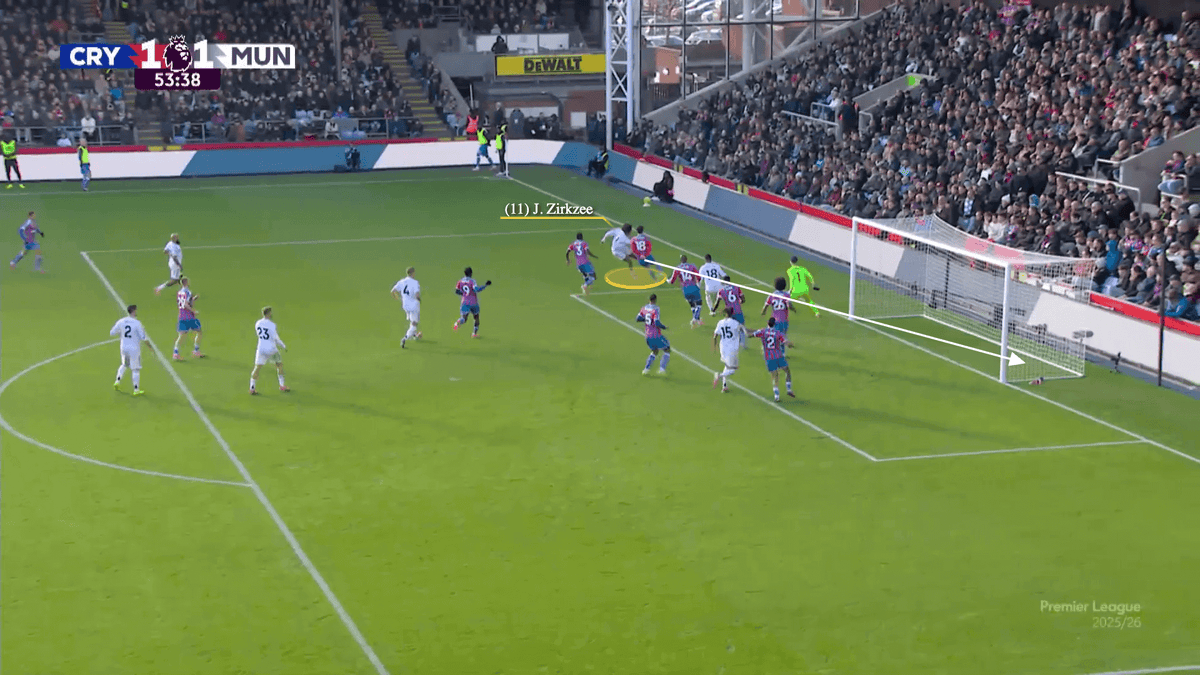
Amorim’s last line in the post-match press conference rang a bell because Joshua Zirkzee’s goal against Palace looked familiar.
Here, The Athletic investigates which set-piece ideas might have inspired Amorim and his staff to reproduce the wide free-kick routine from which Zirkzee scored the team’s first goal against Palace.
Exactly one year before that goal, Newcastle United drew 1-1 against Oliver Glasner’s side, and their goal came from a wide free kick, which Premier League teams have been building on to attack Palace towards the near post.
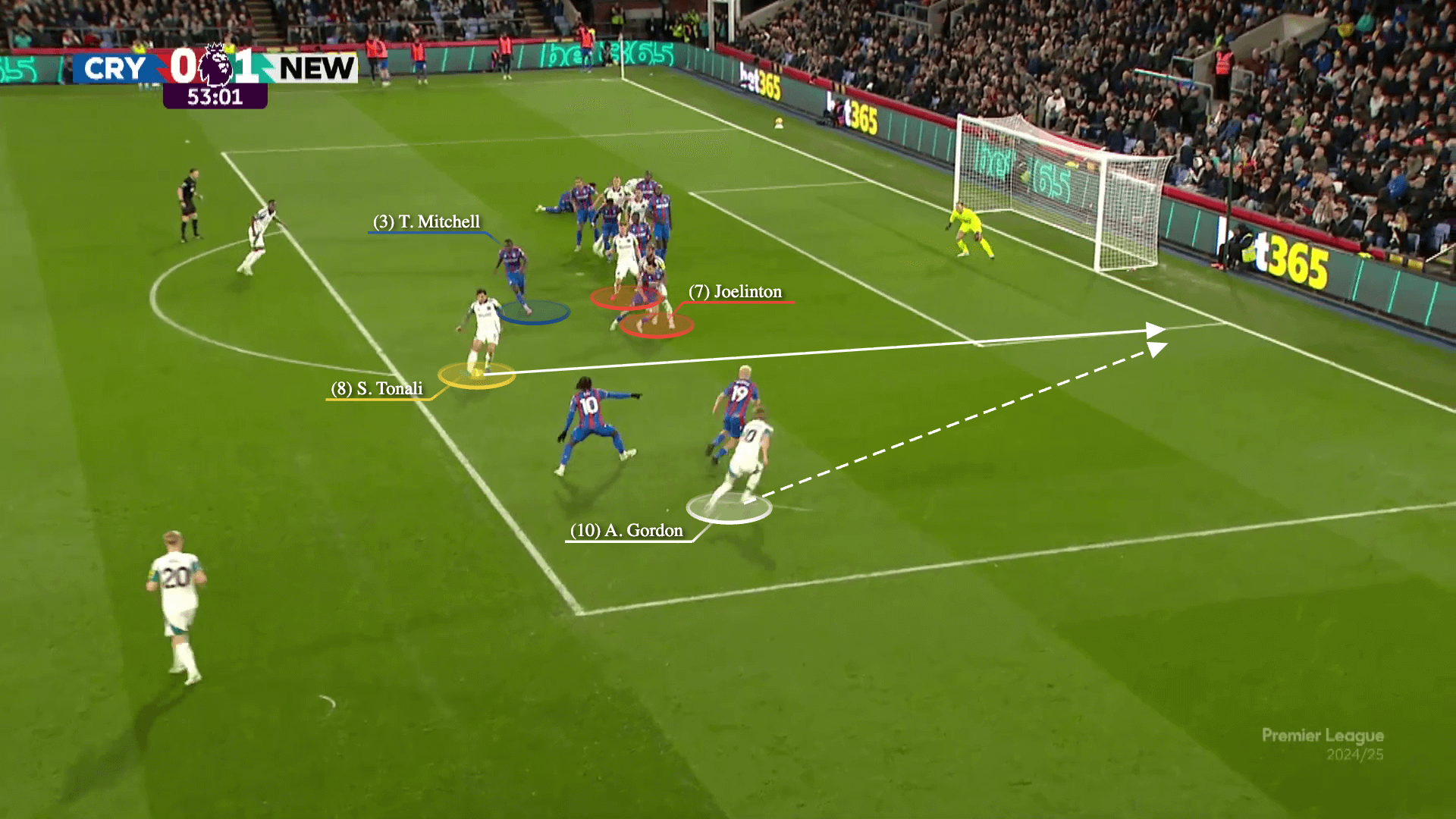
On that free kick, Palace had Daniel Munoz and Ismaila Sarr in position to defend the near post; while Tyrick Mitchell (red) was ahead of the defensive line to track any late runs into the penalty area
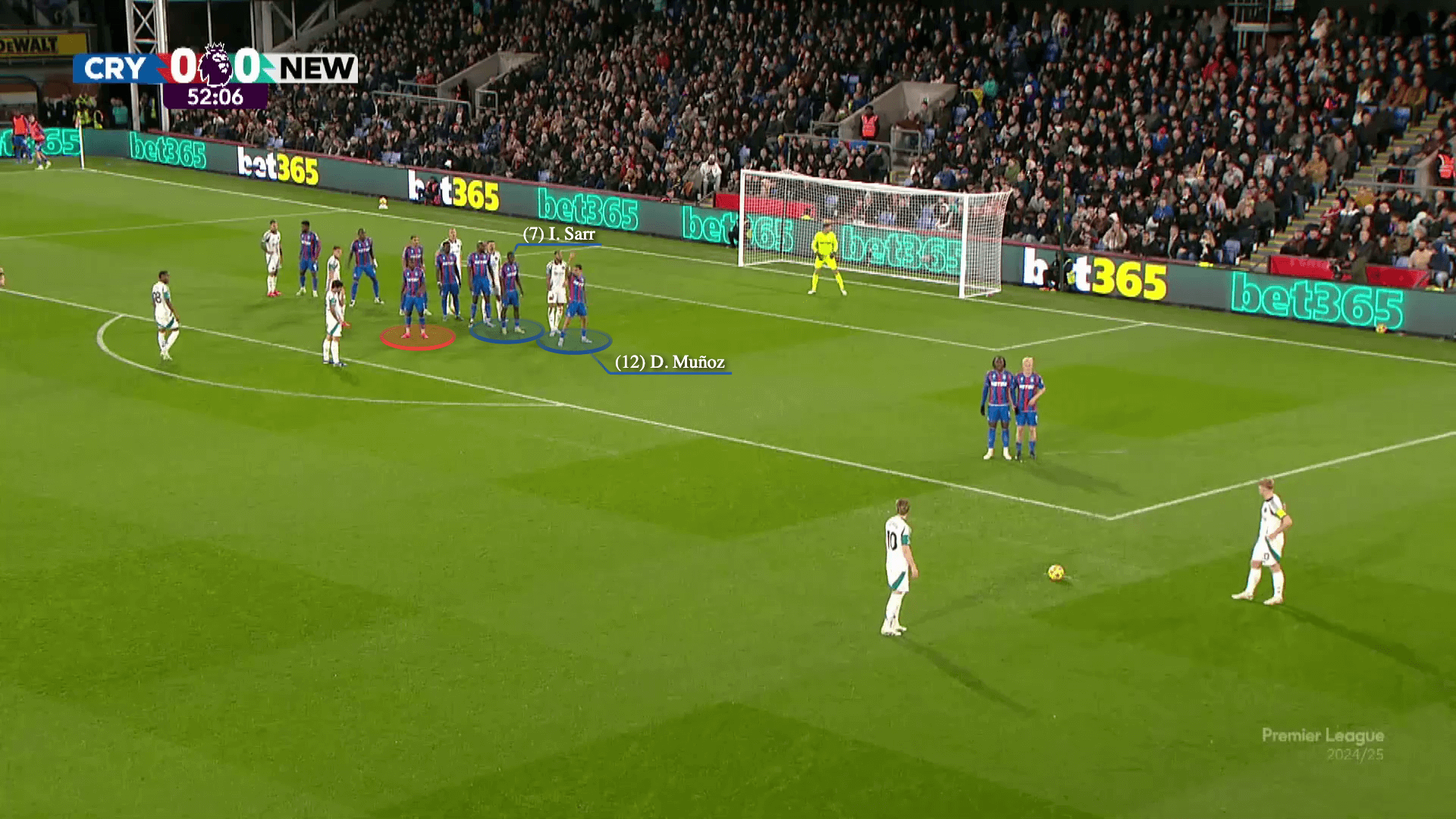
On the other hand, Newcastle’s offensive setup consisted of five players inside the 18-yard box, Tino Livramento (out of shot) defending against the counter, Joe Willock (white) and Sandro Tonali (yellow) by the edge of the penalty area, and Anthony Gordon and Lewis Hall standing over the free kick.
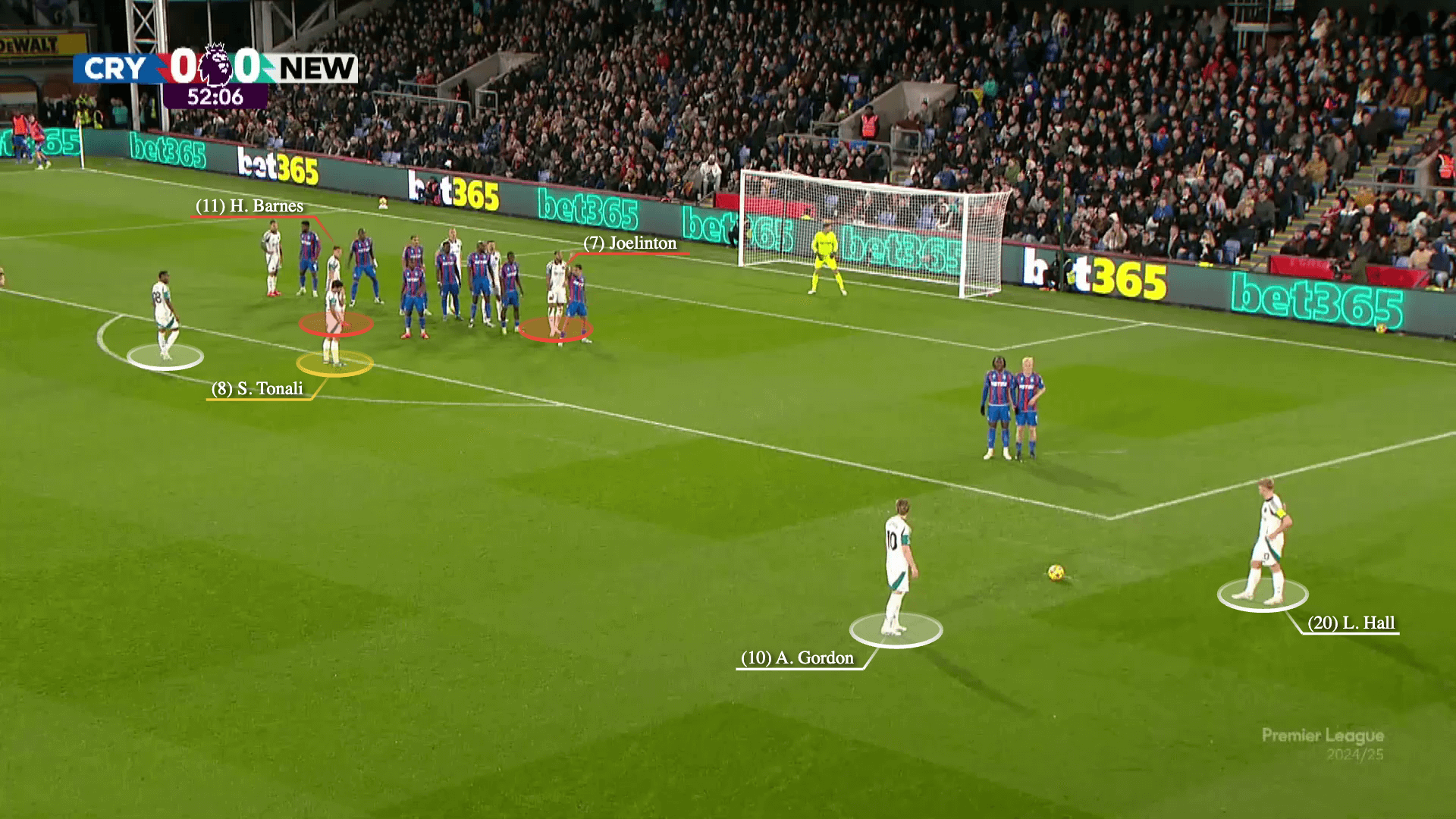
Gordon started the routine by jumping over the ball, which was the trigger for Joelinton (red) to block Munoz and Harvey Barnes (red) to position himself in front of Sarr — neutralising Palace’s near-post defenders.
Meanwhile, Tonali (yellow) dashed towards the gap between Palace’s wall and their defensive line to receive Hall’s short pass. As for Mitchell, he was forced into reacting late because Willock’s position created a two-versus-one situation against the left wing-back.
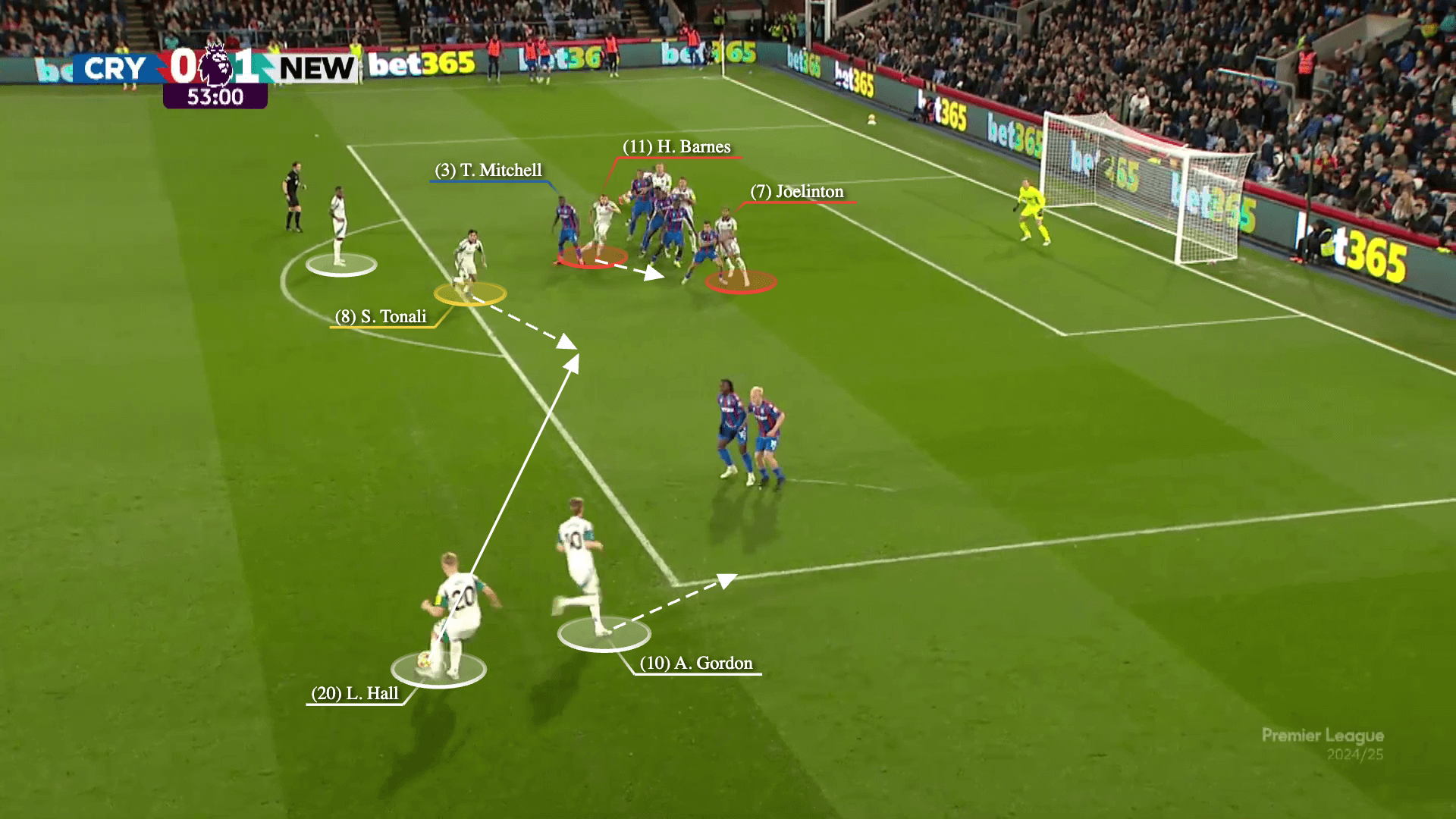
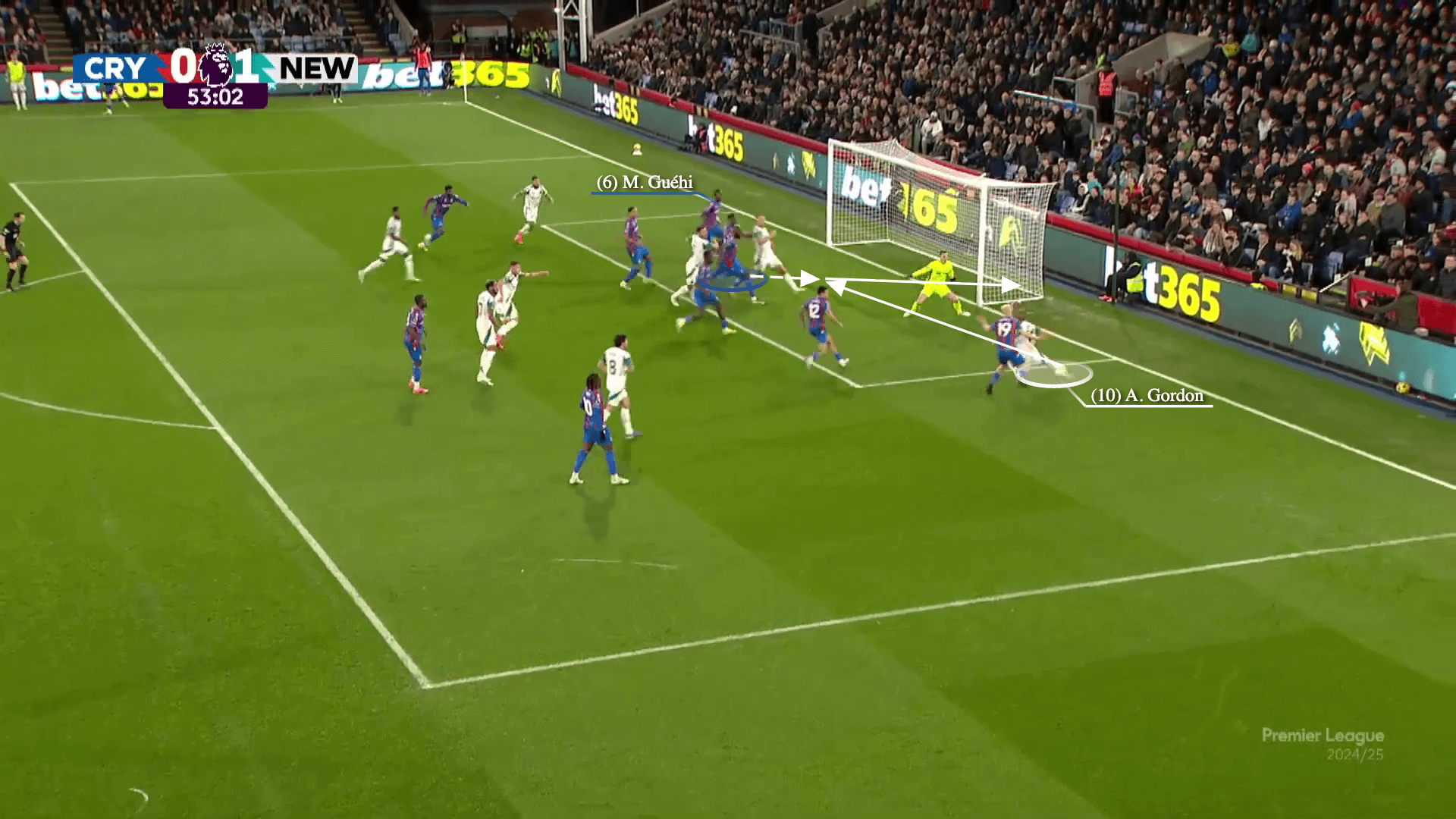
The routine was completed by Gordon, who after faking a cross, attacked the space behind Palace’s wall to meet Tonali’s pass. That was helped by Joelinton (red) blocking Munoz towards the near post.
The Newcastle forward then played the ball across goal to find Dan Burn or Fabian Schar, but it was Marc Guehi who put the ball into his own net.
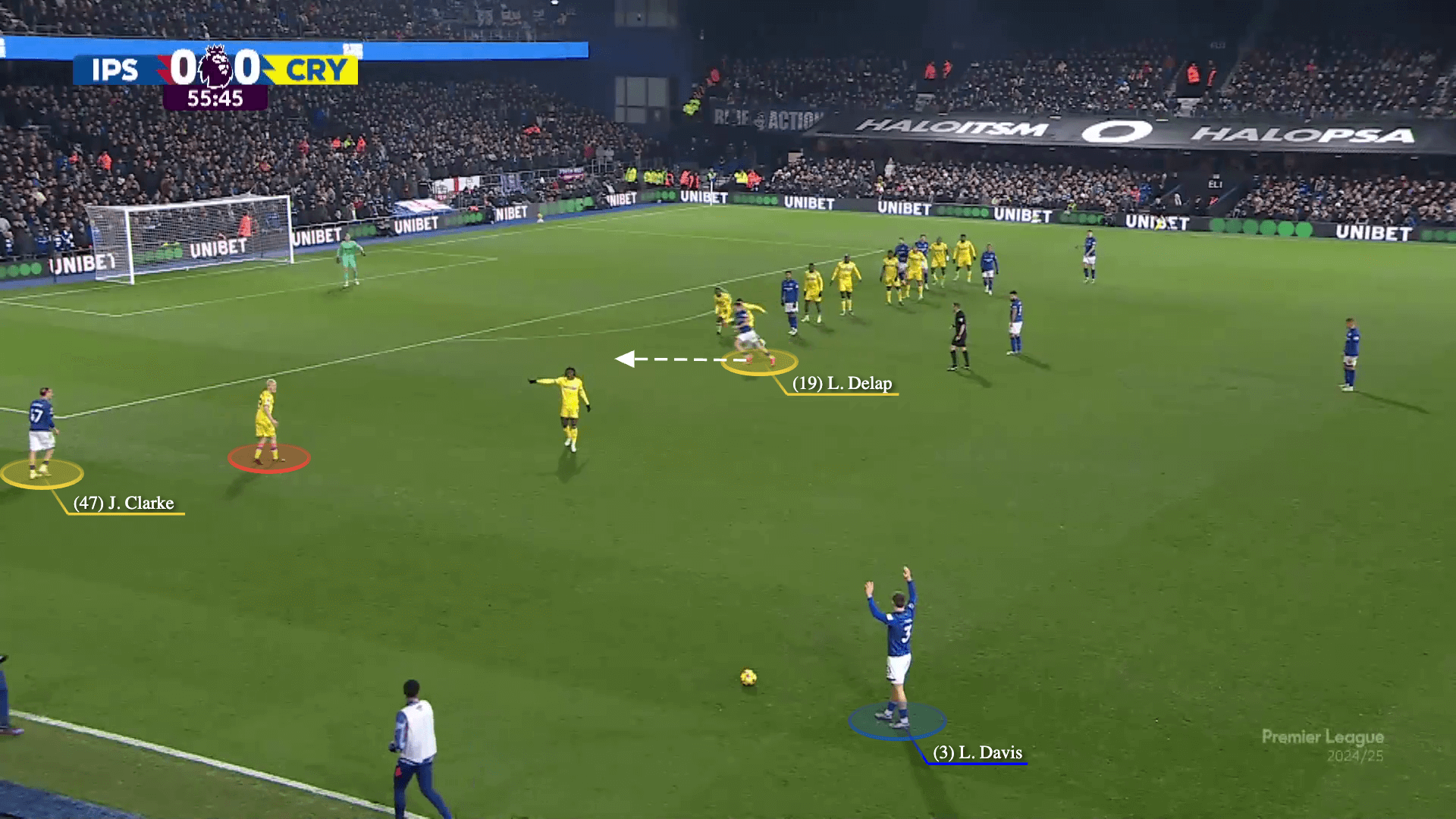
Three days later, in Ipswich Town’s 1-0 defeat by Palace, they tried to imitate Newcastle’s routine but were unsuccessful.
Earlier in the match, though, Ipswich tried to attack the same spot by positioning Jack Clarke towards the touchline to drag one of the Palace players into a dead zone.
In that example, Liam Delap quickly attacked the space behind Palace’s dysfunctional wall, but Leif Davis didn’t find his run.
In December 2024, Southampton tried to replicate Newcastle’s routine in their 2-1 loss against Palace at Selhurst Park, but missed the target. On another wide free kick in the same match, they unsuccessfully attempted to attack Palace’s near post by crossing the ball directly into that area to find Jan Bednarek’s late run, while blocking Sarr and dragging Mitchell towards the touchline — similar to Ipswich’s idea above.
The significance of Southampton’s effort was that it might have inspired Amorim and his staff. In United’s 2-0 defeat by Palace two months later, Amorim’s side built on Newcastle, Ipswich and Southampton’s ideas, but their execution failed them.
On a wide free kick in that match, United used Alejandro Garnacho to drag Mitchell into a dead zone towards the touchline, while Diogo Dalot (red) and Amad (yellow) worked in tandem to attack the near post.
As Bruno Fernandes shaped up to cross the ball into that area, Dalot moved across to block Munoz, allowing Amad a free run into the penalty box. However, Fernandes’ cross was overhit.

Palace’s vulnerability towards the near post was exposed again by Newcastle in the 5-0 defeat at St James’ Park in April. Schar scored from a wide free kick crossed towards that area, and Alexander Isak came close from a different routine attacking the same zone.
Here, Munoz was unsure who was tracking Barnes’ position because that’s not his role. As a result, Sarr was left in a one-versus-two situation against Joelinton (red) and Isak (yellow), who started the routine in an offside position.
Joelinton’s role was to occupy Sarr and create space for Isak. As Kieran Trippier crossed the ball towards Burn (yellow), Palace’s defensive line had to drop, playing Isak onside.
Burn then headed the ball to his centre-forward, but Isak’s shot was saved by Dean Henderson.

Palace were unfortunate to face the Premier League’s best set-piece team the following week. Arsenal, who have mastered the offside/onside trick on wide free kicks, exploited Palace’s weakness at the near post.
On the free kick which resulted in Arsenal’s opening goal, Palace showcased their altered defensive setup, which had Munoz at the back post and Daichi Kamada in his old position.
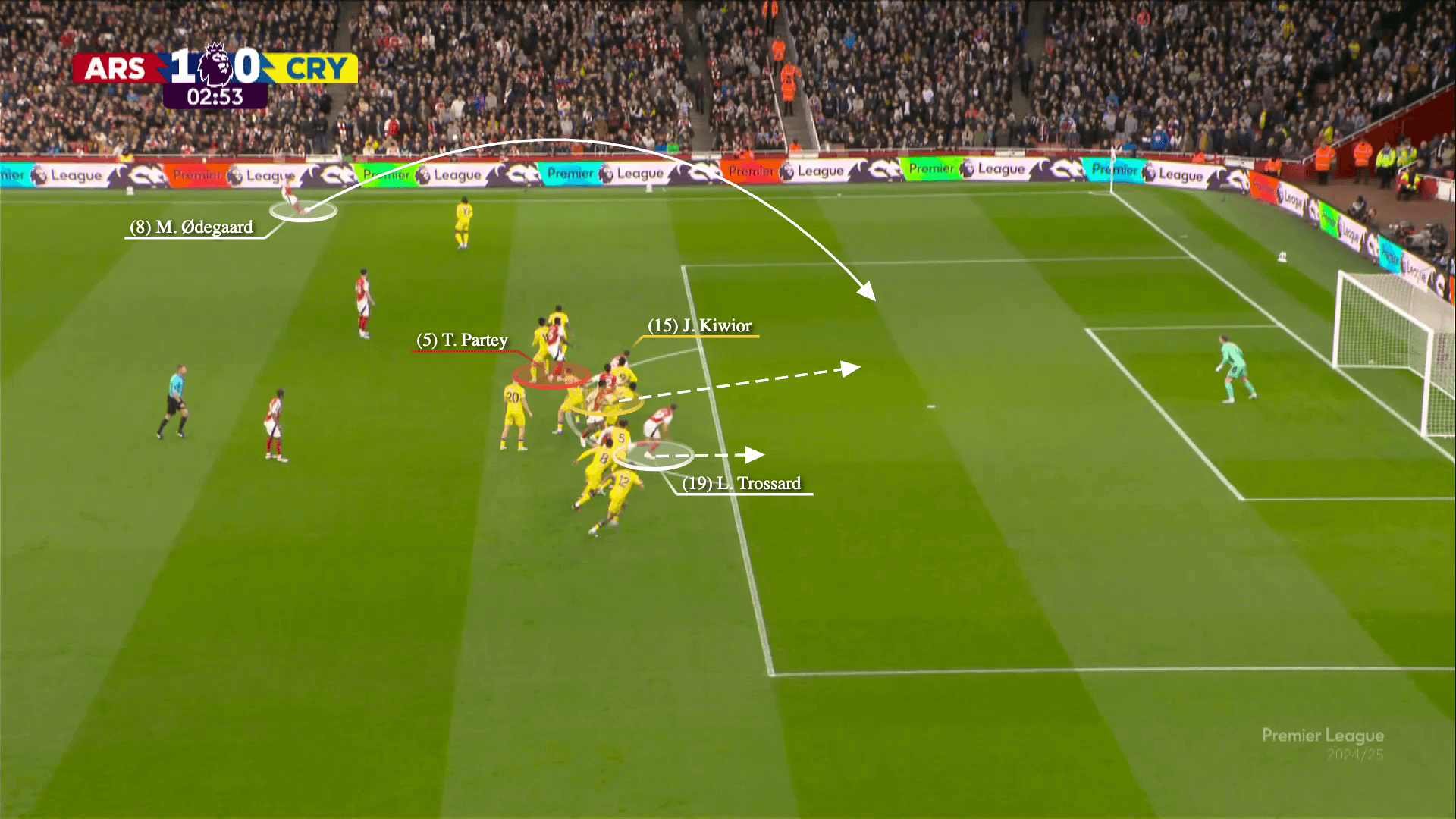
Meanwhile, Mikel Arteta’s side had a stack of players starting in an offside position at the back post, and Declan Rice (white) in place to attack the near post. However, Rice’s task was to occupy Mitchell and prevent him from dropping deeper.
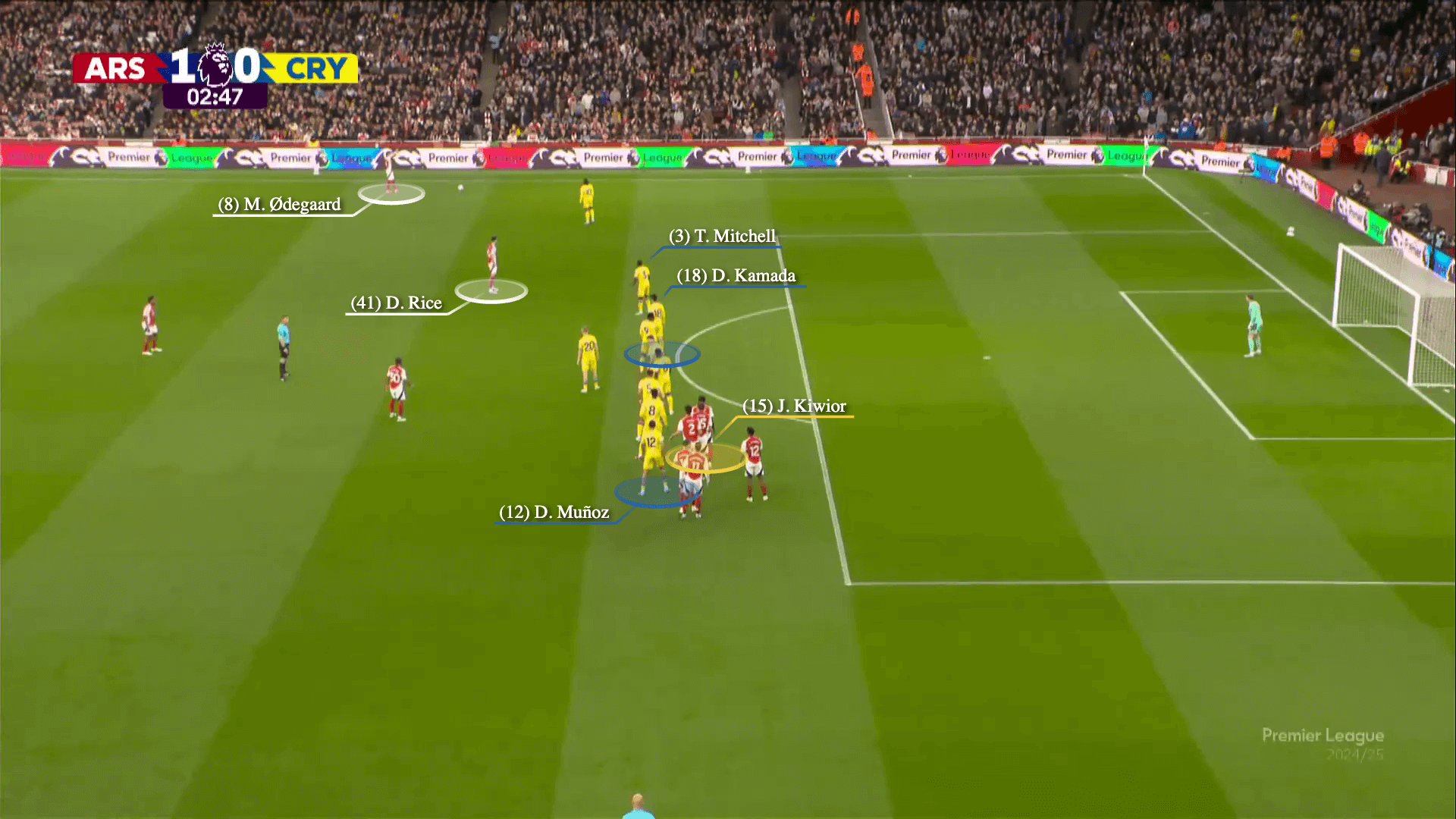
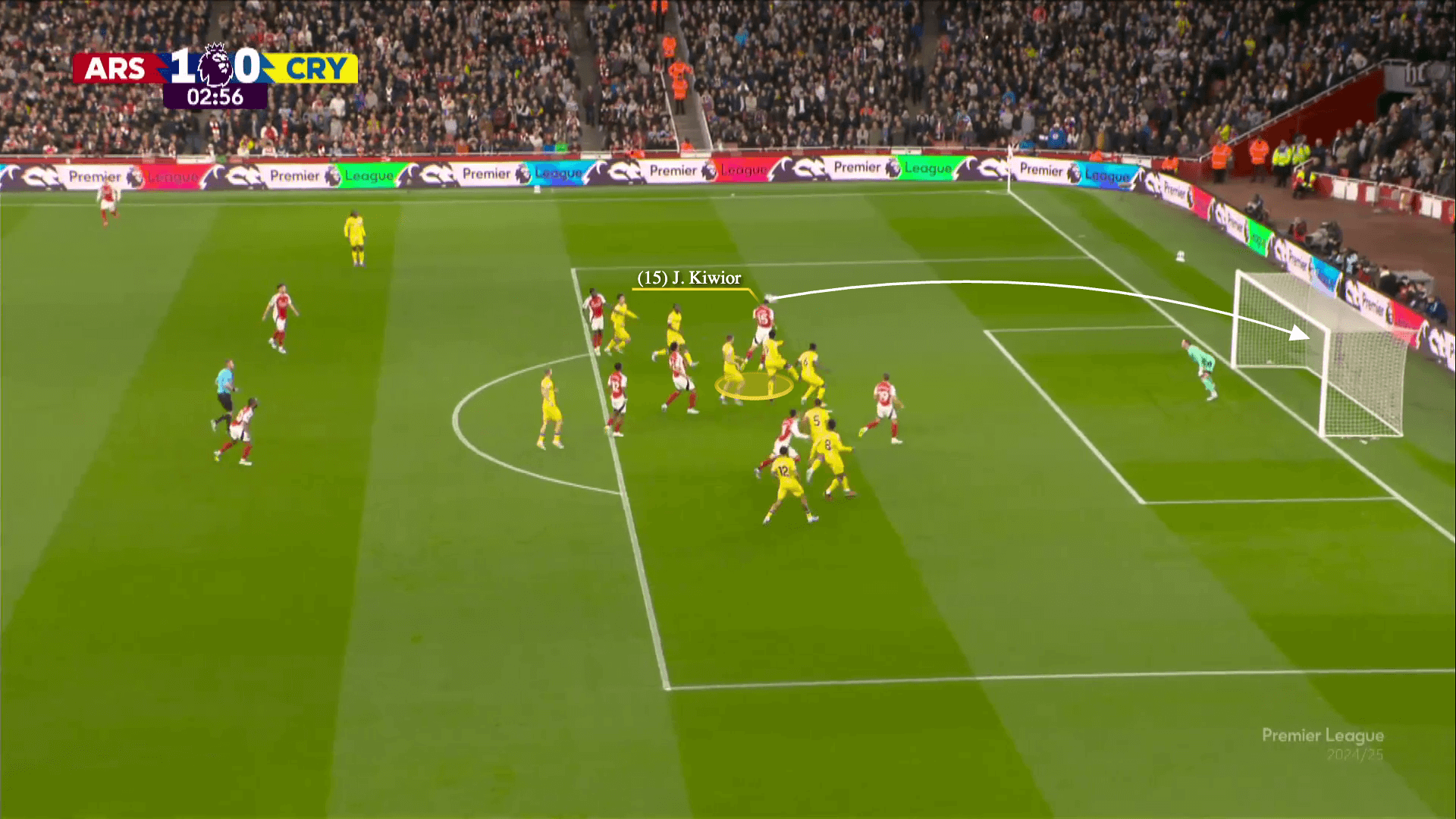
When Martin Odegaard started his run, Thomas Partey (red) and Jakub Kiwior (yellow) moved towards the near post, with the centre-back dropping into an onside position. With Mitchell occupied by Rice, Partey’s role was to block Kamada to clear the near-post zone for Kiwior.
Towards the other side of the Arsenal pack, Leandro Trossard intentionally dashed forward to drop Palace’s defensive line.
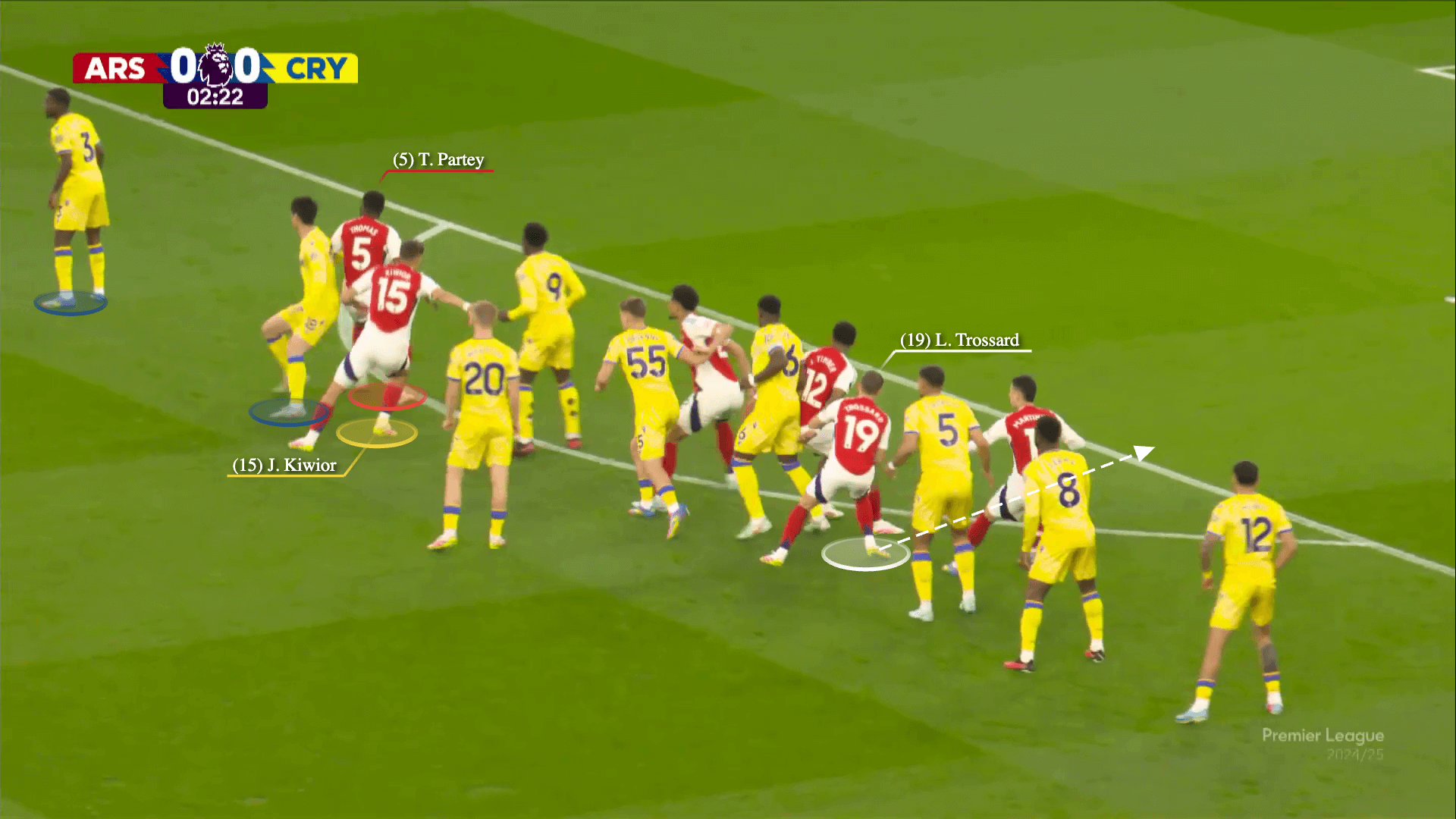
Even if Trossard became offside, the main target was Kiwior, who was onside because Palace dropped their defensive line.
Odegaard then crossed the ball towards the near post, and Kiwior connected with it to score another Arsenal set-piece goal.
In 2025-26, the wide free kick which could have persuaded United to repurpose their routine from their last encounter with Palace was the one Sunderland used at Selhurst Park in September.
It followed the same ideas of pinning Mitchell and dragging him towards the touchline, occupying one of the near-post defenders — Kamada, in this instance — and quickly attacking the space between the wall and the defensive line.
In the below example, Noah Sadiki’s late run towards the near post was found by Granit Xhaka, but the DR Congo midfielder missed the target.

All of the above situations — including United’s own attempt last season — leads us to Zirkzee’s goal on Sunday.
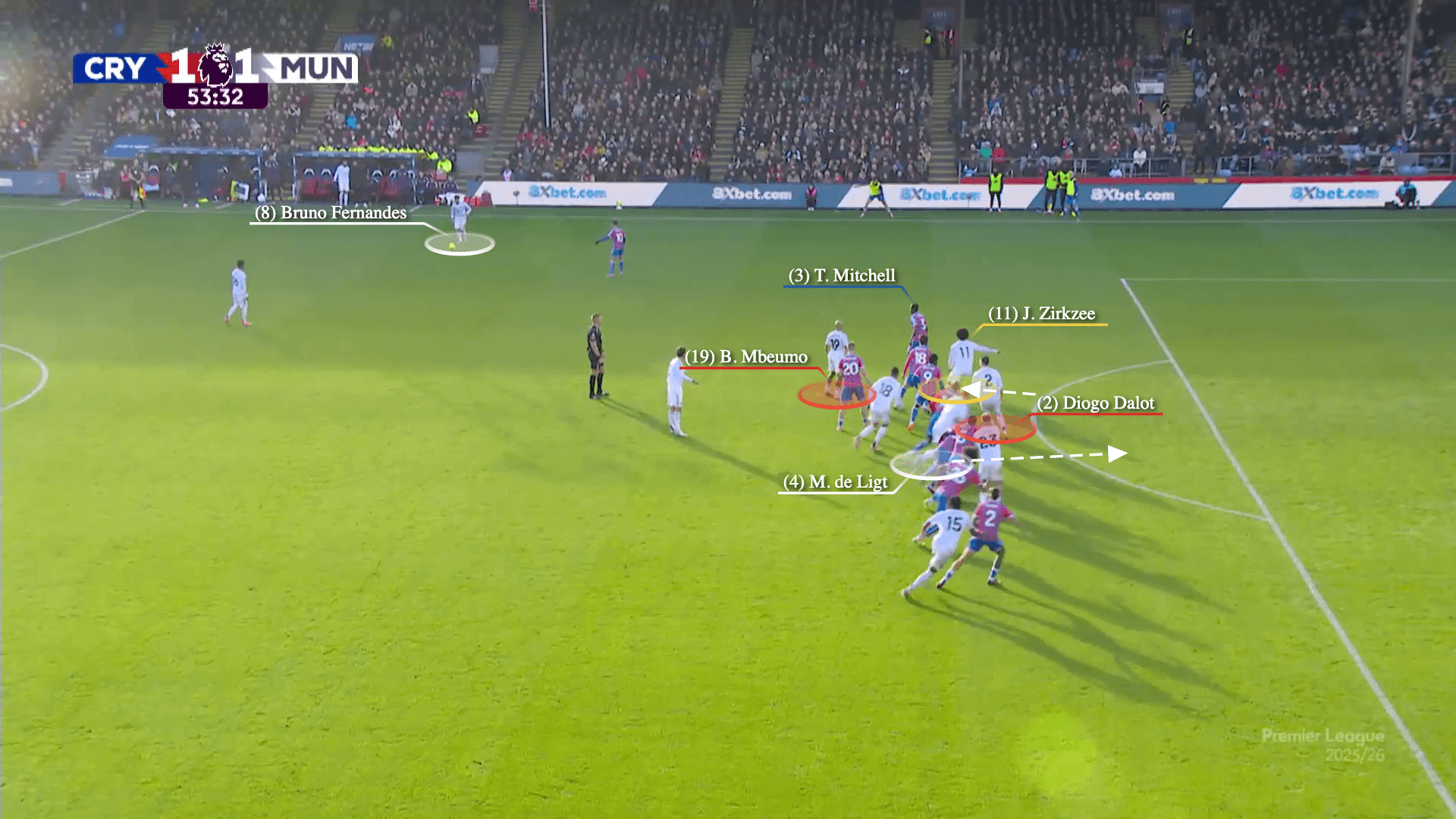
Here, United’s centre-forward (yellow) starts the routine from an offside position behind Kamada, while Bryan Mbeumo (red) tries to grab Mitchell’s attention. In the centre of Palace’s defensive line, Dalot (red) and Matthijs de Ligt (white) are preparing to execute their roles.
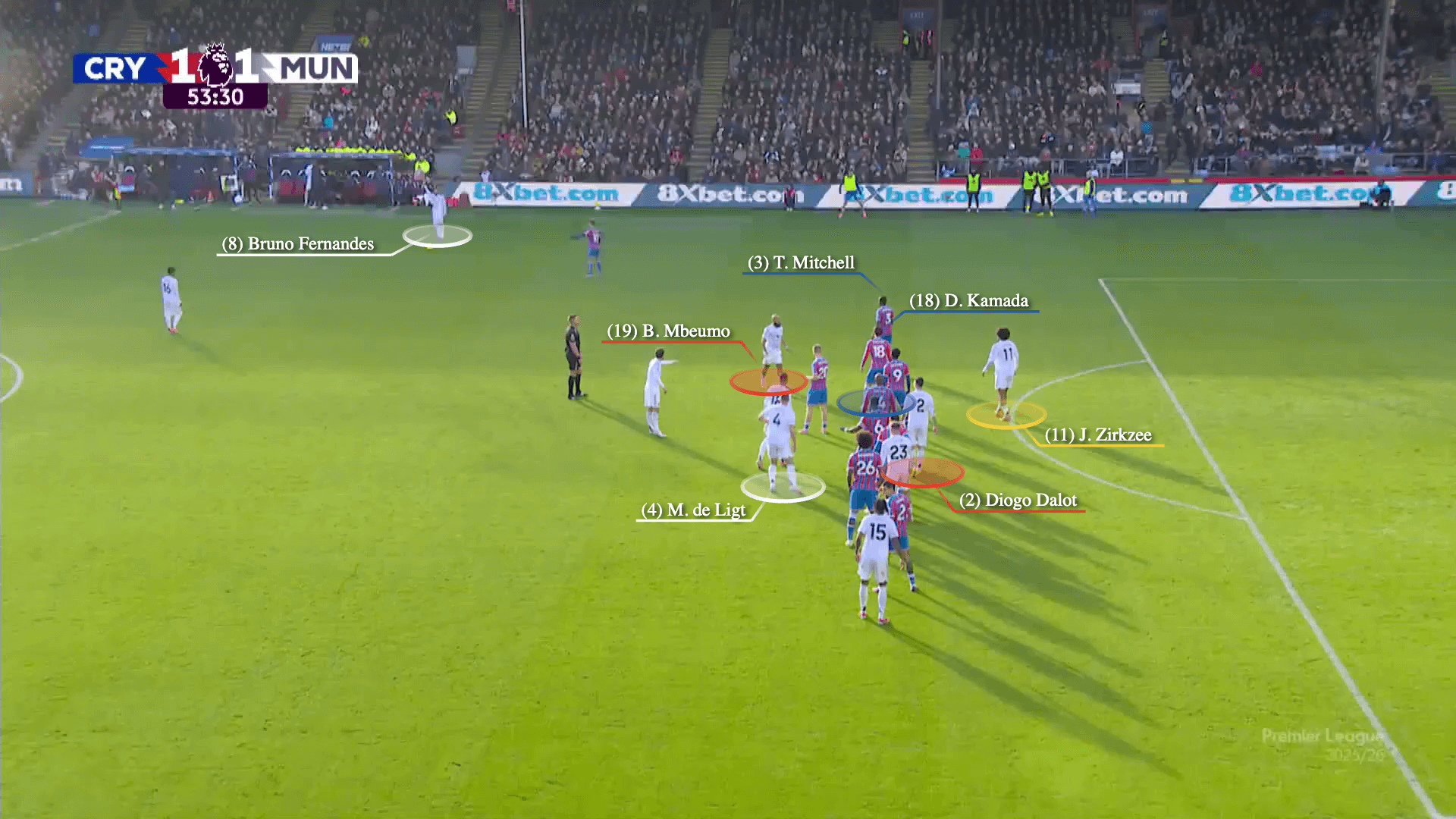
As Fernandes starts his run, Dalot (red) moves towards Eddie Nketiah (Palace No 9) to block the third player towards the near post, and De Ligt (white) dashes forward to drop the rest of Palace’s defensive line.
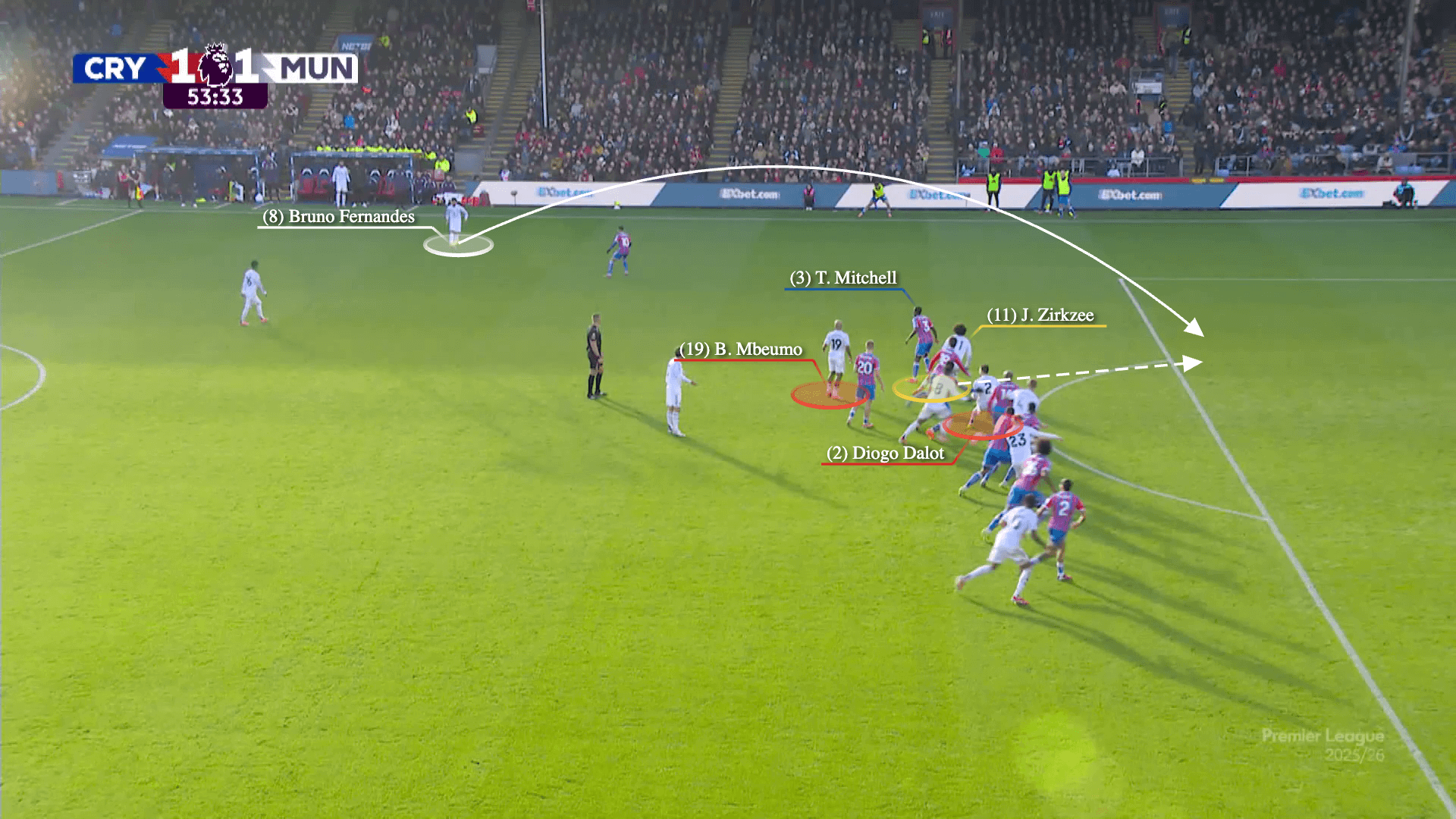
With Mitchell occupied by Mbeumo, Zirkzee (yellow) is isolated in a one-versus-one situation against Kamada (Palace No 18) and has an advantage due to his initial offside position…
… which becomes onside once Fernandes crosses the ball towards the near post.
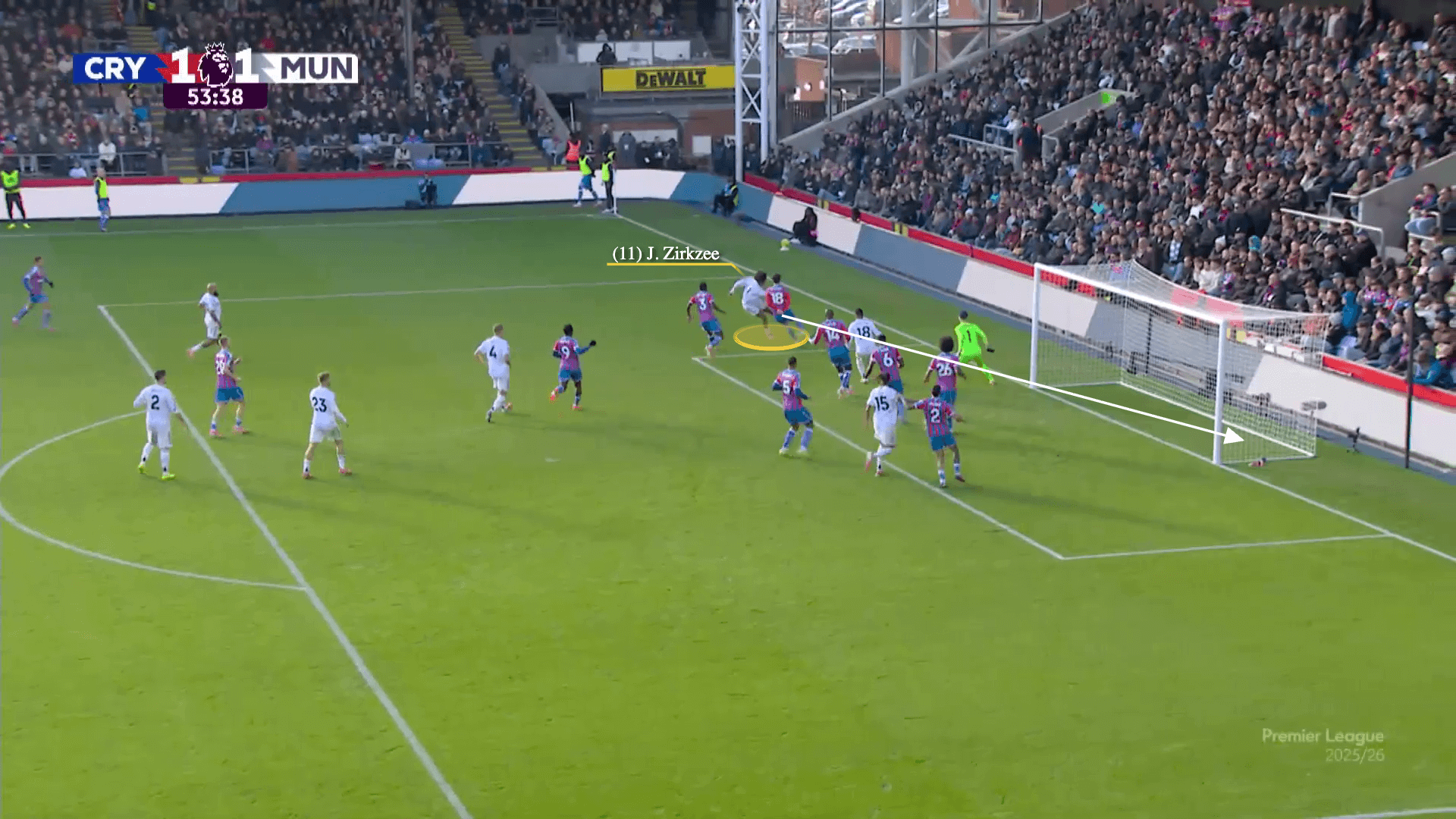
Zirkzee then attacks the target area…
… and controls the ball, before scoring from a narrow angle.
Amorim, Carlos Fernandes, the staff and United’s players deserve credit for the team’s improvement on attacking set pieces.
There’s more to a team’s set-piece success than just stealing ideas — building on them, tailoring them to the players and executing the routines is the harder part.