
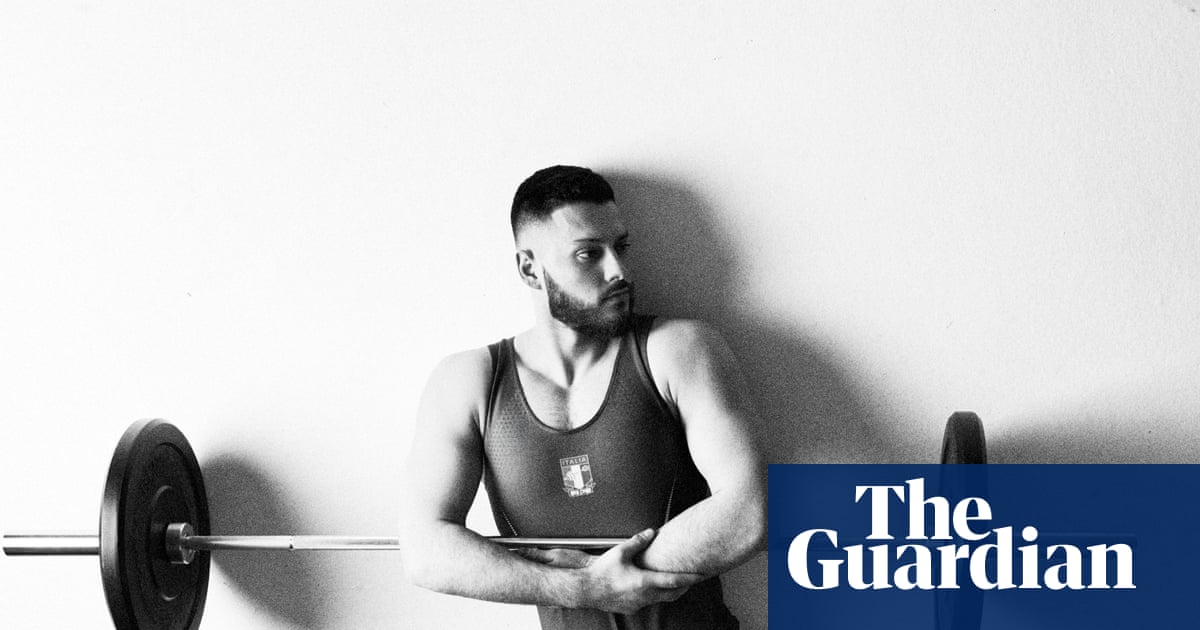
This image is part of a series commissioned by the Italian Paralympic Committee. They asked me to photograph the country’s leading athletes before the 2024 Paralympic Games in Paris. I probably covered 30 different people over three days – I’m a quick shooter. I started out photographing on film, which is still my preferred medium. Even when I’m shooting digitally, I’m very selective and take care with every click.
On a logistical level, it was much easier for me to work in a studio, though that was something I don’t usually choose to do. I’m more of an outside photographer: I like to go on location or shoot people in a park.
For me, photography is a way to learn more about subjects. I use the camera to unlock new things that interest me. I’m informing myself rather than trying to inform the viewer. I photographed the rave scene in the 90s because I was excited by it and wanted to get closer to it. And I photographed my home town of Rovigo long after I’d moved away, in an attempt to get to know more about the place I’d left behind.
In this case, I didn’t know these people, but I always asked for half an hour just to talk with each subject first. I didn’t discuss the pictures – I just wanted to know where the person was coming from. I’d ask simple questions like: “What did you do yesterday? Are you married? What’s the last TV series you enjoyed? Which football team do you support?” Portraying someone is a sort of collaboration, but I didn’t discuss with each sitter how they wanted to be photographed. They trusted me to do my thing.
Photography has to be spontaneous and instinctive – I feel more like a thief than a painter
Donato Telesca, the subject of this picture, is a powerlifter who went on to win bronze at the Paralympics. I’d been shooting him sitting against a vertical background, some more straightforward images, but while we were taking a break, and I was having a coffee, I noticed him leaning back on the floor and resting. There was also, by chance, a ladder in the studio, so I said: “Donato, please don’t move!” I took the ladder, jumped on it and photographed him from above.
For me, photography has to be like that – spontaneous and instinctive. Something catches my eye and I want to capture it. I feel more like a thief than a painter, if you see what I mean. Here, I wanted to keep a reportage photographer type of approach, so I was shooting with the continuous light rather than using flash. When I go on location, I never arrive with an idea. I want to be able to improvise. That’s the method I took for this series.
Some photographers who shoot in studios try to hide the fact, but I wanted to make it obvious that’s where we were. For example, I deliberately included things like the metal wheel of the ladder and that Scotch tape on the floor in the shape of an arrow. The Olympic Committee were wary of this approach but gave me complete creative freedom, and they were happy when they saw the results.
I don’t really like explaining my pictures. I think that demeans them in a way, like trying to explain a song or a poem. But I do love to hear other people’s interpretations. Some people seeing this image for the first time didn’t immediately realise Donato has no legs – they thought he might just be sitting in a weird position. The orientation of the photograph adds another layer of ambiguity. Until you realise it’s taken from above, you might imagine Donato is defying gravity. But the most important thing is that when I showed him the picture, Donato was over the moon.
Mattia Zoppellaro. Photograph: Courtesy Mattia ZoppellaroMattia Zoppellaro’s CV
Born: Rovigo, Italy, 1980
High point: “Beside shooting stars such as Lou Reed, Bono and Patti Smith, working on my current project on the Arabic world in northern Italy.”
Top tip: “Travel light, sell the tripod – and don’t show the images to your subject before making your selection.”
This image is part of the Taylor Wessing Portrait Photo prize exhibition at the National Portrait Gallery, London, until 8 February.