
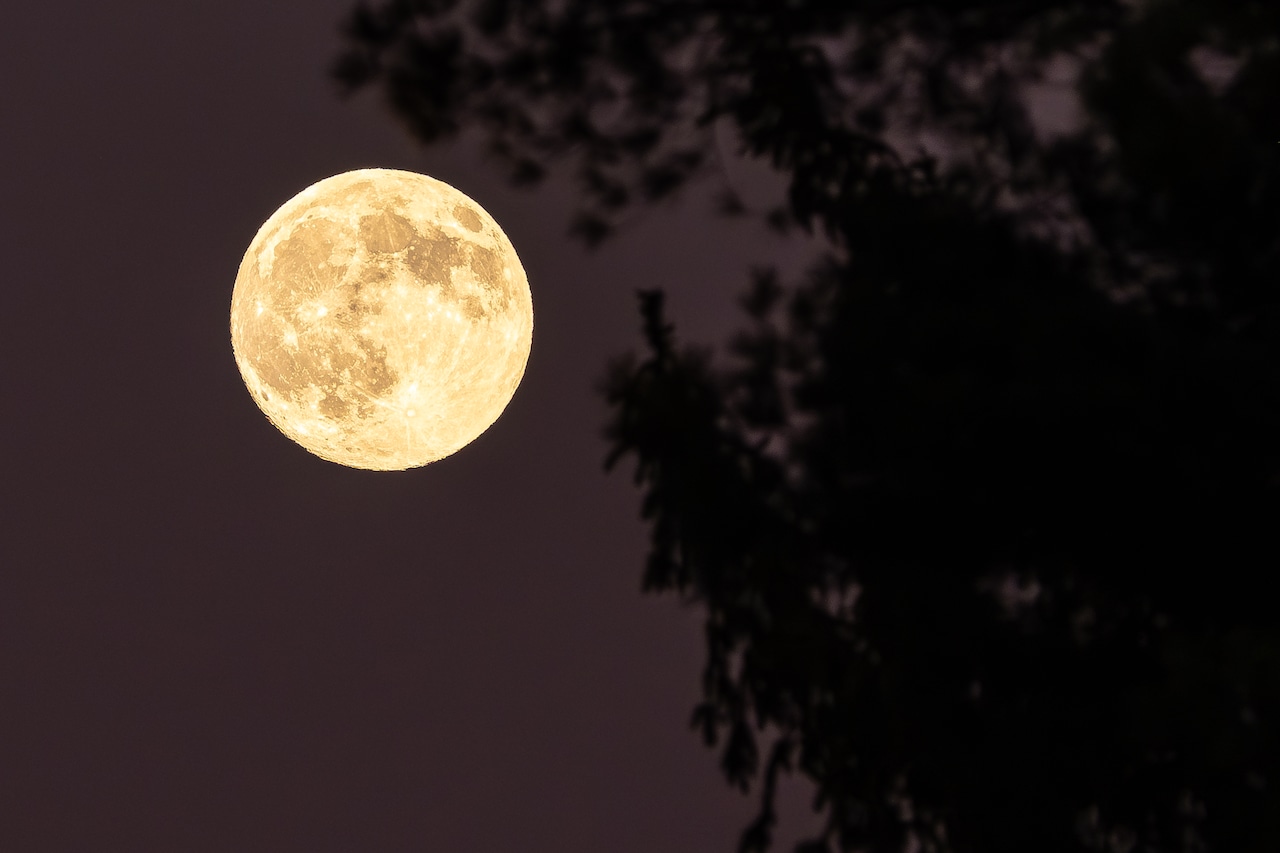
Skywatchers will have a lot to look at in the night skies over Alabama in December.
A super moon, a meteor shower and a comet are just a few.
DEC. 4: SUPER MOON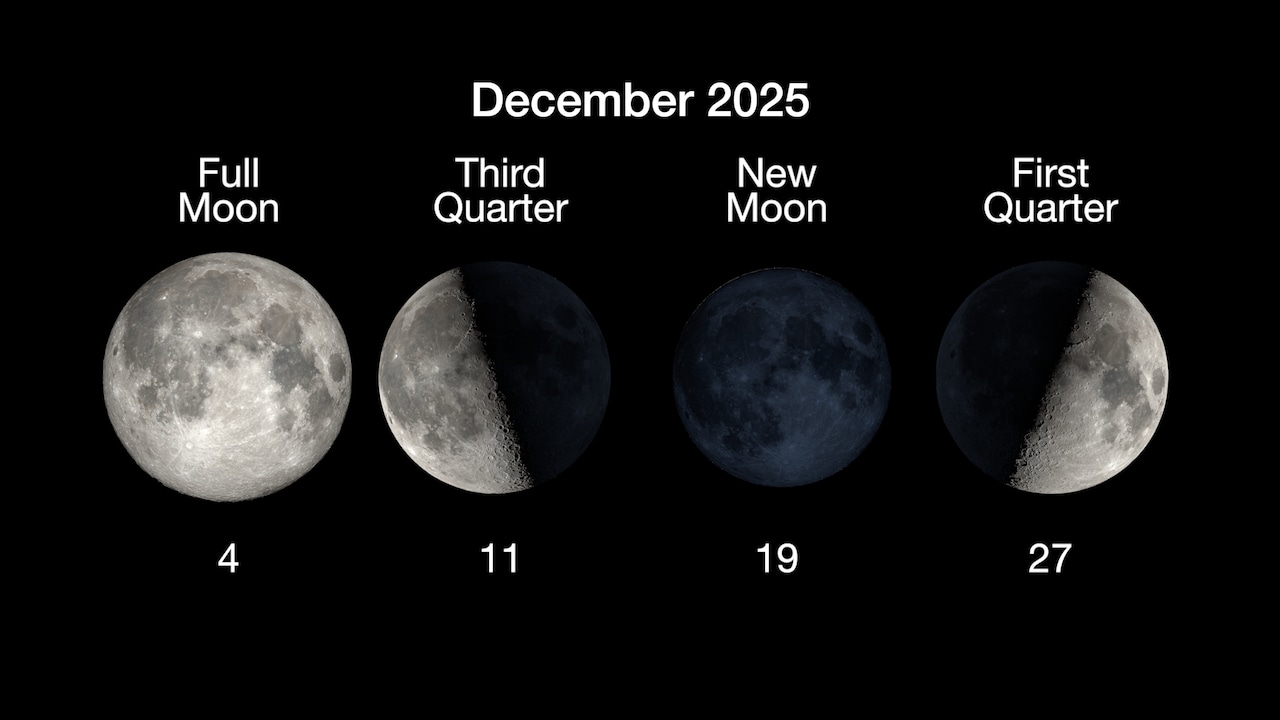 Here are the phases of the moon in December of 2025.NASA
Coming up first is a super moon on Dec. 4 (Thursday).
According to National Geographic the final full moon of the year will also be a super moon, which means it will be at its fullest as it makes its closest approach to Earth.
On Thursday the moon will rise around 5:15 p.m. in north and central Alabama and closer to 5:30 p.m. in south Alabama, and it will appear full tonight and Friday night as well (if you can see it through expected clouds and showers).
However, clouds could get in the way, with rain in the forecast for much of the state starting on Thursday afternoon.
DEC. 7: MERCURY, THE MOON AND JUPITER
According to National Geographic the planet Mercury will also be on center stage this month, reaching what NG called its “longest elongation.”
On Dec. 7 Mercury will reach its widest separation from the sun, which should offer a better view of it away from the sun’s glare.
According to National Geographic look for Mercury about an hour before sunrise on Dec. 7 (Sunday). It will rise above the eastern horizon, with Venus right behind it.
That’s not all.
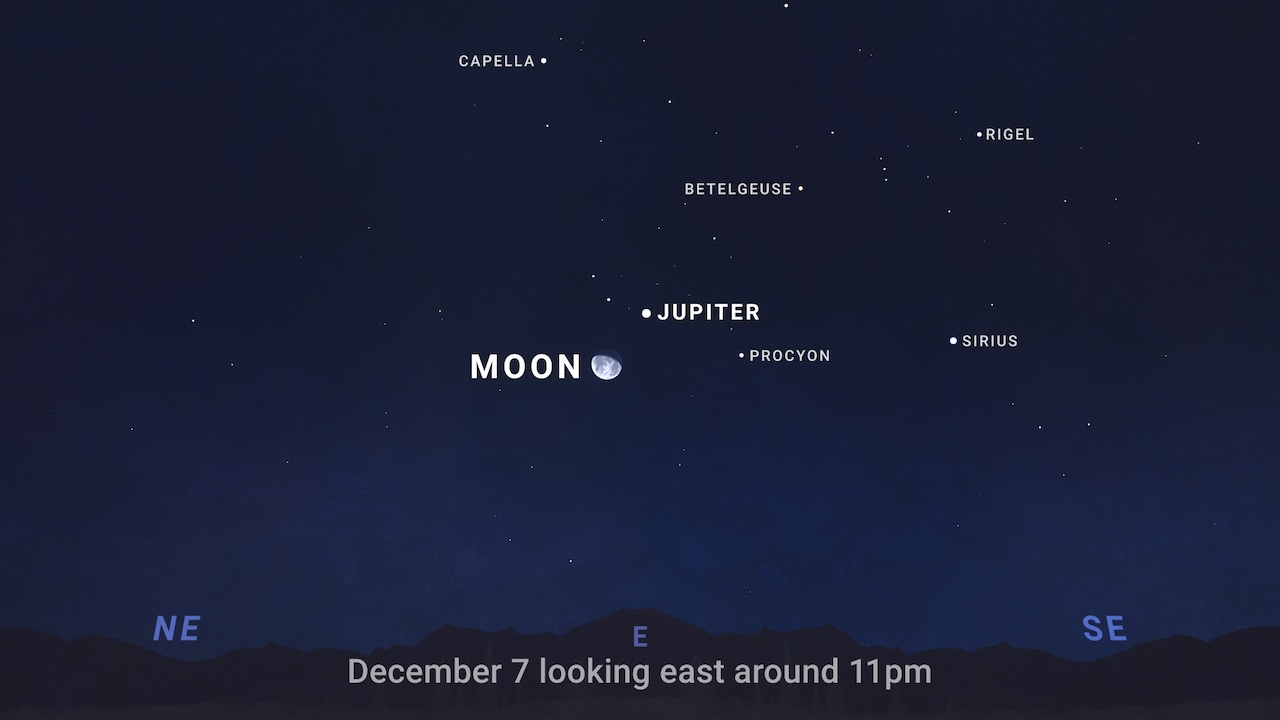 The moon and Jupiter will appear close in the sky on Dec. 7.NASA
According to NASA the night of Dec. 7 will bring a close conjunction of the moon and Jupiter.
NASA describes a celestial conjunction as when planets and moons appear close together even though they’re actually far apart.
“For example, while the Moon and Jupiter will buddy up this month from our view, in space, they’re actually hundreds of millions of miles apart,” the space agency said.
To see the conjunction, look to the eastern sky on the night of Dec. 7 (Sunday). Jupiter will be just above and to the right of the moon.
DEC. 13-14: GEMINID METEOR SHOWER PEAKS
The annual Geminid meteor shower will peak on the evenings of Dec. 13 an 14.
According to NASA the Geminids are known for being bright and colorful. The meteors originate from debris trailing the asteroid 3200 Phaethon.
In the right conditions it’s possible to see up to 120 Geminid meteors per hour.
NASA said to catch the Geminids at their peak, “look to the eastern sky all evening on Dec. 13 and Dec. 14. The meteors will appear near the bright planet Jupiter.”
You’ll want to find the darkest skies possible for best viewing.
DEC. 19: COMET COMES CLOSE-ISH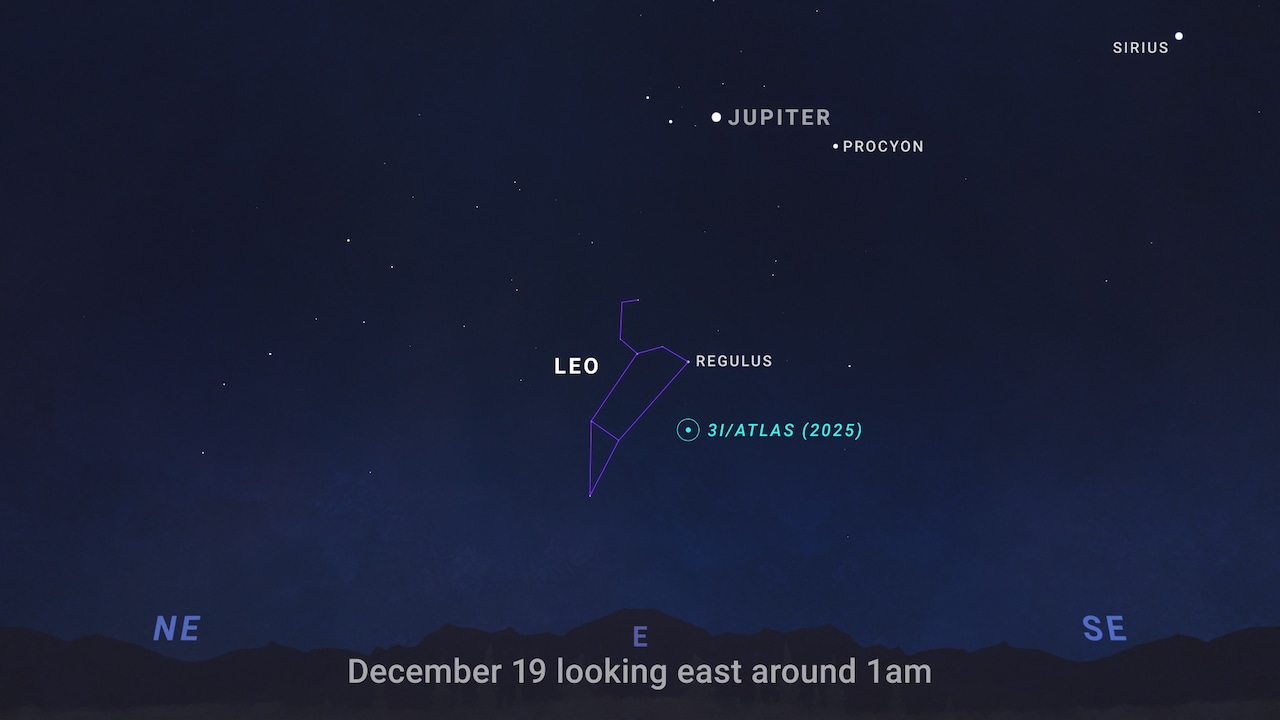 Here’s where to look for the comet 3I/Atlas early in the morning on Dec. 19.NASA
Comet 3I/ATLAS will make its closest approach to Earth on Dec. 19.
But it really won’t be all that close, and there’s no threat to our home planet, according to NASA.
At its closest the comet will be 170 million miles away, or more than 700 times the distance between the Earth and the moon, NASA said.
This comet is also noteworthy because it is the third object in history from outside of our solar system to be discovered within our solar system.
The best chance of seeing it will be with a telescope. Look to the east or northeast in the pre-dawn hours right under the star Regulus in the constellation Leo.
According to National Geographic astronomers believe the comet originated from a faraway star system in the Milky Way and could be more than 7 billion years old.
DEC. 21-22 URSID METEORS PEAK
The Ursids won’t provide as many meteors per hour as the Geminids, but the moon will be very dim at this point in the month, which could aid in spotting a few.
According to National Geographic 10 meteors per hour could be seen under the right conditions.
The best time to look for them will be just before dawn.