
Skip next section Bundestag approves big tax relief for restaurants
12/04/2025December 4, 2025Bundestag approves big tax relief for restaurants
Germany has passed a wide-ranging tax relief package that includes a slashing of the sales tax rate for restaurants. The tax reform bill, was approved Thursday by the Bundestag, Germany’s lower house.
However, the tax break still requires consent from the Bundesrat, Germany’s upper house. That assembly represents Germany’s 16 states, which have so far withheld their approval because of expected revenue losses.
The lower rate for restaurants drew sharp criticism in the debate. Lawmakers from the Greens and the socialist Left Party called it an economically unsound giveaway. The bill passed with support from the governing coalition of the conservative CDU/CSU bloc and the center-left Social Democrats, while the Greens and far-right Alternative for Germany voted against. The Left abstained.
The law can take effect only if the Bundesrat approves it on December 19. The states want compensation for lost revenue, estimated in the draft at more than two billion euros next year alone. The federal government has rejected such compensation so far.
Under the bill, VAT on restaurant food would fall permanently from 19% to 7% starting 1 January 2026. The measure, pushed by the CSU during coalition talks, is intended to stabilize the struggling hospitality sector. Restaurants would not be required to pass the tax cut on to customers.
The bill also includes higher tax allowances for both commuters and volunteers.
https://p.dw.com/p/54l7i
Skip next section Germany plans mandatory door-opening warnings for cars after cyclist deaths
12/04/2025December 4, 2025Germany plans mandatory door-opening warnings for cars after cyclist deaths
When car doors open suddenly, cyclists’ lives may be in perilImage: Marijan Murat/dpa/picture alliance
The German government has been preparing new measures to protect cyclists and e-scooter riders from accidents caused by suddenly opened car doors.
A spokesperson for Transport Minister Patrick Schnieder said Berlin plans to require assistance systems such as door-opening warnings to help prevent these incidents.
Such systems monitor the areas to the sides and rear of the vehicle while it is parked. They detect approaching road users “and warn the occupants in time if a collision could be imminent when a door is opened.”
Cyclists are especially at risk when riding close to parked cars. Such accidents are known as “dooring”. Germany’s main cyclist organization ADFC said the term refers to a car door opening abruptly in front of an approaching cyclist, leaving riders to swerve sharply or brake hard.
Caroline Lodemann, the ADFC’s political director, told the Rheinische Post newspaper that the group has long pushed for mandatory door-opening warning systems and automatic stop mechanisms in motor vehicles.
Dooring incidents often result in serious injuries, particularly when evasive moves lead to collisions with other vehicles. The ADFC noted that police do not track these cases in a dedicated category, meaning reliable statistics are not available.
In one particularly high-profile case Hamburg-based actress Wanda Perdelwitz, known for her roles in two major German television series, “Grossstadtrevier” and “Das Traumschiff,” died in early October after colliding with a suddenly opened passenger door while riding her bicycle.
https://p.dw.com/p/54kT0
Skip next section German lawmakers consider slashing restaurant taxes
12/04/2025December 4, 2025German lawmakers consider slashing restaurant taxes
The German parliament is discussing a plan to permanently lower sales tax on restaurant food to the same level that it was at during the coronavirus pandemic.
The move is part of a broader effort to support businesses and consumers facing inflation, high energy costs and weaker purchasing power.
Ministers have already approved draft legislation from Finance Minister Lars Klingbeil that would reduce the tax on food served in restaurants from 19% to 7%.
The measure still requires parliamentary approval. It forms part of the policy package negotiated in the coalition deal between Chancellor Friedrich Merz‘s conservative bloc and Klingbeil’s center-left Social Democrats.
The coalition, which took office in early May, has made reviving Germany’s slowing economy a central priority.
During the coronavirus pandemic, sales tax on restaurant food had been temporarily cut to 7% to help the sector through lockdowns, but after the end of restrictions the rate returned to 19%.
Can massive state spending turn the German economy around?
To view this video please enable JavaScript, and consider upgrading to a web browser that supports HTML5 video
https://p.dw.com/p/54k7G
Skip next section Study finds German store closures have accelerated
12/04/2025December 4, 2025Study finds German store closures have accelerated
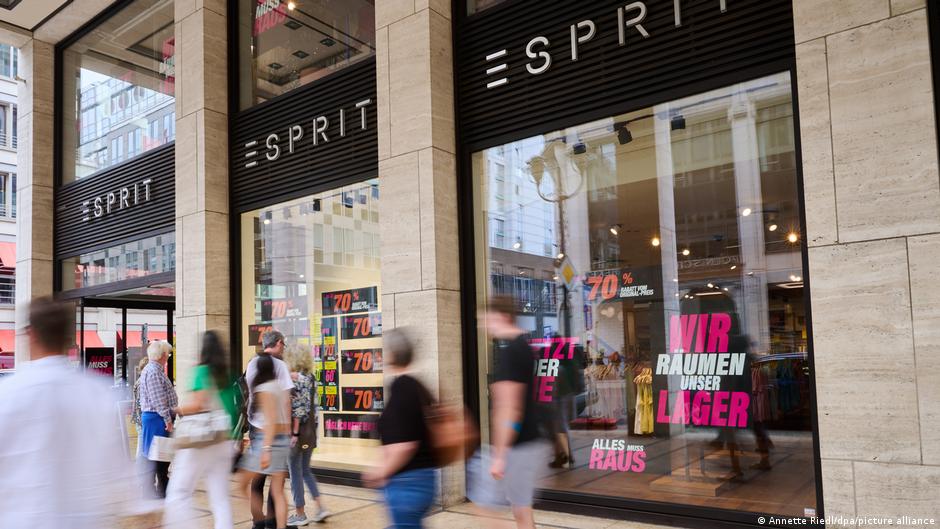
Germany has been seeing a faster wave of retail insolvencies, with a new study reporting 2,490 bankruptcies between August 2024 and August 2025.
The analysis by credit insurer Allianz Trade said the figure came close to the previous record of 2,520 cases set between 2015 and 2016.
“The retail sector is still struggling with the profound changes to its business model that began during the pandemic,” said Allianz industry expert Guillaume Dejean. “To withstand the intensified competition from major online marketplaces, retailers have to invest heavily in digital channels, data-driven merchandising and innovative technologies for store design.”
Allianz Trade said many chains are introducing autonomous warehouse systems, AI-based product recommendation tools and robotic shelf-scanners. Others are testing self-navigating service robots on the shop floor to help customers find items. The insurer said small shops are under particular pressure, describing the situation as “a David-versus-Goliath battle”.
The study said these innovations improve customer experience and profitability but require large upfront spending that many smaller operators cannot afford.
However, the insurance firm also pointed to positive signals, including rising real wages and improved credit conditions.
EU finance ministers have agreed to introduce tariffs on low-cost parcels from Chinese platforms such as Shein, Temu and AliExpress “as soon as possible in 2026”, which could ease competitive pressure.
German insolvencies rise amid runaway costs and inflation
To view this video please enable JavaScript, and consider upgrading to a web browser that supports HTML5 video
https://p.dw.com/p/54k8z
Skip next section Welcome to our coverage12/04/2025December 4, 2025Welcome to our coverageThere’s a festive glow at the heart of the city of BonnImage: Ying Tang/NurPhoto/picture alliance
Guten Tag from DW’s newsroom in an already very Christmassy Bonn.
Danke schön for joining us as a new study reports almost record retail insolvencies in Germany between August 2024 and August 2025.
Insurer Allianz says retailers are under pressure to invest in costly digital tools, AI systems and automated logistics to compete with major online platforms, leaving small shops in a “David-versus-Goliath” fight.
Follow us here for this and the latest headlines throughout the day.
https://p.dw.com/p/54jgO