
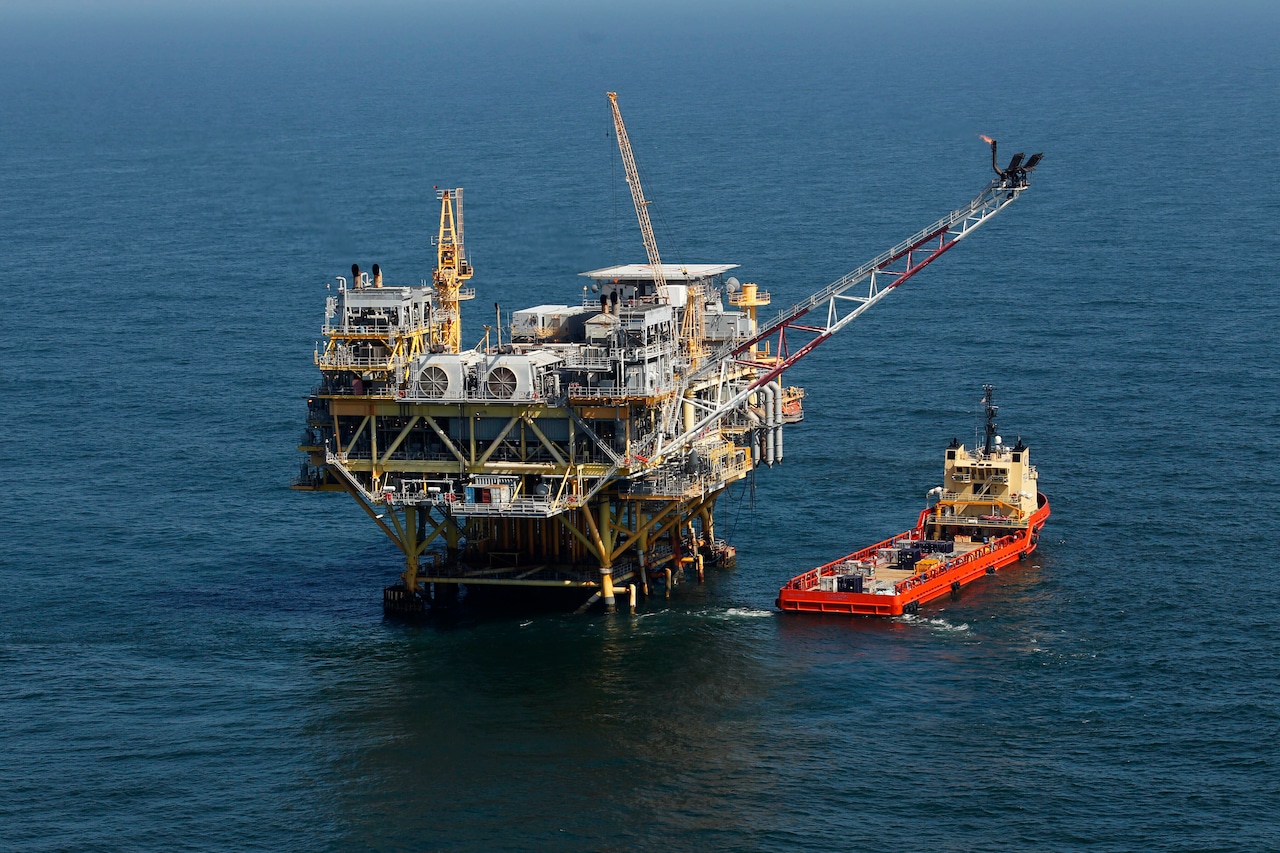
President Donald Trump’s plan to “unleash American energy” will have a dramatic effect on Alabama’s coastline, with new programs that will almost certainly increase the number of rigs off the state’s shores.
It’s a move that environmentalists say puts the coast at risk.
“A single oil spill is all it takes to devastate the healthy waters and clean beaches,” said Megan Huynh, a senior attorney with the Southern Environmental Law Center. “It is not the end of the process, we are going to keep fighting this.”
But state officials herald the expansion as a revenue generator for Alabama and the U.S.
“The 11th National Offshore Leasing Program is a fulfillment of President Trump’s commitment to achieving energy dominance, protecting American jobs, and driving down costs for hardworking families, and it has the support of Senator [Katie] Britt,” said Sam Somogye, a spokesperson for Britt, in an email.
Last month, the Trump administration published the proposed 11th National Offshore Leasing Program, which will provide 34 new offshore lease sales, including seven in the Gulf of Mexico.
The draft proposal is currently open for public comment until Jan. 23, 2026. After the comment period, the proposal will go through more rounds of analysis and refinement until it is approved.
While it’s not clear what areas will be leased under the plan, lease sales are proposed in “Program Area A,” which includes much of the Alabama coast, every year from 2027 to 2031.
For the first time since a 1995 ban, offshore oil and gas leases will be offered in the Gulf off the coast of Florida and the eastern Alabama coast.
Both Republican and Democratic politicians in Florida have fought the development of oil and gas drilling on their side of the Gulf, arguing that the risk of an oil spill jeopardizes their tourism economy, according to the Guardian.
But even more oil and gas drilling is coming to the Gulf, apart from the new leasing program.
On Dec. 10, the Trump administration will hold the first lease sale as part of the One Big Beautiful Bill Act, which mandated 36 oil and gas sales in the Gulf and in Cook Inlet in Alaska by 2040.
As part of the first sale, 32 three-mile-by-three-mile blocks will be offered for lease just a few miles from the coast of Fort Morgan and the Bon Secour National Wildlife Refuge. Many other blocks off the coast of Alabama will also be offered.
In order to keep the coastline view free of obstructions, the U.S. Bureau of Ocean Energy Management (BOEM) will determine where fixed structures, like oil rigs, will be placed in the area off Fort Morgan, according to a map of the lease sales.
But the lease sale first has to survive a legal challenge. Last week, a coalition of environmental groups, including New Orleans-based HealthyGulf, filed a lawsuit against the federal government, alleging it did not conduct the proper environmental review before moving forward with the lease sale.
The case remains pending in federal court in Washington, D.C.
A second lease sale as part of the “big beautiful bill” will be held in March 2026, when 15,000 lease blocks will be available for lease throughout the Gulf. Sales for oil and gas leases in the Gulf will be held twice a year, every year until 2039, according to a news release from the U.S. Department of the Interior.
“Joe Biden’s failed administration simultaneously weakened our economy and national security by engaging in an all-out war on American energy production,” Somogye said. “The imposition of suffocating rules and regulations stifled job creation and drastically stunted coastal economic development.”
Alabama officials say the increased development of offshore oil and gas drilling in the Gulf brings more revenue to the state through the Gulf of Mexico Energy Security Act (GOMESA), which shares a portion of the revenue generated by the leases with the Gulf states, including Alabama.
“We are supportive of the lease sales in federal Outer Continental Shelf (OCS) blocks in federal waters,” said Chris Blankenship, commissioner of the state department of conservation and natural resources. “Funding received by the federal government for these lease sales is shared with the four producing Gulf states through the GOMESA revenue sharing program.”
This year, $2.5 million in GOMESA funds were allocated to sink the Argosy casino boat to create an artificial reef habitat for marine life, for example.
But even beyond the risk of another catastrophic oil spill such as the 2010 Deepwater Horizon spill, offshore oil and gas drilling increases air and water pollution, alters seismic activity, and creates more industrialization in coastal communities, Huynh said.
Increasing the amount of offshore oil and gas drilling in the Gulf puts the whole ecosystem, and the people who rely on it for fishing, recreation, tourism and other industry, at risk, she said. The Gulf of Mexico, which is home to 20 endangered species, is a particularly biodiverse ecosystem worth protecting, she argues.
“The communities most affected by drilling strongly oppose it,” Huynh said. “There’s a lot at stake here.”