
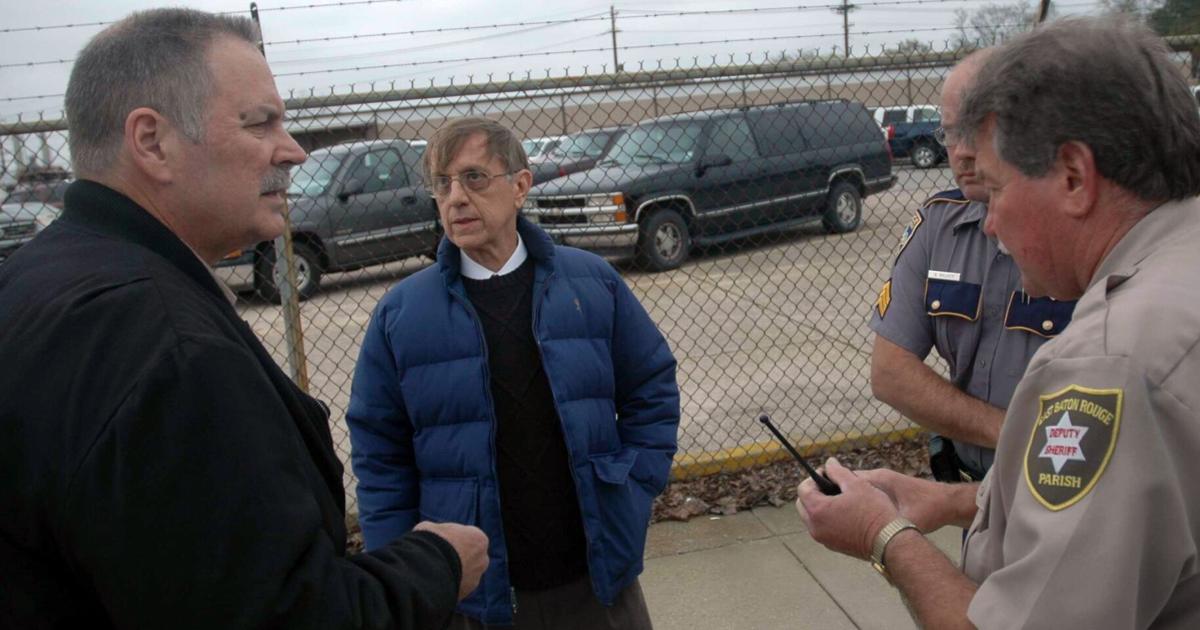
William “Willie” Fontenot somehow became an environmental activist with real power in Louisiana — no small feat in a state that has long embraced the oil and petrochemical industries.
That power was eventually taken away, but not before Fontenot forged a lasting legacy working on behalf of Louisiana communities. He is now being remembered for those efforts, with the renowned environmental activist who held a unique role in state government having died on Nov. 23 at his home in Baton Rouge. He was 82.
His career intersected with a period of Louisiana’s history when, under an environmentally minded attorney general, Fontenot was tasked with organizing community groups and helping them leverage state powers to confront polluting industries. That was a position that was created for Fontenot, and one that would not be filled after he was forced out of his job in 2005 following a tense interaction with law enforcement outside an Exxon refinery.
“As far as I can tell I have the only job in any governmental agency where part of my job is to go out and help organize citizens,” Fontenot said in a recorded interview. “It sounds like maybe it’s the only job like it in the world.”
He found community and common cause in the environmental movement, which was his political home for more than five decades. He got his start with the Sierra Club’s chapter in New Orleans, where he focused on issues related to coastal wetlands. In Baton Rouge, he worked with the Louisiana Wildlife Federation, starting in 1975.
Then, under Louisiana Attorney General William Guste, he worked as an environmental community liaison — a job that was created in 1978 specifically for Fontenot — organizing communities facing environmental problems.
“Attorney General Guste said, ‘The citizens need some help dealing with environmental problems, how to file a complaint, how to figure out what their problems are, how to work with public officials and the news media,’” Fontenot told The Times-Picayune in 2005.
“He put his whole heart into his work,” said Marylee Orr, the executive director and a co-founder with Fontenot of the Louisiana Environmental Action Network (LEAN).
He seemed to know everyone in the environmental space, and everything about local environmental issues.
“He was like Wikipedia before they had such a thing,” Orr said.
‘Such an effective advocate’
But the political tides shifted, and in 2005, Fontenot was pushed out of the position he had held for 27 years.
He had recently taken a group of students on a community tour near the ExxonMobil refinery in Baton Rouge that exploded on Christmas Eve in 1989, killing two workers and injuring four others. For years, Fontenot led tours near industry sites in Louisiana. But that day, guards confronted the group and told Fontenot to collect the students’ drivers’ licenses. He refused.
Two weeks later, the attorney general, Charles Foti, Jr., gave Fontenot a choice: He could retire or face disciplinary hearings that would lead to his firing.
“He was such an effective advocate and community organizer,” said Billy Goodell, an attorney who worked alongside Fontenot at the attorney general’s office. His firing was “pure politics,” he added.
The role Fontenot vacated would not be filled. It existed for him, and only him. He had served in the role under three attorneys general.
“We don’t have anybody like Willie now in government. We haven’t had anyone like that for a long time,” said Audrey Evans, who worked alongside Fontenot as a community outreach coordinator with the Tulane Environmental Law Clinic.
“What we lose with him, if we don’t remember that there ever was someone like Willie Fontenot in the state government, is the concept that the government could even serve the function of helping people to understand what to do when they’re faced with an environmental situation.”
‘Focused on solutions’
But neither his firing from the AG’s office nor the loss of his sight kept Fontenot from environmental justice work. The Opelousas native continued to advocate alongside the Sierra Club and LEAN, and advised communities that sought his expertise.
Indeed, for the last three decades of his life, Fontenot was legally blind, suffering from a condition that caused him to lose sight in the center of his field of vision. But somehow, he always seemed to know exactly where he was, his family and friends said.
After Fontenot could no longer drive, his son, Jacques, got a special driver’s license at 13 that allowed him to ferry his father to and from community meetings.
“We were driving over the Atchafalaya Spillway on the interstate — you know, along that road, everything looks the same, right?” said Jacques Fontenot. “He said, ‘In a mile, there’s going to be a cypress tree off to the right with a square cut in it.’”
Someone, years prior, had cut into it to make a jewelry box, Fontenot told his son.
“In one mile, there it was,” his son said. “People would get lost, and think, ‘Man, I wish we had that blind guy around to direct us.’”
In much the same way that he was able to find his way in the landscape with a kind of oracular second sense, those close to him described Fontenot as able to steer the energy of the environmental movement in the state over his long career as an activist. He was a modest and calming presence, someone who didn’t get overwhelmed in the face of adversity, and with a slow persistence, made change.
“I never, ever heard my dad complain about industry, about the people who he was working against,” said his daughter, Dona Fontenot. “He didn’t fixate on the problem. He focused on solutions.”
A celebration of life will be held Sunday December 28, from 1 to 3 p.m. at The Guru, in the Circa 1857 complex at the corner of Government and 19th Streets in Baton Rouge.