
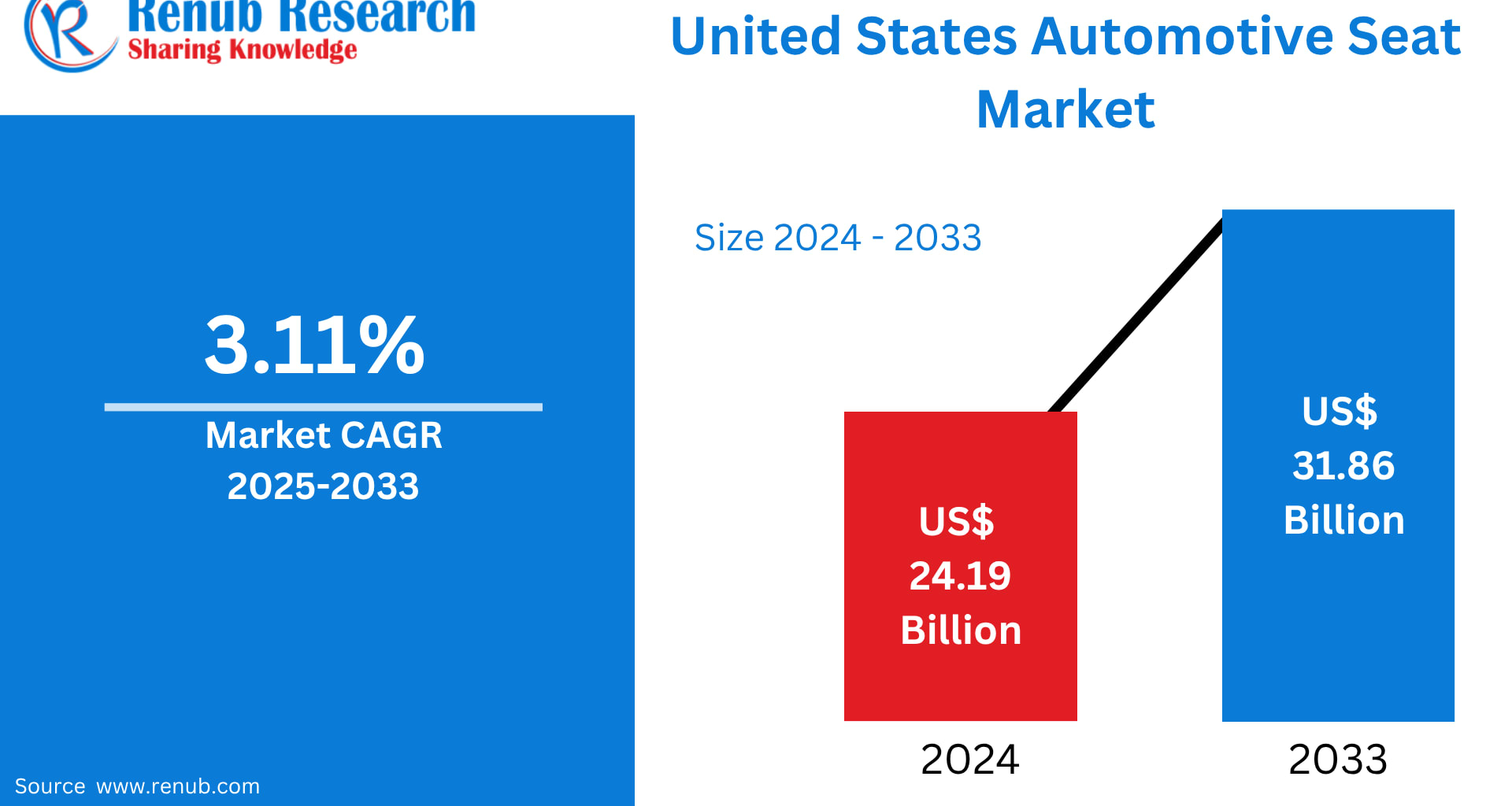
The United States Automotive Seat Market is anticipated to reach US$ 24.19 billion in 2024 and expand to US$ 31.86 billion by 2033, according to Renub Research. This represents a steady CAGR of 3.11% during 2025–2033, underscoring how comfort, safety, and high-end technological features have moved from desirable add-ons to essential elements shaping vehicle purchase decisions.
As America accelerates toward electrification, automation, and the next era of in-car experience, the car seat—once a simple fixture—is transforming into a complex engineering product packed with ergonomics, electronics, intelligent sensors, and sustainable materials. Today’s U.S. consumers expect their vehicles not just to move them, but to support posture, monitor health, enhance long trips, reduce fatigue, and ultimately deliver a luxury experience even in mid-range models.
This deep dive explores the key drivers, disruptions, segments, regional dynamics, and leading players redefining the United States automotive seat landscape.
United States Automotive Seat Market Outlook
At its core, an automotive seat serves one purpose: to provide comfort, safety, and proper posture for drivers and passengers. But the definition of comfort has evolved dramatically.
Modern U.S. automotive seats are engineered with:
Heated & ventilated systems
Lumbar support & multi-axis adjustability
Memory functions & driver profiles
Embedded airbags, pressure sensors, and bolster controls
Massage and fatigue-reduction systems
Smart fabrics and cooling/heating perforations
In addition, seats now integrate directly with airbag modules, seatbelt pretensioners, and advanced driver-assistance systems (ADAS), making them a crucial safety component.
As Americans spend more time commuting, road-tripping, and engaging in long-distance travel, ergonomic seat design has become a major differentiator among automakers. The shift toward autonomous and electric vehicles is further accelerating the evolution, emphasizing interior flexibility, cabin comfort, and futuristic seating layouts designed for relaxation and personalization.
Growth Drivers in the United States Automotive Seat Market
1. Rising Demand for High-End Comfort and Safety
U.S. consumers increasingly expect their car seats to behave like smart furniture. Premium features—once exclusive to luxury vehicles—are becoming mainstream as drivers seek continuous comfort.
Key factors include:
Seat heating & ventilation, now standard in many SUVs
Ergonomic lumbar adjustments to reduce strain during long drives
Massage functions, quickly gaining popularity in upper-segment vehicles
Seat-integrated airbags, boosting occupant protection
A major milestone in 2023 came from Lear Corporation, which introduced an intelligent seating system equipped with biometric sensors and real-time health monitoring. This innovation enables seats to track driver posture, temperature, heart rate, and fatigue levels—paving the way for the next frontier in vehicle safety.
2. Growth of Electric and Autonomous Vehicles
EVs and autonomous vehicles place renewed importance on interior comfort and flexibility. With fewer mechanical components and quieter cabins, interior design becomes a competitive battlefield.
Future-focused seating features gaining adoption include:
Swiveling and rotating seats for social cabin layouts
Zero-gravity recline positions
Fully adjustable rear-seating environments
Smart control panels integrated into armrests
The autonomous vehicle segment is especially influential. In July 2025, Waymo expanded its driverless taxi operations into Atlanta through a partnership with Uber, providing rides across a 65-square-mile zone. As these vehicles expand nationwide, seating will transition from “driver-first” to passenger-focused engineering—boosting demand for luxurious, multi-position smart seats.
3. Increasing Vehicle Production and Steady Sales Growth
The U.S. automotive industry is regaining momentum, driving parallel increases in seat manufacturing demand. SUVs and luxury cars—both of which feature advanced seating technologies—dominate consumer preferences.
According to S&P Global Mobility, U.S. auto sales reached 1.27 million units in June 2025, helped by strong inventory and consistent demand. As production rises, automakers are expanding seating specifications to maintain competitive branding and improve in-car experience.
Market Challenges and Disruptions
1. High Production and Raw Material Costs
Advanced seating systems require:
High-strength lightweight composites
Smart fabrics
Leather alternatives
Embedded electronics
Multi-motor adjustment systems
These materials significantly increase production costs. For manufacturers balancing innovation with affordability, the challenge is maintaining competitive prices without compromising quality or features.
2. Regulatory Compliance Pressures
U.S. crash safety and environmental regulations are among the strictest globally.
Manufacturers must address requirements such as:
Seat anchor strength
Side-impact airbag integration
Flame-retardant materials
Recyclability and sustainability mandates
Constant R&D investment is required to remain compliant, often delaying product cycles and increasing costs.
United States Automotive Seat Market — Segment Analysis
1. Bucket Seats
Bucket seats continue gaining popularity in:
Sports cars
Luxury sedans
Performance SUVs
Designed for lateral support, these seats boost stability during acceleration and cornering. Their sporty appeal and ergonomic benefits make them a prominent differentiator in high-performance models.
2. Passenger Car Seat Market
Passenger cars—spanning sedans, crossovers, and compact SUVs—form the largest segment of the U.S. automotive seat market.
Key trends include:
Broader adoption of memory seats
Enhanced side bolsters
Climate-controlled seating
Greater integration with vehicle infotainment systems
Consumers increasingly expect premium features even in mainstream vehicle trims.
3. Electric Automotive Seat Market
Motorized seats equipped with:
Height and recline adjustments
Multi-point lumbar control
Memory modules
are rapidly growing as EV sales surge. Automakers now widely include electric seats as standard in mid- and high-tier trims, boosting demand across the nation.
4. Powered Seats
Powered seats—offering motorized multi-directional adjustment—are becoming ubiquitous in American vehicles. They are especially dominant in:
SUVs
Pickups
Premium sedans
These seats often come with heating, cooling, massage, and memory features, aligning with demand for personalized comfort.
5. Standard Automotive Seats
Despite technological advances, standard seats remain essential for:
Entry-level models
Commercial fleets
Budget-conscious consumers
They prioritize:
Durability
Basic ergonomics
Regulation-compliant safety
This segment continues to maintain stable demand due to its role in the commercial and economy vehicle sectors.
Regional Market Insights
1. California
California represents one of the biggest and most advanced automotive seat markets in the nation. Drivers prioritize:
EV-friendly designs
Sustainable materials
Luxury comfort features
Given its progressive automotive culture and high EV penetration, manufacturers tailor seats with tech integration and premium ergonomics to meet consumer expectations.
2. Texas
Texas, with its huge appetite for pickups, SUVs, and family vehicles, demands:
Durable seats
Spacious layouts
High comfort for long-distance travel
Texans value practical, rugged, yet comfortable seating—making the state an important market for powered, ventilated, and heavy-duty seat designs.
3. New York
Cold winters and a robust luxury-vehicle culture shape New York’s seating preferences:
Heated front and rear seats
Smart controls
Premium upholstery
Urban consumers also seek compact but high-comfort seating in city vehicles.
4. Washington
Washington’s tech-driven population and strong EV adoption rates make it a thriving market for:
Eco-friendly seat materials
Smart seating systems
Electrically adjustable seats
Sustainability and technology are primary purchase drivers in the state’s automotive segment.
Market Segmentation Overview
Seat Type: Bucket, Bench, Others
Vehicle Type: Passenger Car, Commercial Vehicle
Energy Source: Gasoline, Diesel, Electric, LPG
Technology: Powered Seats, Standard Seats, Ventilated Seats, Others
Top 10 States: California, Texas, New York, Florida, Illinois, Pennsylvania, Ohio, Georgia, Washington, New Jersey
Key Players in the United States Automotive Seat Market
Each company below is evaluated on: Overview, Key Person, Recent Developments, SWOT Analysis, and Revenue Outlook.
Aisin Seiki Co. Ltd.
Gentherm Incorporated
IFB Automotive
Magna International Inc.
Tata Autocomp Systems Limited
Grammar Seating Systems
Adient Inc.
Lear Corporation
Toyota Boshoku Corporation
These players collectively shape innovation across comfort, safety, sustainability, smart technologies, and manufacturing efficiency.
Final Thoughts
As the U.S. moves toward a future where vehicles function as mobile living spaces, workstations, and entertainment hubs, automotive seats will become one of the most important competitive battlegrounds. Comfort is no longer a luxury—it’s an expectation. Safety is no longer passive—it’s proactive. And design is no longer about aesthetics—it’s about intelligent ergonomics, smart sensors, and personalized experience.
Between EV growth, autonomous technology, advanced manufacturing, and shifting consumer preferences, the United States Automotive Seat Market is set for meaningful transformation through 2033. With its expected rise to US$ 31.86 billion, the industry stands at the center of innovation shaping America’s next generation of mobility.