

The Athletic has live coverage of the FIFA Men’s 2026 World Cup draw.
Finally here we are — World Cup draw day. This is the point at which excitement for next summer’s World Cup goes up another level as we get to see the paths countries must take as they bid for glory in the United States, Mexico and Canada.
Amid all the pomp and glitz FIFA can muster, onlookers around the world will tune in to find out which groups their teams are in, and what matches they can look forward to.
Below is a handy guide to what’s going on in the U.S. capital, Washington, D.C., on Friday. And if you’re new to the World Cup — or even to the sport itself — we have all your questions answered here.
What time is the draw and how long will it take?
The draw takes place at 12pm ET (9am PT; 5pm GMT) on Friday and is expected to last for two hours.
What else do I need to know about it?
FIFA has assembled a star-studded cast to host the event. Comedian Kevin Hart, model Heidi Klum, and actor Danny Ramirez will be on stage, while there will be live performances from Italian tenor Andrea Bocelli, along with pop stars Nicole Scherzinger and Robbie Williams.
North American sporting icons Tom Brady, Eli Manning, Wayne Gretzky, Shaquille O’Neal and Aaron Judge will help conduct the draw, which will be led by former Manchester United and England player Rio Ferdinand, alongside host Samantha Johnson.
FIFA president Gianni Infantino will be overseeing proceedings, but with U.S. President Donald Trump also expected to be present, it is possible he too will be involved.

FIFA president Gianni Infantino will oversee proceedings (Tasos Katopodis – FIFA via Getty Images)
All this will take place at the John F. Kennedy Center for the Performing Arts in Washington , D.C., on the banks of the Potomac River.
A record 48 competing countries will be split into 12 groups of four for the group stages. Before the draw, teams will be seeded and divided into four pots based on their FIFA rankings as of November/December 2025. The three host countries will join the highest-ranked FIFA teams in Pot 1.
What might the groups look like?
Imagining what the draw might look like is half the fun — you can see what some of the potential outcomes are using our interactive tool here.
We know 42 of the 48 qualified teams, but there are still play-offs to come in March, so even once the draw is done, we will not know exactly what every fixture will look like.
Because Italy are in the play-offs (and the play-off teams go into Pot Four), there is the possibility of a Group of Death. One potential scenario is: Argentina, Morocco, Norway and Italy. That would feature, in order, the World Cup holders, the 2022 semi-finalists, arguably the world’s best striker (Erling Haaland), and the four-time winners who were European champions in 2021.
We delved into what the USMNT’s possible best and worst-case scenarios could be here.
Who are the most unlikely qualifiers?
In October, Cape Verde — which has around 525,000 inhabitants — became the second-smallest country by population ever to qualify for the world’s biggest sporting event.
If that was an unlikely turn of events, then the following month, Curacao achieved an even bigger shock. They became the smallest nation to qualify for a World Cup after a 0-0 draw against Jamaica.
Curacao has a population of 185,487 —the world’s 189th most populous nation, as ranked by Worldometer — and they surpass Iceland (population 398,266), who qualified in 2018, as the smallest nation by population to play in the tournament.
Some other relatively tiny nations may yet join them via the play-offs. New Caledonia (Oceania), Suriname (North America), and Kosovo (Europe) are still in with a chance.
What do I need to know about the play-offs?
Italy’s presence in this mix offers the most potential drama. The draw for March’s European play-offs pitted the four-time World Cup winners against Northern Ireland. If they come through that single-leg home semi-final, they will travel to face either Wales or Bosnia and Herzegovina for their bracket’s final five days later.
The 16 countries in the draw — there either via performance in regular World Cup qualifying or the 2024-25 UEFA Nations League — were divided into four qualification paths. Each path comprises two semi-finals and a final, meaning four teams will emerge with places at the tournament.
Then there are the intercontinental play-offs. For the first time, FIFA has chosen a play-off tournament, taking place on neutral soil. And, after the draw in Zurich (which happened shortly before the UEFA play-off draw), we know a little more about what that competition will look like.
It will take place between March 23 and March 31, 2026, less than three months before the World Cup itself. All the games will be played in Mexico, with matches held in Guadalajara and Monterrey.
There are six teams from five confederations. Two of them — DR Congo and Iraq — were seeded for the draw because they sit higher in the FIFA men’s world rankings than the others. Those teams go directly to the finals of two mini-brackets. The remaining four sides must face off in two single-legged semi-finals to reach that stage.
Jamaica will have to beat New Caledonia in their semi-final, with DR Congo lying in wait.
In the second pathway, Bolivia play a semi-final against Suriname, with Iraq — who have only qualified for one previous World Cup, in 1986 — facing the winner.
Who are the best players to have qualified?
Big tournaments are usually illuminated by the game’s biggest names. Lionel Messi, Cristiano Ronaldo, Haaland, Kylian Mbappe and Harry Kane are just some of the star players who are on their way.
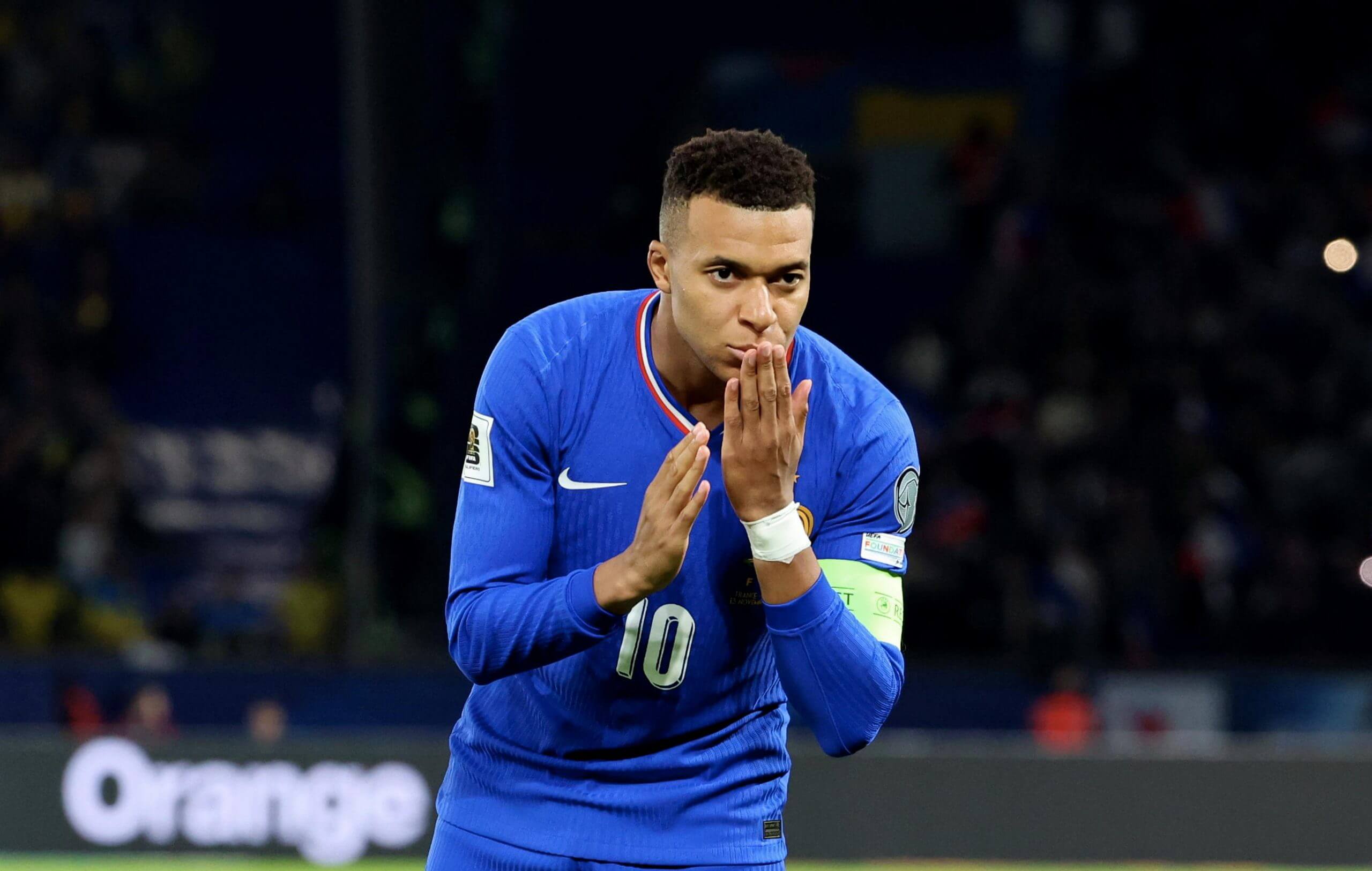
Kylian Mbappe scored a hat-trick in the 2022 World Cup final (Xavier Laine/Getty Images)
There’s also Colombia and Bayern Munich’s Luis Diaz, Liverpool and Egypt star Mohamed Salah, Arsenal and Brazil defender Gabriel, and France and Paris Saint-Germain attacker Ousmane Dembele.
We have ranked the top 100 here.
And after all that, who will win it?
After all this, there will, of course, be one winner at MetLife Stadium in July, and some of The Athletic’s writers have predicted who they think will be hoisting the trophy aloft.
Jack Pitt-Brooke
Winner: Spain
Why? In winning Euro 2024, Spain played a level of football you rarely see in the international game, controlling possession and attacking with the fluidity of a club side. There is no reason they should not be even better next year, as long as Lamine Yamal and his fellow Barcelona youngsters stay fit and fresh for the World Cup.
Jack Lang
Winner: Spain
Why? They have a clearly defined system and players who know it by heart. Their ability to control the ball and the tempo will be a massive advantage in the kind of baking conditions we can expect in the North American summer. The team spirit looks good, with few big egos. They know how to get over the line in a big tournament. There are no obvious issues like there are with all of the other putative contenders.
Felipe Cardenas
Winner: England
Why? Speaking of heart, mine wants to pick Colombia. But a return to the U.S., where in 1994 Colombia experienced failed expectations and tragedy, has me on edge. I think the 2026 tournament will be kind to England. And I believe Thomas Tuchel will lead the Three Lions to glory at MetLife Stadium on July 19. Tuchel has a strong and talented side. He’s also hell bent on proving a point — that he, not his predecessors, can unlock the fragile psyche of the English footballer at a knockout competition.
James Horncastle
Winner: Brazil
Why? OK, so this is primarily a punt on the tournament whisperer. Carlo Ancelotti’s first experience as a coach was at USA 94 when he served as Arrigo Sacchi’s assistant. Italy reached the final in Pasadena, losing to the nation Ancelotti now presides over. If there’s anyone capable of making a team of highly talented individuals even greater than the sum of its parts, it is Ancelotti. He already knows a number of the players from his days at Real Madrid, Paris Saint-Germain and… Everton. Come June, there’s a chance Estevao will go to the World Cup as South America’s answer to Yamal. In Carlo we trust.
Seb Stafford-Bloor
Winner: France
Why? True, they rarely add up to more than the sum of their parts under Didier Deschamps, but France moved smoothly enough through qualifying (unbeaten in a group containing Ukraine, Iceland and Azerbaijan) and will take a formidable squad across the Atlantic next summer. They have so much attacking power and so few obvious weaknesses. Deschamps will omit more world-class players than many of his rivals are able to select.
Greg O’Keeffe
Winner: Spain
Why? Having watched Spain’s imperious stride to Euro 2024 success, beating Germany, France and England along the way, with a squad average age of 27 (a collective peaking nicely into their golden years), it is hard to see La Roja’s dominance ending any time soon.
Their indomitable form in qualifying for next summer has not changed that feeling. A squad with that magical mix of experience, youth and individual brilliance are best placed to cope with the heat and deliver again.
Paul Tenorio
Winner: France
Why? A squad that advanced easily out of European qualifying, France are tournament-proven — winners in 2018 and runners-up in 2022 — and have only added more attacking quality to what was already an overwhelming amount of talent. They have the pedigree to become the first team to get to back-to-back-to-back World Cup finals since Brazil in 2002, and like the Selecao, they will win it for the second time in three tries.
Joshua Kloke
Winner: Spain
Why? This is a bit of an obvious answer, but sometimes the simplest answer is the right one, eh? No elite team has as few questions about them — or has answered recent questions — like Spain. They were ruthless in qualifying, scoring 21 goals in six games and allowing just two. Their Euro 2024 win should have them humming with confidence in a tournament setting. Oh, and they toppled France and England, two other teams listed here, en route. Spain can move the ball with fluidity in a way few other international sides can and also look suited to deal with the summer heat.
Oliver Kay
Winner: France
Why? In truth, it feels wide open, but France are one of the few squads with the right combination of established top-class players, experienced campaigners and emerging stars. I really thought Zinedine Zidane would take over for the 2026 World Cup campaign — perhaps he still will — but Deschamps is no fool. I’m just fascinated by how Mbappe, having struggled at Euro 2024, handles the responsibility and pressure he will face as an outstanding player at possibly the peak of his powers. It’s never as easy as it looks.
Henry Bushnell
Winner: Colombia
Why? As Oli said, it’s wide open, so… why not take a chance on a first-time winner? The Colombia hype cooled when they labored through the latter half of the CONMEBOL qualifying gauntlet, but their run to the 2024 Copa America final — and their two-year, 28-match unbeaten run that was ended, narrowly, by Argentina in that final — is more indicative of this team’s quality. They’ll also have excellent fan support in the United States. They won’t be bothered by searing heat. They should, at the very least, be considered among the top contenders.
Stu James
Winner: France
Why? I gave serious consideration to Spain and Colombia, whose performances at the Copa America in the U.S. last year were hugely impressive. But the depth of talent in the France squad is astonishing, in particular when it comes to attacking players who can produce individual moments of brilliance that win matches — that’s a long list before you get to Mbappe. Spoilt for choice is an understatement, which, of course, will also be a challenge for Deschamps to manage.
How can I watch the draw?
It will be live on FIFA.com and on FIFA’s YouTube channel. In the U.S., viewers can tune into Fox and Fubo, while in the United Kingdom, it will be broadcast on the BBC and BBC iPlayer. In Canada, it will be shown on TSN. In Australia, the draw will be broadcast on SBS and SBS On Demand.