
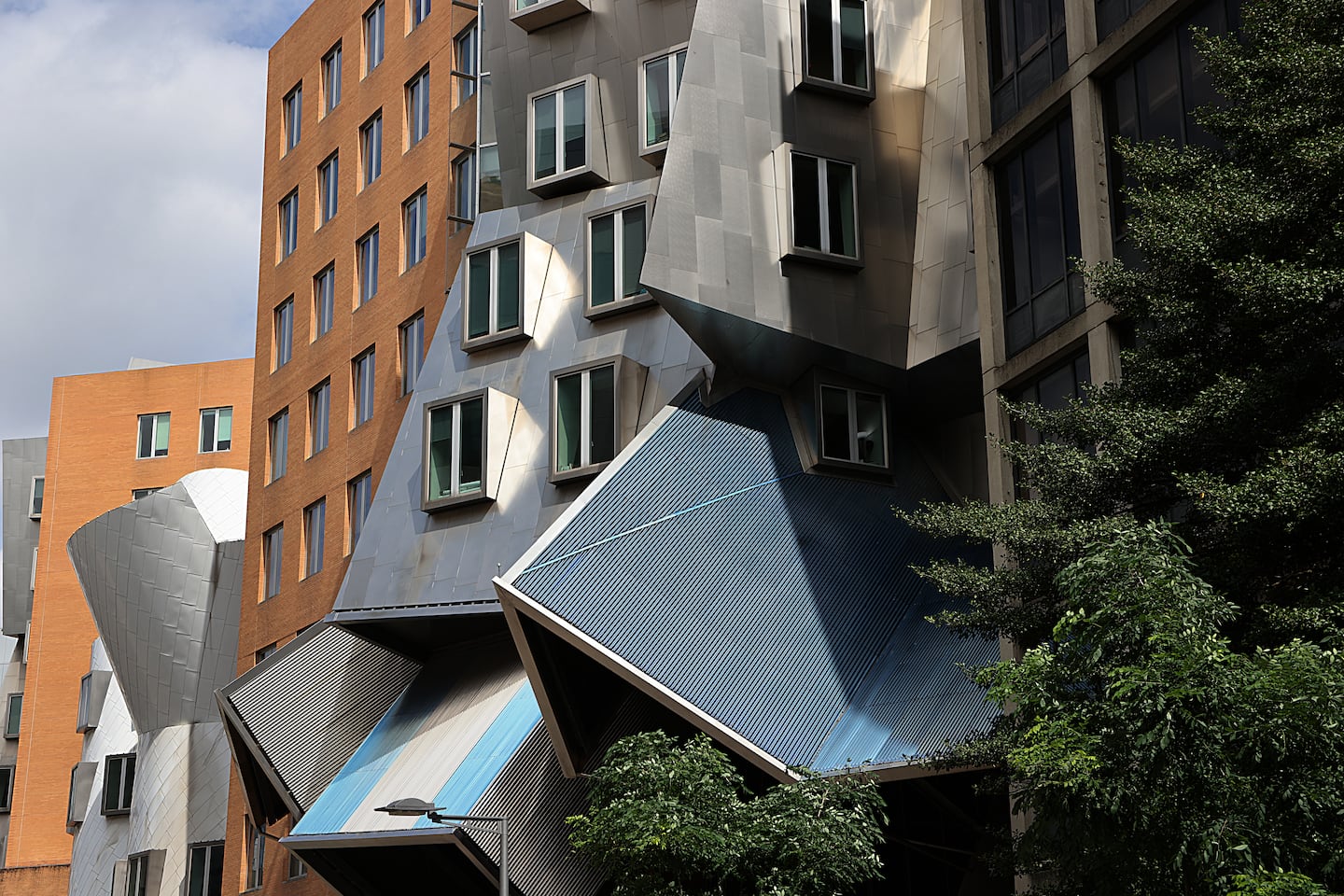
A lot, according to MIT’s website.
“The Stata Center has five classrooms, a cafe/food court, a pub, an athletic facility and a 350-seat auditorium,” the site says.
The center also houses MIT’s Laboratory for Information and Decision Systems and the Department of Linguistics and Philosophy, according to the site.
The Stata Center opened in 2004, according to MIT.
The school’s website says that at the time of its opening, then-Boston Globe architecture critic Robert Campbell lauded the structure as “a work of architecture that embodies serious thinking about how people live and work, and at the same time shouts the joy of invention.”
What are its dimensions, and what’s it made of?
A Quonset hut the center is not.
According to MIT, the Stata facility “occupies 720,000 square feet and 2.8 acres, and is made of 2.6 million pounds of steel and 1 million bricks.”
The year after it opened, the building received the American Council of Engineering Companies’ Grand Award for Engineering Excellence and the Gold Award for Sustainable Site Design, per MIT.
The school says the Stata’s “striking design” includes “tilting towers, many-angled walls, and whimsical shapes” that challenge “much of the conventional wisdom of laboratory and campus building.”
Where’s it located on campus?
The Stata Center is built on the foundation of MIT’s “legendary Building 20,” the school says on its website.
Building 20, dubbed MIT’s “Magical Incubator,” opened during World War II to house a radiation lab, and “it’s here that MIT engineers refined the development of radar and helped win the war,” the site says.
Has the building had any issues?
Yes.
In 2008, MIT sued Gehry, claiming that planning and construction flaws resulted in leaks and cracks in the $300 million Stata Center.
Gehry said the problems were minor and to be expected in a complex structure, and the case was “amicably resolved” in 2010, said a joint statement at the time from MIT, Gehry and the builder, Skanska USA Building Inc.
More recently, vandals in July defaced the building by spray painting the phrase “Death to the IDF” on an entrance to the center, in reference to the Israeli armed forces, amid protests of the war in Gaza.
Following the July vandalism, MIT said it was stepping up campus security and collaborating with the FBI to investigate the message.
No arrests have been made.
Material from Bloomberg and from prior Globe stories was used in this report.
Travis Andersen can be reached at travis.andersen@globe.com.