
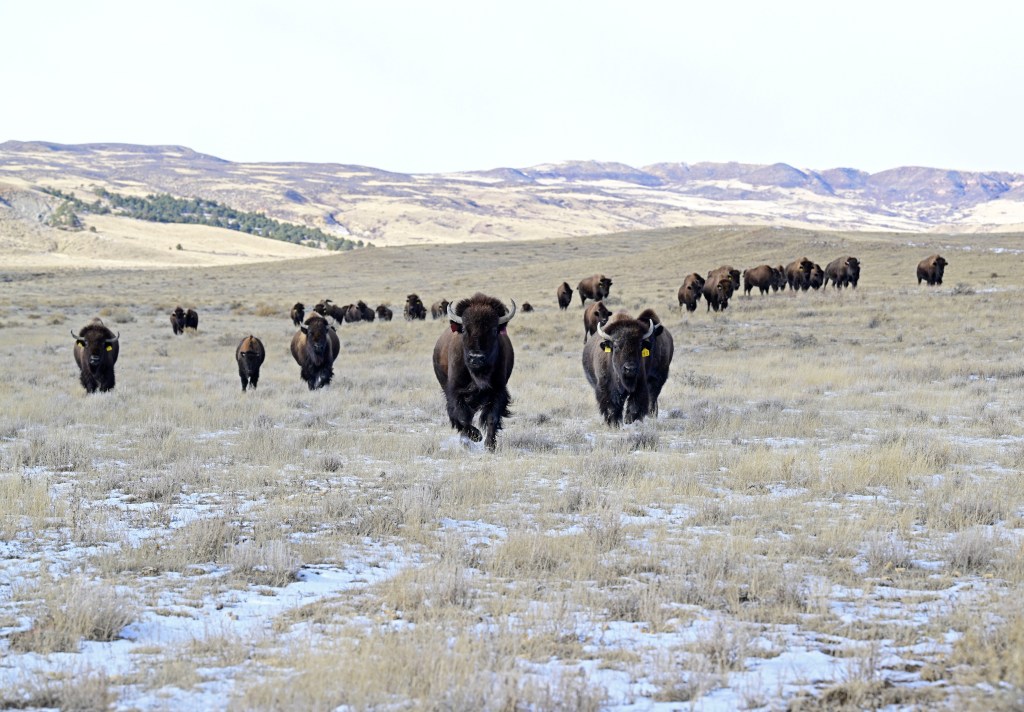
Centuries ago, herds of bison roamed the Great Plains, numbering in the tens of millions. One of the most populous mammal species in North America, enormous herds of the animals grazed and migrated across huge stretches of grasslands and provided one of the primary sources of food, hide and bone to countless Native American tribes throughout the region.
By the end of the 19th century, the American bison had declined to near extinction, in part due to killing by Americans intended to deprive Native people of their traditional source of sustenance in an effort to force them to reservations.
The species has rebounded since then — in part due to a thriving agricultural industry that raises bison as a beef alternative, but those animals have interbred with domestic cattle, becoming something of a distinct animal that bears less and less resemblance to the creatures that roamed the plains prior to the Civil War.
Yellowstone National Park was one of the only places in the United States where purebred — or at least the purest bison come these days — remained, but that small herd was relegated to their sanctuary because of a rampant case of brucellosis, a bacterial infection that affects livestock, wildlife and sometimes even humans.
That infection presented an obstacle to breeding or transferring bison from that herd.
A decade ago, Colorado State University researchers, conservationists at the city of Fort Collins and Larimer County and the United States Department of Agriculture collaborated to create a new herd, purebred and free of the affliction that ravaged their northern cousins.
Research helped pave the way for the bison to be reintroduced into the country elsewhere and created a “seed herd” in Larimer County, shipping healthy animals across the country to public and private herds and, perhaps most notably, tribal lands, so that the rulers of the plains can once again begin to roam the land as their forebears did.
A bacterial puzzle
Brucellosis is a somewhat rare ailment in livestock, typically causing infertility and weak, unhealthy offspring, according to the USDA. A zoonotic disease, brucellosis can spread to humans as well, often by consuming contaminated products such as milk from infected cows or other animals, or by handling those animals’ corpses, such as in slaughter houses or while hunting.
The USDA reports that the most common sources of brucellosis are wildlife in the Greater Yellowstone Area, largely bison and elk, two populations that it describes as “the last remaining reservoir of the disease in the United States.”
The rampancy of brucellosis in Yellowstone bison made spreading that herd a challenging task.
Jennifer Barfield, professor of reproductive physiology at Colorado State University, was first in touch with USDA officials as part of a research effort to produce healthy bison calves unaffected by the bacterial infection.
Her technique applied the same basic principles used in human infertility treatment to bison. The process had also been used on livestock but had never been tried on wild bison.
“There are ways that we can handle the sperm, the eggs, the embryos, to minimize the potential for disease transfer when there’s bacteria around those sperm, eggs and embryos, but not in them,” she said. “So we started applying these techniques that had been commonly used in wildlife to prevent the spread of disease, and we started doing that with bison, and we had some success.”
Once that breakthrough had been made, a simple question arose, she said.
“Once we had that research success, we started wondering: ‘We have these calves, what do we do with them? What could we do with them?’” Barfield said. “That was when we started, through our partnership with the folks at USDA, talking with the folks at the city of Fort Collins and later Larimer County, and realized we had the opportunity to create this conservation herd.”
Bison back in Northern Colorado
CSU kept a small group of 10 calves in relatively small pens on its Foothills Campus between Fort Collins and Horsetooth Reservoir, but that served as insufficient space as the animals grew.
The missing link, according to Larimer County Land Conservation, Planning & Resource Manager Meegan Flenniken, was land, and a lot of it.
Local governments had the answer.
The city of Fort Collins owned the Soapstone Prairie Natural Area, and Larimer County owned the adjacent Red Mountain Open Space, two conserved properties on the southern side of the Colorado-Wyoming border, and acres for a bison pen, now totaling 2,700 acres, were set aside for the small herd to grow, finally being released to the wild Nov. 1, 2015.
And grow it has, although the numbers on this specific plot of land have grown and waned.
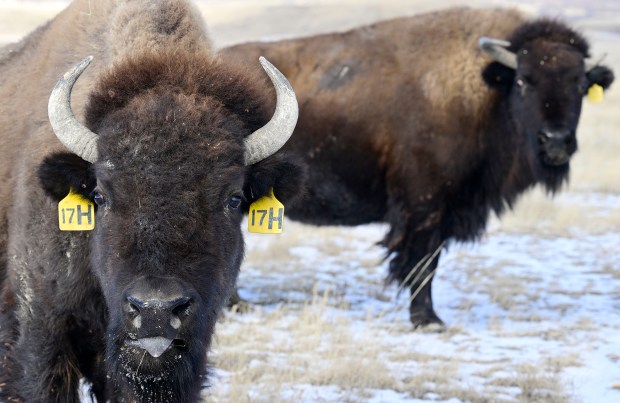 Bison cows graze in a field Friday at Soapstone Prairie near Wellington. They are part of the CSU purebred bison herd that has lived on the prairie for 10 years. (Jenny Sparks/Loveland Reporter-Herald)
Because it is a “seed herd,” the bison project’s architects and managers have endeavored to send healthy purebred bison across the country, now around 200 over the last 10 years, supplementing existing herds and establishing new ones to help bring about a return of the hulking creatures to their natural habitat, in the form they took before their numbers were decimated by white settlers over a century ago.
The steady removal of bison from the herd to build their own families across the country also had the effect of ensuring that the existing Larimer County habitat has plenty of resources for the bison living there at any given time.
“It’s vacillated over time,” Flenniken said of the Larimer County herd. “It grew to over 100 at one time, and then during drought years we reduced the herd, just to stay within the carrying capacity of the grasslands up there. But the real intent is to propagate the heritage genetics and to send bison to other conservation herds around the United States.”
The reasons for adding purebred bison to conservation herds across the nation vary. Some are seeking to improve the landscape of their areas, while others, namely tribal lands, have a cultural reason for returning these animals to the lands they once called home.
“For many communities it can be revitalization of the land, it can be cultural revitalization for tribes, connecting youth back to their traditional ways,” Barfield, the CSU scientist, said. “I think all of those are really important for the spirit of people, you know? Being able to appreciate how interconnected we all are. Bison are keystone species ecologically, but they’re keystone species spiritually too.”
Family unit
There are currently 59 bison — 29 adults and 30 calves — in the pasture that the herd has called home for the past 10 years. About once a week, Matt McCollum, bison manager for Colorado State University, makes the drive north in the “Bison Truck,” a charmingly ramshackle SUV covered in mud, dirt and bison saliva bearing two shattered lenses on its taillights after various bison-related mishaps. Either he or CSU students head up to the prairie periodically to supplement the pasture’s natural grass and shrub with hay, ensure that water sources aren’t frozen over in winter months, and otherwise tend to the herd while maintaining as natural an environment as possible.
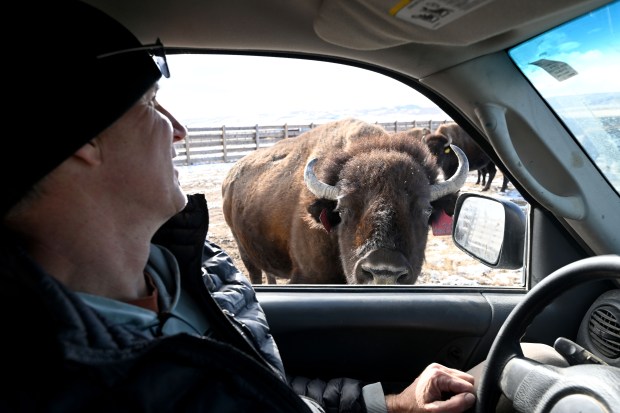 Matt McCollum, the bison manager for Colorado State University, laughs as a bison cow approches his driver’s side window Friday at Soapstone Prairie near Wellington. McCollum was checking in on the cows and calves in the CSU purebred bison herd that has lived on the prairie for 10 years. (Jenny Sparks/Loveland Reporter-Herald)
As he approaches the herd from the east, he comes to a stop and lays on the Bison Truck’s horn, a recognizable sound for the animals, which begin to shamble toward a familiar face.
Their ambling turns into a gallop as he exits the vehicle and shakes a bag of dense pellets of grain and vitamins affectionately dubbed “cookies,” like a 30-pound bag of dog treats. They cover the intervening few hundred yards in seconds, swarming the car like anxious pets hoping for a tasty snack, and McCollum quickly obliges, tossing handfuls of cookies to the eager bovines.
“Hi, Fifty,” he says with the same inflection one would use with a beloved pet, as a female bison that has been a part of the herd since its inception 10 years ago shoves her enormous head through his driver side window in search of the goodies within.
“If you’ve ever been to Red Mountain Soapstone, you can look out over that prairie and for the most part you can’t really see houses or things that interrupt that viewshed,” Flenniken said. “So when you go out and see bison on that landscape, it looks and feels, probably, very similar to how it felt 150 years ago when they were common and wild.”
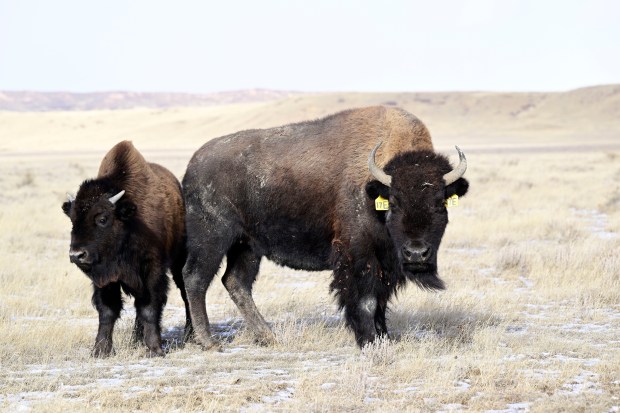 A bison cow and calf stand near each other Friday, Dec. 5, 2025, at Soapstone Prairie in Wellington. They are part of the CSU purebred bison herd that have lived on the prairie for 10 years. (Jenny Sparks/Loveland Reporter-Herald)