
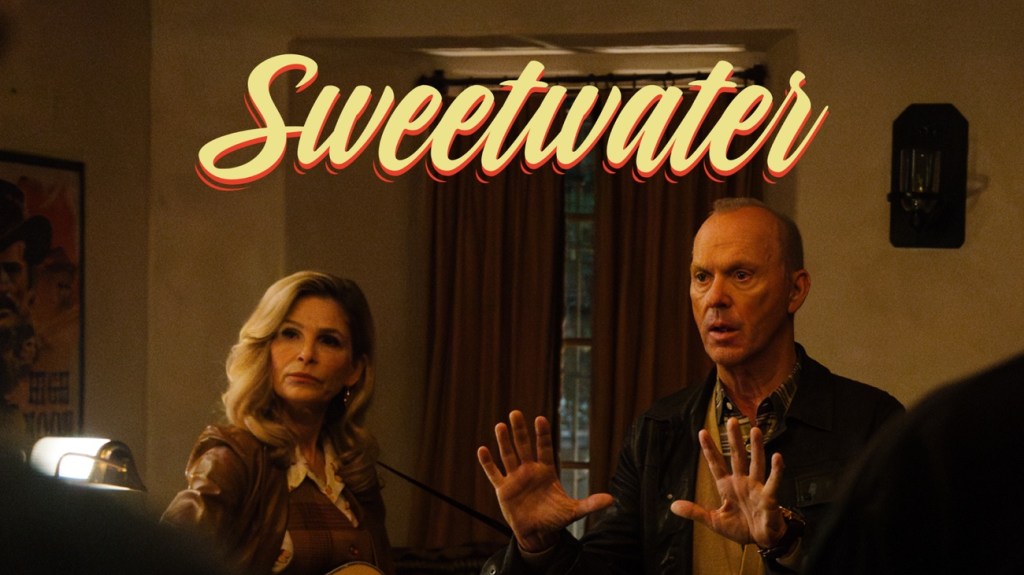
The complex conversation over artificial intelligence’s growing prevalence in the industry continues. But at least this time, songwriter-producer turned screenwriter Sean Douglas has thrown his hat into the ring in a more nuanced way. In Sweetwater, written by Douglas and directed by his father, Michael Keaton Douglas, the 21-minute film asks whether new-age technology can offer humans a healthier alternative to work their their grief after a love one has passed.
The film follows Robert (Keaton Douglas) as he returns to his childhood home to prepare it after putting it up for sale. However, during cleaning, he is greeted by an AI recreation of his celebrity mother, Bettie (Kyra Sedgwick), who is trained solely on publicly available information on the internet. Amidst grieving the loss of his beloved mother, the AI interactions he has with her cause him both discomfort and a modicum of relief. Below, Douglass and Keaton Douglas talk with Deadline about partnering with Google’s AI on Screen program, balancing drama with science fiction and inspirations behind the short film.
DEADLINE: Sean, where did the idea of the short film come from?
SEAN DOUGLAS: Google was starting this initiative called AI on Screen. The idea was open-ended. It was just like, “We want to see AI stories, the what-if, speculative fiction things, of what could come with this technology and how it is going to enter people’s lives,” not sunshine-and-roses, color-glasses type stuff necessarily. I like science fiction, so I had this idea about a guy who returns to his childhood home, which is almost like a mini-Graceland, but it’s been dedicated to his celebrity mother, who was a mid-century actress and entertainer. He has to reckon with the duality of what this place is, and that’s a place that he shared with his mother and with the public. Then, I thought about what if he gets this strange, mysterious gift from another fan abroad who has made this AI projection [hologram] of his mother, and now he has a very surreal experience talking to her.
DEADLINE: You’ve done a lot of work in the music composition space, but this is your first time writing a film. Talk a bit about the challenge of that?
DOUGLAS: Well, it’s the first thing I’ve made that has come out. I’ve been spending more time screenwriting over the past couple of years. I have a feature that’s in the middle of packaging right now, and a TV thing that is being developed. This was the first one to come out, and it was a great experience. It’s nice. It’s so different from music, and it’s nice to have a change.
My dad and I were talking about this the other day, and a lot of the process of creating this involves a lot of big questions in the background. It raises many questions about the future, and we only get a 20-minute slice of the story. I think it’s challenging to make this little jewel box of a thing, where you get enough information and leave enough mystery and have enough of an arc between these two characters. But the most rewarding part is when you get to the end of the movie, and you’ve made that journey with the characters in a short time. That’s pretty satisfying.
DEADLINE: You’ve directed two feature films. What’s the difference between that and your first time directing a short film?
KEATON DOUGLAS: I don’t think I’m alone in saying this. I have some friends who are quite established and well-respected novelists, and both have told me how difficult it is to be a really good short story writer. It’s only easier in the sense that, when someone tells you, “Here’s the job, do this by a certain time,” it gives you a stronger sense of responsibility because there’s the pressure to listen to your employer. Luckily, Sean is a great writer, and I started telling him how I saw the story as a set number of minutes, and there was more story in his script than he thought. We only had two and a half days to get this done.
I like to think about that in terms of mileposts. Dustin Hoffman – sorry for the name-dropping – told me to pay attention to mileposts. Mileposts of the performance about where your character is and where the story is by certain points throughout any given project. So, I kept looking and saying, “OK, right here, we should be about there in development.” Or “Man, this can’t be however many amount of minutes long, so we have to think about this on a practical level.” We really had to get into the nitty-gritty about how to use this limited amount of time and make it something effective and good. So, we didn’t make too many cuts, but we reshaped some stuff we had to lose, and Sean was excellent about that – because writers can get very precious.
DEADLINE: A lot of this is about the main character dealing with the fact that he has to share his mother with the public. Sean, you grew up with actor parents. How much of this short film is you?
DOUGLAS: I knew that a certain amount of it was me from the start, but then it wasn’t until finishing it that I realized how much of it was. It’s not autobiographical at all, but having the entertainer parents element is clearly a part of it. Not to dwell on this for too long, but I lost my mom some years back, and people who’ve gone through things like that know that it can be the defining thing in their life for a lot of it. I was writing this thing, and I didn’t realize how bizarre it was, because I wasn’t writing it specifically for my dad to act in, even though I thought it would be very cool for him to direct. It’s surreal, and there’s layers of oddity stacked up in a fun way. It was really nice to work together for the first time and have it also be a personal story.
DEADLINE: How did Kyra Sedgwick come aboard?
KEATON DOUGLAS: I would run into Kevin Bacon and Kyra occasionally when they were living out in Los Angeles. I’ve always liked them as actors, and they’re just really nice people. She popped into my head because she’s got a real earthiness and authenticity. She was a complete gem and was a total team player.
DEADLINE: As you mentioned, this was made in partnership with the Google AI on Screen initiative, but there was no AI used in the film, right? It’s just about technology as a tool.
DOUGLAS: Right, I didn’t use AI.
DEADLINE: Considering AI is a hot topic right now, what are you trying to contribute to the conversation?
KEATON DOUGLAS: I’ll let Sean answer that. But I’ll just say this. Google was very good through this whole thing, and they just basically said, “We’re not looking for a pro or con approach to this. This is not a commercial for us or a promotional thing for artificial intelligence or anything like that.” It just had to be a factor. What Sean wrote went the other way. He said, “Let’s just tell a story and let the what-if come to the forefront.” In the short film, the what-if lingers. You don’t have to talk about [the effects] of it. He doesn’t even mention it. It’s just the idea of there’s this version of artificial intelligence down the road, probably. It opens up a lot of questions. I like when movies don’t button everything up, and there’s a little bit of that in this.
[Regarding the AI conversation], I’m developing a movie with Morgan Freeman and Laura Linney. We were speaking to people in Austria and Germany about this unbelievable technology that comes out of the gaming world, and I’m not a gamer. So, in speaking with these people, I was asking a lot of questions. And the real reason we’re doing this is, honestly, from a financial perspective. We’re going to have X amount of money, so we talked about if this technology could save us money and still do what I want to do in the story. So, one of the guys did bring up how it would work and how much the new technology saves time and money, but also what came up was that there was an AI element to it – which I hadn’t been thinking about. I am very curious about it. And that question still hasn’t been answered. But I’m talking about it and looking at it.
I want to be very clear. I’m in that camp of do not replace people. Do not replace actors, or [journalists and crew members], I’m old-fashioned. People have to work. I love the art of it coming from real humans, flesh and blood humans. At the same time, I’ll tell you, there’s some real creative stuff that can be done that is pretty exciting to me. I’ve already started thinking, “Is there a creative way for me to use it, as opposed to letting it use me?”
DEADLINE: Sean, what do you hope audiences get out of this short film?
DOUGLAS: We had a screening the other night and it was interesting. It was a bigger thing than I thought it was going to be, which was really fun and a lot of people there wanted to talk about it afterwards. It was also cool how personal some of these conversations with strangers happened quickly. People were volunteering experiences from their lives and sharing scenarios in which curiosity [about technology] crept into their minds, just as these questions are coming into public consciousness.
It’s also interesting regarding the question of reality. It’s getting harder to tell what is real. And the discussion around that all the time is about what is: what is appropriate? What do people want? Is it ethical if it can create real healing for someone? So again, Google was non-restrictive about what these short films were supposed to be. But I wanted to beg the question of people, what would you do if you were hurting like this and [this technology to talk to your loved one] was foisted upon you? Would you embrace it or run from it?
[This interview has been edited for length and clarity]