
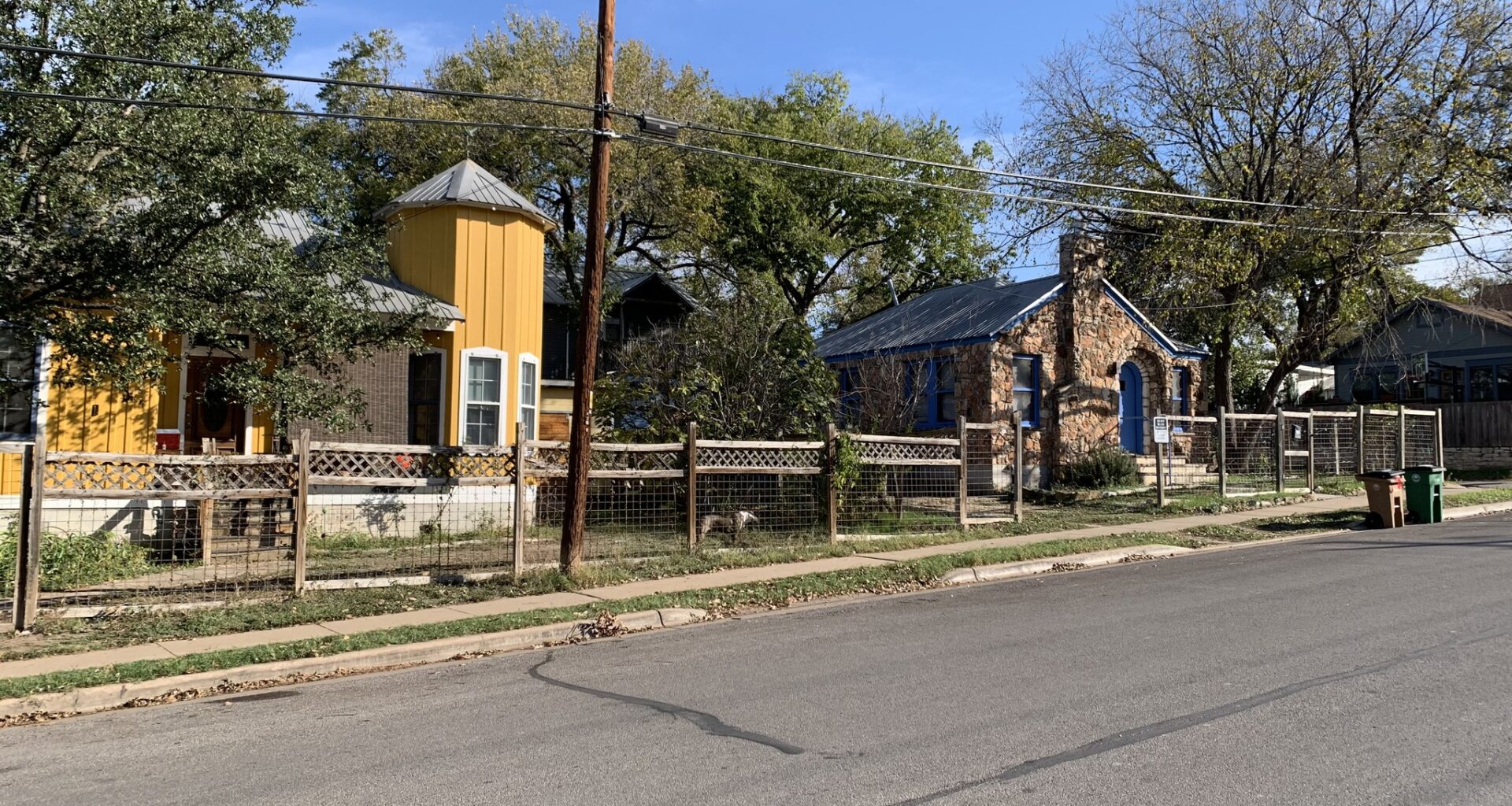
These two whimsical rental houses on West Monroe Street in Austin come with enchanting back stories.
Michael Barnes/American-Statesman
Perhaps you’ve spotted them.

If not, a pair of whimsical houses await you on the corner of West Monroe and Newton streets in the Bouldin Creek neighborhood, not far from where we live.
Article continues below this ad
Old-timers and newcomers often ask: “What’s their story?”
After all, the nearby surviving structures in South Austin date as far back as the 1870s, when this district, part of the Swisher Addition, served as a freedom colony for the formerly enslaved. These days, bungalows from the 1920s sit astride fantastical follies from the 1960s and modernist mansions of recent vintage.
These two, however, stand out from the eclectic crowd. The larger, canary-yellow house, faced with board-and-batten, is dominated by a marvelously incongruous tower, while the cottage with the rough stone façade next door looks like something out of a fairy tale.
In succession, writers, artists, journalists and other creative types have rented these residential gems for the past few decades.
Article continues below this ad
The answers arrive unbidden
A workman reassembles the stone exterior of 206 W. Monroe St.
Dagmar Grieder
Out of the blue, the answers to our nagging questions about the historical provenance of these two houses, along with some new queries, arrived by email.
On Nov. 12, Statesman reader Dagmar Grieder, who published the memoir, “The Mushroom Girl: From Hitler’s Germany to Today’s Texas,” sent me a message about 206 and 208 W. Monroe St.
Article continues below this ad
When Grieder purchased the property in 1997, there was only one small house — the one at 208 W. Monroe St. that she painted yellow — near the middle of the lot.
Yet three surviving water taps implied that, at one time, three small houses once stood on the property, likely dating to the days of the freedom colony. In fact, at least two other existing small houses on Newton Street that date from that era employ the board-and-batten technique of covering the seams between wide, vertical boards with narrow strips of wood called battens.
“I made the house a little larger, brought it up to code, and, yes, gave it a little turret,” Grieder writes. “As the area gentrified and taxes surged, I had to choose between selling to a developer or adding an additional dwelling unit. I decided to add a second house, as I already had experience moving at least one house prior.”
Grieder owns several rental houses around town.
Article continues below this ad
“I began to look for one that would fit into the available space, would blend into the neighborhood, and be within the parameters of the city’s building code,” she writes. “I found, most likely in the classified pages, a small house located at 4417 Marathon Blvd.”
Marathon is located one block west of North Lamar Boulevard in the Rosedale neighborhood.
“I was immediately intrigued by what I saw, a compound of two houses,” Grieder says, “one large, the other small, both in the same style and clad in a thick veneer of interesting, non-local stone.
“The interiors were well designed with beautiful woodwork. The seller, probably a developer, rather than the resident, had other plans for the well-situated lot and agreed to sell the small house to me for only $6,000, a small price compared to the moving costs. He told me that both houses were architect-designed, built in 1937, my birth year, and that the small unit had been occupied by a writer, possibly in residence. How I wish now that I had asked more questions and had taken notes.”
Article continues below this ad
Grieder had noticed a swarm of bees in the attic of the small structure when she first looked at the property.
“Having made the purchase, I tried to find a beekeeper who would harvest the colony,” she writes. “However, before I could find one, the seller had an exterminator treat the house. While I started the permitting process, my handyman was in the attic taking out and filling a large trash bin with thousands of dead bees and endless amounts of comb full of now-poisoned honey.
“I call the house my Beehouse.”
Who lives in Beehouse now?
Beehouse soon after it was moved from Rosedale to Bouldin.
Dagmar Grieder
The house was perfect for its new Bouldin location, except it was a couple of inches too long, which intruded into the 15-foot setback from the street. With the support of some neighbors, Grieder was granted a variance from the city.
Article continues below this ad
“The house is now occupied, again, by a writer. You may have encountered Donald Mace Williams while walking on Monroe,” Grieder says. “He is a retired journalist. He is also a poet and a writer who has published eight books: fiction, poetry, memoir and translation. He is an interesting and kind person and a good neighbor.”
Born the day the stock market crashed in 1929, Williams and his family lived in a tent and traveled frequently during the Great Depression, including time following his father, who had signed up for the Civilian Conservation Corps.
Williams lived in Austin during his junior year of high school, then later when he earned his Ph.D. at the University of Texas, where he wrote a prosody of the Old English poem, “Beowulf,” for his dissertation. (He recently published a translation of the poem.)
“When I was 16 or 17, I told my dad I wanted to be a writer,” Williams told the Austin Chronicle earlier this year. “He said, ‘If you want to be a writer, go to work for a newspaper, where they’ll blue-pencil your copy and teach you not to waste words.’ So I did.”
Article continues below this ad
Williams worked on the newsroom staffs of the Denver Post, Fort Worth Star-Telegram, Amarillo Globe-News, The Wichita Eagle and Newsday. In 1999, he retired to write poetry and fiction. Among his books are “Black Tuesday’s Child,” “Beowulf: For Fireside and Schoolroom” and “Poems of Rainer Maria Rilke: A 150th Anniversary Reader.”
Along with translations and fiction, he still writes poetry.
He told the Chronicle: “An image will occur to me, or maybe a first line, and that’s all I want or need.”
House owner a crackerjack storyteller, too
Owner of the two whimsical houses, Grieder lives about half a mile away on East Bouldin Creek at 502 W. Live Oak St. There was no structure on the property when she purchased it, but she discovered signs of previous occupation scattered around. In 2005, she built a graceful house there and moved in.
Article continues below this ad
She’s kept chickens ever since, which leads to one more coincidence for today.
“I’ll tell you a story: On a Sunday afternoon, the bell rang and an unknown man was at the door,” she writes. “He was very apologetic about disturbing me, but he just had to ask me if these were ‘precious chickens.’ I told him that they were precious to me but that I did not quite understand him. I invited him in. He told us that he used to ride his bicycle in this neighborhood when he was a boy, and that a lady lived here in a shack who also kept chickens.
“Her name was Precious.”
Article continues below this ad