

Listen to this article
Estimated 4 minutes
The audio version of this article is generated by text-to-speech, a technology based on artificial intelligence.
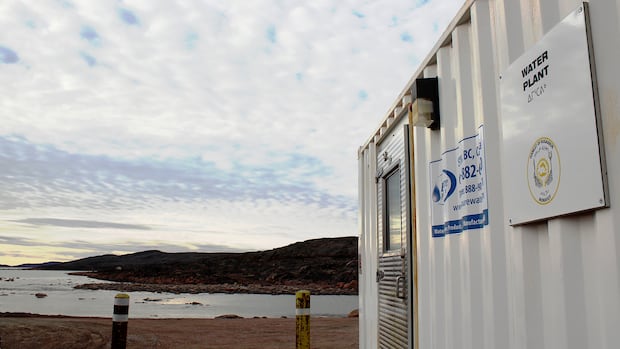
Schools and offices in Kugaaruk, Nunavut, are closed as the hamlet grapples with a state of emergency after sea water got into the water treatment plant.
In a post on Facebook, the hamlet said it declared a local state of emergency at 11:30 a.m. on Sunday because the water plant is unable to produce clean water to the community of roughly 1,200 people.
“The water treatment plant in the Hamlet of Kugaaruk is no longer able to produce water,” it wrote in the post, adding that leaves the community without a reliable source of potable water.
In an email to CBC News, Michelle Byers, the senior administrative officer, said unusually high supermoon tides caused sea water to travel upriver into the water treatment plant.
“The plant, located approximately two kilometres from town along the river, automatically shut down as designed to protect the system,” she said.
She said there is a limited amount of bottled water already in the community, and Nunavut Emergency Management (NEM) is sending an additional 5,000 litres of water, as well as an additional pump to gather water from a backup source.
“We are also preparing our long-standing secondary water source, known locally as the swimming lake. Pumps and equipment are being set up so that water truck deliveries can begin as soon as that source is ready. We expect this location will be able to meet community needs,” she said.
In a news release from Sunday, the Nunavut Emergency Management (NEM) said the emergency was declared after sea water infiltrated the water treatment plant. NEM, within the Community Services Department, said it is working to support the hamlet.
Schools and government offices are closed until further notice, and the health centre is providing emergency services only.
Community resilience
The Koomiut Co-op is still open, although some sales are limited, as it works through the water emergency. Assistant manager Cody Keagan said the store is assisting in distributing bottled water to community members, as well as providing their own supply.
But he also sees a lot of resilience among the community, with some people venturing on snowmobiles and qamutiik to nearby lakes and springs to tap into the water – as they normally do in the winter.
 Cody Keagan, the assistant manager of the Koomiut Co-op, says most people in the community are resilient and are finding other ways to source water (Submitted by Cody Keagan)
“What they do is they either use an ice auger or an ice chisel to chip down through the snow and the layer of ice to access the water. And then, they dunk their jugs in and fill them up that way and then bring them back to town,” he said.
Byers said the hamlet is continuing to monitor the conditions at the water treatment plant, and the salt water may naturally drain over the coming days, though the hamlet is prepared to intervene if needed. There’s no timeline yet for when operations will return to normal.
A boil water notice is in place, NEM said, and all water must be boiled for at least one minute before use, including any water drawn from rivers and lakes. Byers said the hamlet has not delivered any salt water to homes.
NEM encourages residents to conserve bottled water for essential use only, and stock up on three days worth of supplies.
Nunavut’s Health Department is asking people to call the community’s health centre directly at 867-769-6411 for emergencies, and calls made after hours will be directed to the nurse on call.
In an email to CBC News, Netsilik MLA Cecile Nelvana Lyall said she has been in contact with territorial leaders and is ready to support in any way she can.
She’s encouraging people to follow official updates from the hamlet and the Nunavut government, and check in on family and neighbours who may need extra support.