
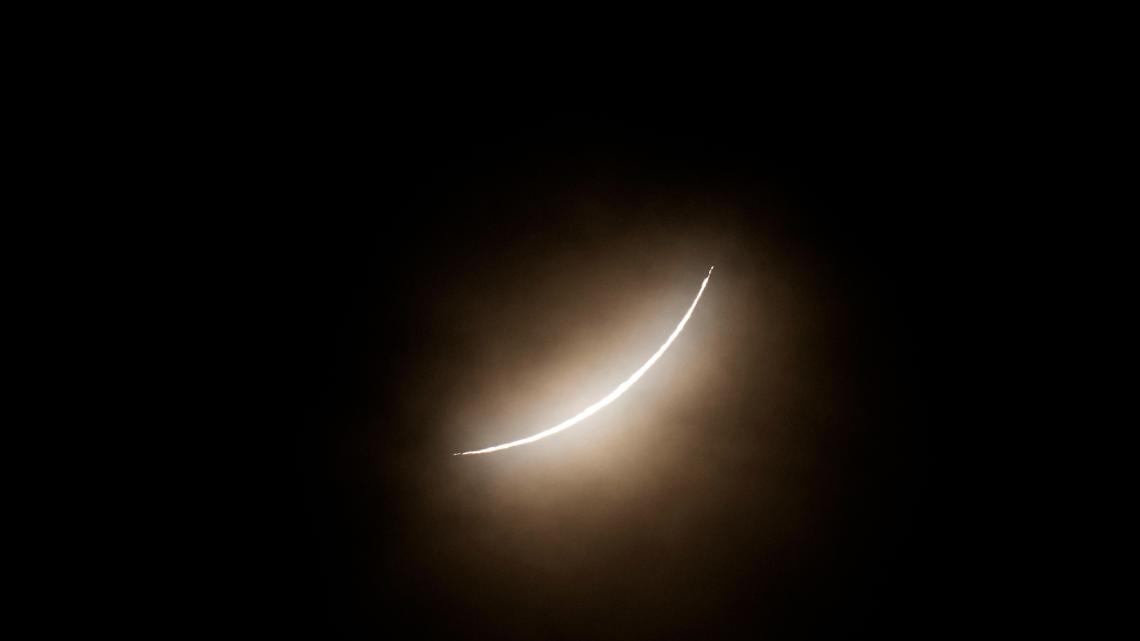
The maximum totality of the total solar eclipse in August 2027 will last 6 minutes and 23 seconds, but you’ll need to travel to see it.
On August 2, 2027, sky gazers across North Africa, Europe, and the Middle East will witness what astronomers are already calling “the eclipse of the century” — a total solar eclipse with a duration of totality that won’t occur again on easily accessible land for the rest of the 21st century.
The maximum totality will last 6 minutes and 23 seconds, according to data from NASA. In contrast, the totality of the “Great American Eclipse” that crossed over much of the U.S. on Aug. 21, 2017, lasted just 2 minutes and 40 seconds.
The longest a totality can take, based on the distances between the Earth, moon and sun, is 7 minutes and 32 seconds.
The longest total solar eclipse in recent history was on July 11, 1991 across Hawaii, Mexico, Central America, and South America. The 1991 eclipse lasted 6 minutes and 53 seconds at maximum, making it slightly longer than the upcoming 2027 event.
Will you be able to see the 2027 solar eclipse?
Americans should expect to travel if they want to see the 2027 solar eclipse.
The event will not pass directly over any U.S. soil. In the U.S., only a partial solar eclipse will occur in parts of Maine.
The path of totality will cross Spain, Gibraltar, Morocco, Algeria, Tunisia, Libya, Egypt, Sudan, Somalia, Saudi Arabia, and Yemen.
The ancient Egyptian city of Luxor has emerged as the most popular destination among tour operators, offering nearly six and a half minutes of totality combined with proximity to some of the world’s most spectacular archaeological sites.
What makes this the ‘eclipse of the century’?
The 2027 eclipse is the second longest total solar eclipse in the 21st century, with the longest being the eclipse on July 22, 2009. The 2009 eclipse’s maximum duration of 6 minutes and 39.5 seconds occurred over the Pacific Ocean, with the longest duration on land occurring on the remote, uninhabited island of North Iwo Jima.
What makes the 2027 eclipse particularly special is its accessibility. The 2027 eclipse will pass over major population centers and tourist destinations with well-developed infrastructure, making it feasible for hundreds of thousands of people to witness this rare astronomical phenomenon.
The long eclipse occurs because of a fortuitous cosmic geometry. The eclipse will happen about 2.5 hours before the moon reaches perigee, when it is closest to Earth, making the moon’s apparent diameter larger. This larger apparent size means the moon can block the Sun for an extended period as it moves across the solar disk.
Adding to the eclipse’s significance, the path of the August 2, 2027 eclipse will be crossed by the path of another solar eclipse less than 7 years later, on March 20, 2034. These intersections are considered unusual, as the average interval for any given spot on Earth to observe a total solar eclipse is about once every 375 years. This phenomenon happened with the intersection of the August 2017 and April 2024 total solar eclipses over southern Illinois.
Upcoming eclipses
Aug. 12, 2026: Totality visible from Greenland, Iceland, Spain. Partial eclipse visible from parts of northeastern U.S. and Canada.Aug. 2, 2027: Spain, North Africa, Middle East. Partial eclipse visible from parts of Maine.July 22, 2028: Australia, New Zealand, including Sydney. Not visible from U.S.Nov. 25, 2030: Southern Africa, Australia. Not visible from U.S.March 30, 2033: Alaska, including Nome, Kotzebue, Utqiagvik. Maximum 2 minutes, 37 seconds.March 20, 2034: Africa, Middle East, Asia. Will intersect 2027 path over Egypt. Not visible from U.S.Sept. 2, 2035: China, Japan, North Korea, South Korea. Not visible from U.S.July 13, 2037: Australia, New Zealand. Not visible from U.S.Dec. 26, 2038: Australia, New Zealand. Not visible from U.S.Aug. 12, 2045: California, Nevada, Utah, Colorado, Kansas, Oklahoma, Arkansas, Mississippi, Alabama, Florida. Maximum totality over 6 minutes. Partial eclipse visible from most of North and South America.