
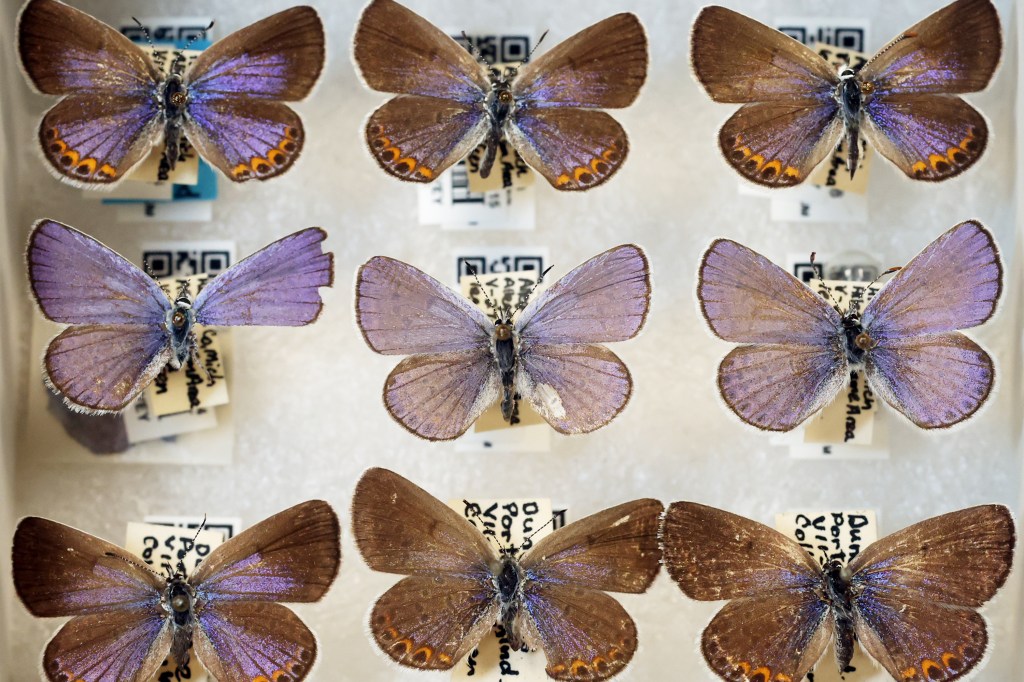
Every five years, a small group of biologists and environmentalists assemble in a large corner office in Springfield with long glass windows. Inside that room, they weigh in on the fate of every animal and plant that exists in Illinois.
They might not see it so starkly — who could wake up every morning with that burden?
And yet that’s the job of the nine voting members of the Illinois Endangered Species Protection Board. They gather four times a year and consider and revise the Illinois state list of endangered and threatened animals, insects and plants, which, at the moment, includes 29 birds, 8 mammals, 16 reptiles, 40 fish and 338 plant species. They unveiled their latest five-year update in mid-November. The journey there was full of snoozy, polite meetings but the results will be far-reaching and complicated, even loved and hated by the same people. Joyce Hoffman, a research scientist with the Illinois Natural History Survey, steered the list through its last two revisions; she chaired the board for a decade and recently retired. She had clipped white hair and the calm of an elementary school teacher. She kept a notebook before her, jotting her thoughts longhand. Often seated alongside her was Phil Willink, the new chair, a former biologist with the Field Museum and Shedd Aquarium.
They are disarmingly plaintive about their roles.
When she’s asked why the 53-year-old list of endangered species is important, Hoffman simply says: “Because, all of these animals, plants — because they’re there.”
“We are just making a list,” Willink says.
Towards the end of the five-year revision process, Hoffman took pains to remind the board that things change, and five years is a long time for an endangered species to be formally declared endangered, so yes, they can make alterations more often than every five years. Bats and bees and snails and sunfish will rise and fall without regard to them.
Yet after five years of deliberation, they must produce a new list.
Just as, five years from now, they will produce another list.
“OK, take a deep breath,” she said after they voted last winter. They removed southern water snakes from “endangered” status. They added eight bee species as endangered. They added the Little Wabash crayfish. The bluebreast darter went from “endangered” to “threatened.”
When they were done, they sat in silence, five years of meetings behind them, 10 months of approvals and public notices and legislative reviews before the list was released. Five years of board members being agnostic toward a species, even if it’s their specialty. Five years of speaking in measured tones, only laughing when someone lapsed into a blunt assessment. Five years of concerns that whatever goes on a new list is backed by data and, as Willink says, “legally defensible.” And five more years of worldwide ecological decline.
Hoffman broke the silence.
To think, she said, not so long ago, none of this would have gone this smoothly.
The headquarters of the Illinois Department of Natural Resources is long and large and tucked lightly into the forest surrounding it. It’s muscular without looking imposing. It’s elegant, modern, modest. It’s like the Illinois Endangered Species Protection Act itself, created in 1972, several months before the Federal Endangered Species Act.
On days when the endangered species board meets, its membership — which is staffed by volunteers given three-year terms, and must include at least two zoologists and a botanist — files through silent IDNR offices to the third floor, past mounted game heads and a taxidermy of a mountain lion that wandered into the state years ago, driven east by habitat loss or hunting. Several board members are retired scientists, several teach at universities. Most are still out there, actively surveying species in the wild.
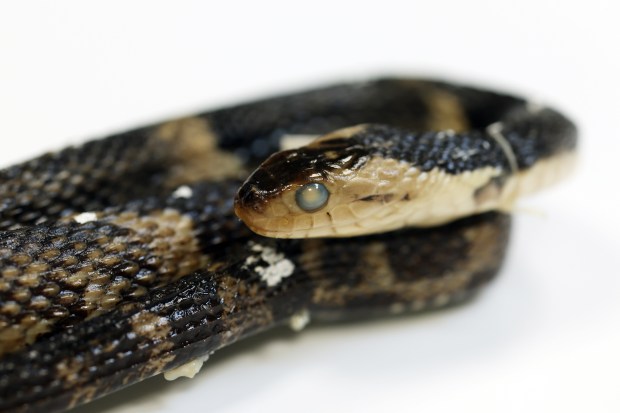 The banded water snake (Nerodia fasciata), which has been placed on the Illinois Endangered Species Protection list, is at the Field Museum in Chicago on Nov. 12, 2025. (Terrence Antonio James/Chicago Tribune)
They bring the latest news about osprey and fireflies and ground junipers and crayfish. There’s a request before them to consider the smooth greensnake, a perfectly-named creature. They’re long, they’re bright green; flip a hubcap in the Chicago area and you may run into one. The conversation is skeptical and pragmatic. Where are the numbers in this petition from? It’s hard to believe people aren’t seeing smooth greensnakes, offers a forest preserve biologist. Do they have enough information to pull the trigger on this one? They don’t.
Yet, sand reed leafhoppers. Hadn’t seen those in a decade, until one morning …
Should the Federal Endangered Species Act itself become a victim of the current White House — which has openly called for its gutting — the Illinois Endangered Species Protection Act remains. Whatever is on the federal list automatically is on the Illinois list. Nevada was the first to assemble its own list. Today, 46 states update their own lists, each a little different than the next, each with a history of wins and losses. The Illinois list is often seen as a catalyst for helping to restore osprey, barn owls and river otters in Illinois.
But like the federal list, the majority of what goes on the Illinois list tends to stay there. That is often the argument of opponents — that the act inserts buffers around a species and its habitat without doing enough to restore those species. Todd Atkins, of the Ohio-based Sportsmen’s Alliance, a hunter’s advocacy group, said he agrees with the need to protect and preserve troubled species, but “I think where people tend to lose confidence in endangered species acts is when folks would rather give the species on these lists a sort of permanent protection — recovery is no longer the goal.”
But many others — especially the scientists who have direct experience with shaping endangered species lists — see a chicken-and-egg situation built into protecting species. Take the greater prairie chickens, which went on the list in the 1990s, and show no signs of leaving. “Some species will never come off,” said Michael Patrick Ward, a professor of sustainability at the University of Illinois Urbana-Champaign who sits on the committee that advises on birds. “We put resources into them, and sometimes there is no way back — and yet they remain at risk of extinction.”
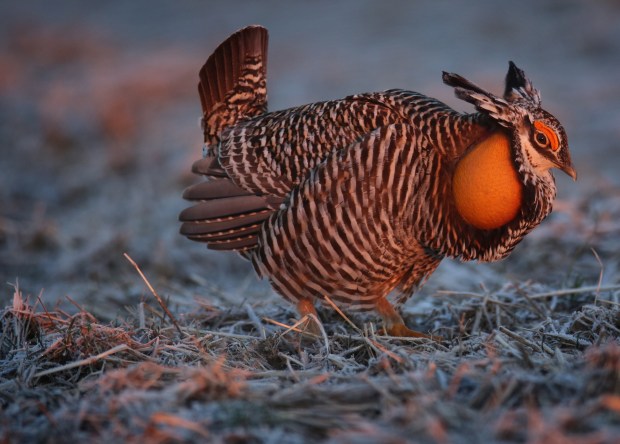 A male Illinois greater prairie chicken displays during a mating dance to try and establish dominance over other males and hopefully lure a hen at the Prairie Ridge State Natural Area near Newton, Illinois, on April 2, 2013. (E. Jason Wambsgans/Chicago Tribune)
One of the key problems with the list, he said, is that the state “has done a poor job of highlighting its successes, so what we hear about it tends to be all negative.” The IDNR often hears the assumption that once an animal or plant is designated endangered, the state can swoop in and acquire any land it’s found on. “We work with a lot of farmers, and a lot of the time they have an impression that their property can be seized.”
It can’t.
Federal endangered species law is more aggressive about land. At the state level, there are fines for harming endangered species, and sometimes restrictions on how land is used if a species is present, and occasionally, the IDNR might acquire land to protect a species headed for extinction. That said, explained Joe Kath, IDNR’s longtime director of the endangered species program, endangered and threatened species are largely found on land the state owns, and when endangered species are found on private land, “it generally works out, people are receptive, it’s a happy experience. Especially with companies, let’s face it, the situation can be good PR.”
But therein lies the rub.
After the Illinois Endangered Species Protection Board releases its latest list, it’s tasked to the IDNR to carry out protection plans. The board and the IDNR itself are technically independent of each other. The board, however, has no paid staff. So the IDNR — here’s another big criticism — might make suggestions, but it can not force those changes.
A high-profile example played out recently in Rockford, where the Chicago-Rockford International Airport expanded into some of the last remaining habitat of the rusty patched bumblebee. Environmental groups sued the IDNR, claiming that it wasn’t doing enough. But there are other examples. Box turtles that halt wind energy projects. Dragonflies that stall state public works. Sometimes a species wins, and sometimes it’s steamrolled. Alan Branhagen, executive director of the Natural Land Institute, which sued over the rusty patched bee, said, “I’m glad the list exists, but sometimes it’s too little too late.”
 Cargo planes are visible behind the Bell Bowl Prairie adjacent to Chicago-Rockford International Airport on Oct. 20, 2021, in Winnebago County. Airport construction cut through the five-acre virgin gravel prairie. (Brian Cassella/Chicago Tribune)
At the root of endangered species lists are years, sometimes decades, of surveys that shape it, the field studies carried out by biologists and graduate students and amateur scientists. Birds, reptiles, mammals, plants — each gets a committee.
The problem is, of course, there will never be enough surveys. Can you ever be completely sure a Shawnee snail doesn’t exist?
“It’s not a problem unique to Illinois,” Kath said. “It’s true at the federal level, university, state — there’s never enough time or money to be more extensive, to know something 100%.”
Consider the northern long-eared bat, which, on the latest list, was changed from threatened to endangered. Tara Hohoff, project leader for the Illinois Bat Conservation Program, and a mammalogist who advises the endangered species board, said knowing exactly what’s still flying or walking or slithering is always “a best educated decision.” The northern long-eared bat is among many bat species in steep decline, primarily because of a fungus that’s caused white-nose syndrome. They were common in northern Illinois. Since her program started in 2016, she’s netted only one.
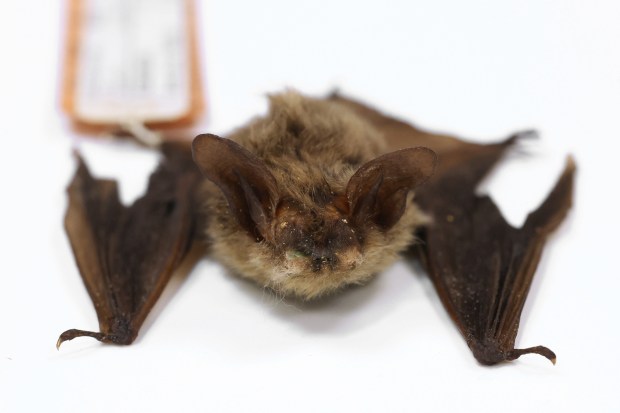 The northern long-eared bat, which has been placed on the Illinois Endangered Species Protection list, is at the Field Museum in Chicago on Nov. 12, 2025. (Terrence Antonio James/Chicago Tribune)
Until recently, for the first decades of the Illinois endangered species list, “you basically had a bunch of people meeting, pitching species, trying to make the best decisions they could with what they knew, and those decisions might not necessarily hold up to scrutiny,” Willink said. So Hoffman helped institute a new system to formalize the inclusion of a species, requiring data and proof of studies.
Take the latest list, which classified eight new bee species as endangered in Illinois; an additional four bee species were listed as threatened. Biologists who petitioned for those 12 species of bees noted they could have petitioned for even more.
But we’re in triage territory these days.
Chris Dietrich, an entomologist with the Natural History Survey who petitioned for leafhoppers — two new species made the list this cycle — said: “You’re faced with narrowing down the number of species to save because you don’t want to overwhelm the system. Plus, there are political considerations. There are those politicians who want to know why we’re not just supporting the next bald eagle, and if you throw a bunch of bugs onto every updated list, you could undermine support for the list in general.”
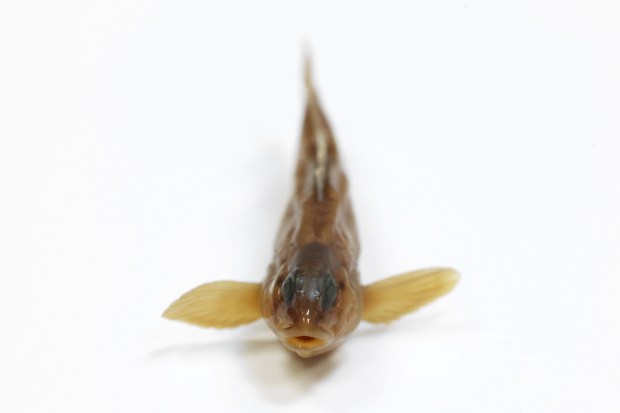 The bluebreast darter, which has been placed on the Illinois Endangered Species Protection list, is at the Field Museum in Chicago on Nov. 12, 2025. (Terrence Antonio James/Chicago Tribune)
The first endangered species board in Illinois required that at least half of its members represent the fur industry. Indeed, its initial list of protected species included polar bears and snow leopards, not because polar bears and snow leopards were traipsing around the Midwest, but because early versions of the Illinois Endangered Species Protection Act focused on the trafficking of hides, shells and furs. It had been one of a series of ecologically-minded bills pushed by Gov. Richard Ogilvy, a Republican.
The Federal Endangered Species Act, enacted months after the Illinois act, had been supported by Richard Nixon. As for the Illinois version, the chief sponsor was State Rep. George Burditt, a Republican from La Grange.
Burditt signed the legislation while petting a tiger cub in the Lincoln Park Zoo.
Within months, there was already a court case pitting the habitat of a bald eagle against the private grounds of a small ski resort in southern Illinois. They saw some successes (bald eagles, mussels, turkeys, darters), and an occasional prosecution: Fran Harty, a longtime conservationist who worked for IDNR and the Nature Conservancy of Illinois, remembered being a witness against a Chicago pet store that sold endangered box turtles.
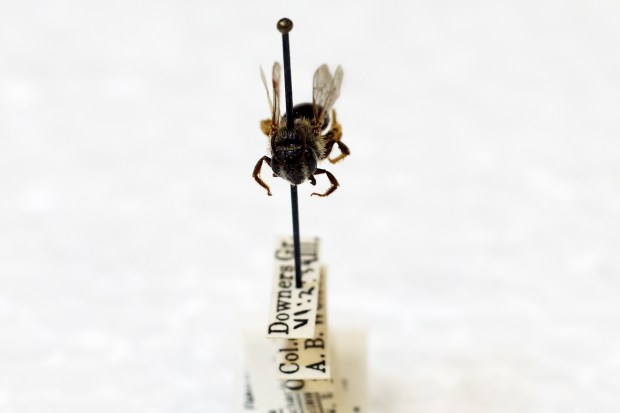 The Virginia miner bee, which has been placed on the Illinois Endangered Species Protection list, at the Field Museum in Chicago on Nov. 12, 2025. (Terrence Antonio James/Chicago Tribune)
But for much of its existence, the board hasn’t had the funding or staff to be thorough. That’s never changed. Deanna Glosser, who led the endangered species program for IDNR in the ‘90s (and is now executive director of the Land Conservation Foundation), remembers “feeling personally responsible for ensuring a listed species continued, and when we failed, I would get depressed and stay like that for days.”
In 2012, the last time the board and the list had a comprehensive state review, findings were mixed: More than 600 species had been on the Illinois list since 1972, yet the criteria for making the list were vague. Of those 600 species, 160 species had been removed from the list, yet almost 50% were taken off because their species was now considered extinct. Only about 50 species were removed because their population had actually recovered.
“I think of this list like those old thermometer graphics for blood drives,” said Harty. “You may see movement, and the red goes up. But at a scale that will matter? You’re never sure.”
“Does anyone at the IDNR actually read these reports?” Chris Dietrich asked at a meeting of the board last winter, when they voted. He said later he’d been in a bad mood that day, maybe harboring the perpetual gripe of entomologists, that all of the attention on endangered species lists goes to “charismatic” animals — wolves, turtles, butterflies, birds with airplane-esque wingspans.
It’s also just an anxious moment to be making lists of species.
Even as scientists warn we are losing species at a faster rate than usual, even as science writer Elizabeth Kolbert has famously said we may be entering “The Sixth Extinction,” members of the Illinois Endangered Species board are hearing more often from politicians and developers concerned about the financial costs of any protection of any species.
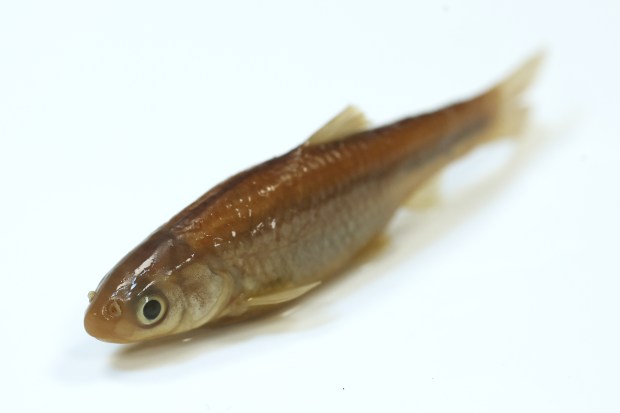 The brassy minnow, which has been placed on the Illinois Endangered Species Protection list, at the Field Museum in Chicago on Nov. 12, 2025. (Terrence Antonio James/Chicago Tribune)
Meanwhile, the White House created what it refers to as a “God Squad” to weigh the fate of species, from grizzly bears to gray wolves. The administration would like to remove the word “harm” from federal protections, making it tougher to claim the actions of a logging business or mining operation are hurting a species.
Some remain cautiously optimistic.
National polls about endangered species acts have found, consistently, that the majority of Americans are supportive. Amy Doll, director of the Friends of Illinois Nature Preserves, said she would like to see more education about what the lists mean for landowners, and notes that many hunters often make excellent conservationists. (Indeed, the Endangered Species board never meets during deer season, partly because several IDNR staff are also hunters.) “Even if the federal list went away tomorrow, we have a state list,” she said. “I believe citizens will step up.”
In the meantime, we have the Illinois Endangered Species Protection Board. According to Willink, they are ever more reliant on hard data. He expects the next couple of years of meetings to weigh heavily on the question of what even counts now as a native Illinois species. “That’s becoming far more important these days because the more we see climate change in action, the more we’re seeing migrations.”
After they voted on the new list, he said they now had five years to make the next list.
There were light chuckles.
They faced years of petitions and disagreements and reflections ahead, he said. All of the known unknowns, and the unknown unknowns. “But I think we are doing this better and better.”
cborrelli@chicagotribune.com