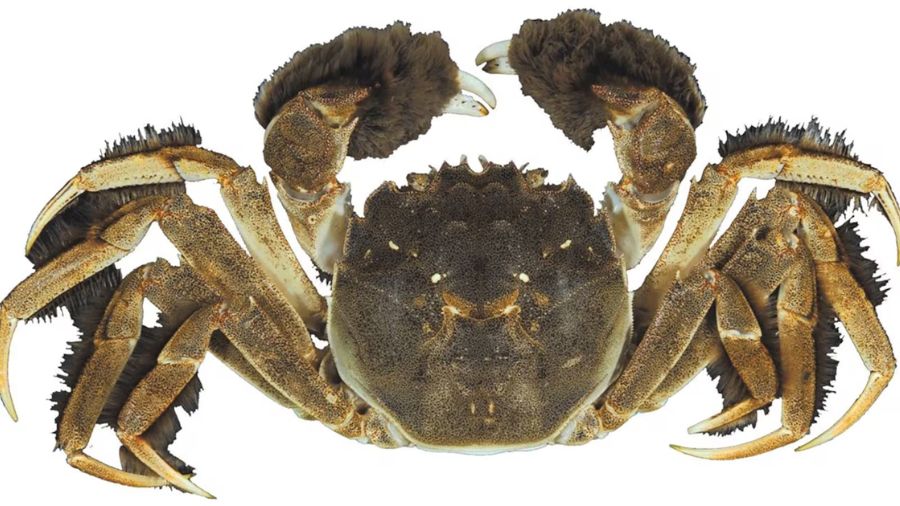
A second invasive Chinese mitten crab was found in Oregon’s Willamette River last month, raising concerns for local officials over its potential appearance in Washington.
The Chinese mitten crab was caught on Nov. 18 and is prohibited in both Washington and Oregon, according to the Washington Department of Fish & Wildlife (WDFW).
Chinese mitten crabs spend most of their lives in freshwater, but reproduce in saltwater. Some of its burrowing habits can cause significant damage to dikes, levees, and stream banks through increased erosion.
The invasive crab can also carry harmful pathogens and tends to eat and outcompete native species, including clams, mussels, and fish eggs.
The Washington Invasive Species Council (WISC) also noted that the Chinese mitten crab may carry lung flukes, which can infect humans when eaten uncooked.
A Chinese mitten crab can be roughly three inches wide, with four spines on either side of their eyes and outer claws that are hairy and “mitten-like.”
The WISC urged people in WA to report any suspected sightings of the invasive crab on its website here.
Another invasive crab species found in WA this year
In late November, an invasive species reached Skagit Bay for the first time in history.
Researchers confirmed the presence of European green crabs in the northern Whidbey Basin, raising alarms about their spread in Puget Sound.
The discovery began in late September when a volunteer spotted a crab shell at Similk Beach on the Swinomish Tribal Reservation, according to Washington Sea Grant’s (WSG) Crab Team. The report triggered an urgent trapping effort.
“We found a concerning number of European green crabs,” said Emily Grason, WSG Crab Team program lead.
Crews captured 12 crabs at three sites, and their size suggests they’ve been there for at least two years. The species — considered one of the world’s most damaging — threatens ecosystems, shellfish harvests, and fisheries. This detection follows a recent find at Mission Beach in Possession Sound by the Tulalip Tribes.
Green crab numbers have surged in Washington’s inland waters this year, partly due to El Niño conditions, according to the WSG Crab Team. Officials said continued monitoring and community involvement are critical to managing the spread.
Contributing: Aaron Granillo, KIRO Newsradio
Follow Jason Sutich on X. Send news tips here.