
 Credit: Netflix
Earlier this week, world-renowned photographer Dave Burnett broke his silence on the issue of Nick Ut and his authorship of the photo “The Terror of War” through an opinion piece published in The Washington Post. Yesterday, he elaborated on that story and not only doubles down on that stance, but also alleges “The Stringer” used his photos without permission or attribution — a blatant violation of the law.
While Burnett briefly mentions permission and attribution in the Washington Post article, he is far clearer on the issue in the post on Facebook.
As a brief recap, Burnett’s Washington Post story, which is an edited version of this longer take on Facebook, does not mince words on how the photographer feels about not only the conclusions of the documentary, but the way the VII Foundation and Gary Knight came to those conclusions.
“One of the main justifications for the VII Foundation film, ‘The Stringer’, as I heard directly from Executive Producer Gary Knight a couple of years ago, is that there needs to be truth, even uncomfortable truth, in all that we do as journalists, that we need to honor the sense of truth which journalism demands. I chose not to participate in the film, feeling that, above all else, they were trying to prove a previously chosen point of view rather than celebrate the act of discovery and enquiry. In all the decades that I have been a photojournalist, it has been a common vision that the story — the pictures, the narration — are more important than the photographer, and it is something I have always taken to heart. Yet authorship is something which cannot be easily trifled with, and we in the profession take our work seriously,” Burnett writes.
“I was unaware that Gary had already decided that the question of the authorship of the ‘Terror of War’ photograph would be worthy of a film, when he wrote me, out of the blue, in March 2023, asking if we could have a chat about my time in Vietnam, and Trang Bang in particular.”
Burnett says he spoke on the phone with Knight for well over an hour that day while sitting in his car in a Walgreens parking lot. During that conversation, he told Knight that he was certain that during his investigation of this situation, he would no doubt hear a story from a former AP photo editor named Carl Robinson and that he would claim Ut did not take the photo.
Burnett Did Not License His Photos to ‘The Stringer’
The photographer says that he appreciated that Knight wanted to know everything Burnett knew about that day in Vietnam and, as a measure of professional courtesy, he sent Knight a dozen black and white photos he took that day to help “fill in a little of the way it all looked.” Burnett says there was no other intention in this gesture than this and furthermore, he had no idea that Knight was in the process of working on the documentary that would eventually become “The Stringer.”
“No mention of a film was made to me or that my photos would be exploited and even worse, used without crediting me in the film, which goes against both the ethos of professional photojournalists and violates the law,” Burnett says.
Later, in January 2024, one of the producers of “The Stringer” emailed Burnett and asked to license those photos for the film, which Burnett says he declined. This is in contrast to when the AP reached out to him during its own investigation, where he did use a number of Burnett’s images in the report, which he did license to the organization.
“It could not have been more clear that I did not wish to license the images for the film. Other than a couple of subsequent phone calls with Gary, asking me to be interviewed for the film, that was the end of my brief interactions with the production team. Having already seen what their purpose was — to try to prove that another photographer had taken the famous photograph, I was torn about doing an interview, but in situations like this, you have zero control, zero input as to how what you say might be edited, and cut, and I wasn’t confident that my point of view would honestly be represented,” Burnett explains.
“So when I finally watched the film this week on Netflix, I was astonished and crestfallen to see something like ten of my pictures used in the film’s narration, all without attribution, and in direct contravention of what I had written [the producer]. And it wasn’t as if they couldn’t have known they were my photographs,” he writes. “Additionally, they used a clip from a video interview I did with Robert Caplin at Adorama, also without any attribution, all of which might have falsely given the impression I was collaborating with the filmmakers.”
“The fact that my pictures were dropped into the film, after I refused, is a grievous miscarriage of justice, and copyright infringement. Is that the kind of ‘truth’ and honesty that Gary and his team deployed for other elements of the film? There is a deliberate disingenuousness and deception which remains at the forefront. I sent the pictures to Gary, prior to any knowledge of there even being a film, as an act of one friend in the business, to another. Other than a couple of phone calls asking me to sit for an interview, I never heard back from Gary. Neither was there an offer before or since the Sundance festival to view a screener. Gary never mentioned using my pictures in the few times we had further short conversations. This kind of betrayal makes you think twice the next time a colleague calls to ask a question about a place or to see images of where you might have worked.”
A ‘Carefully Assembled Polemic’
Burnett does not mince words on his thoughts of this documentary beyond the issue with image rights.
“More than anything I feel like this film is less a documentary and more of an unfairly constructed, and carefully assembled polemic, with historical elements altered to meet their desired conclusion,” he writes.
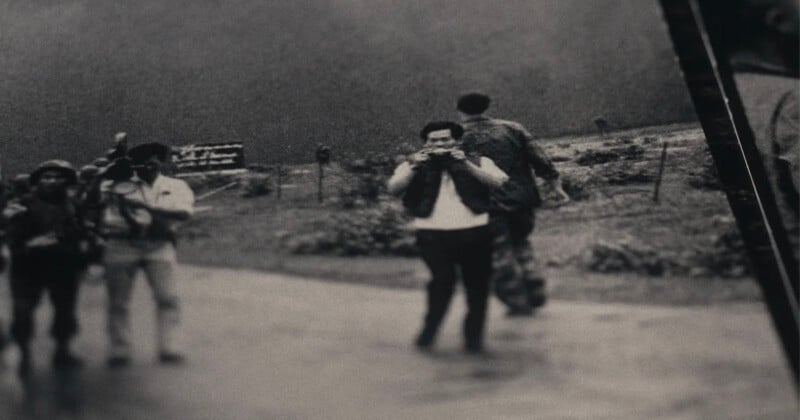 A still from The Stringer that shows freelancer Nguyen Thanh Nghe at the scene of Napalm Girl. | Netflix
“I still believe that while the film tries to prove that ‘Nick Ut couldn’t have taken the picture…’ in my mind, Nick Ut, having been the first and only photographer to run down the road towards the pagoda and the oncoming children, was the only one who COULD have taken the picture. Mr Nghe, the ‘stringer’ appears in several of my photographs. He has his camera, yet, like the NBC crew he was accompanying, he didn’t come down the road to where the children were until the dispersing movement of the group of journalists.”
Burnett’s full opinion can be read on Facebook.