
Is it a two-for-sun deal.
Astronomers were blown away after discovering a bizarre exoplanet that orbits twin stars closer than any ever seen before in a binary star system, per a starry study published in the journal “Astronomy & Astrophysics.”
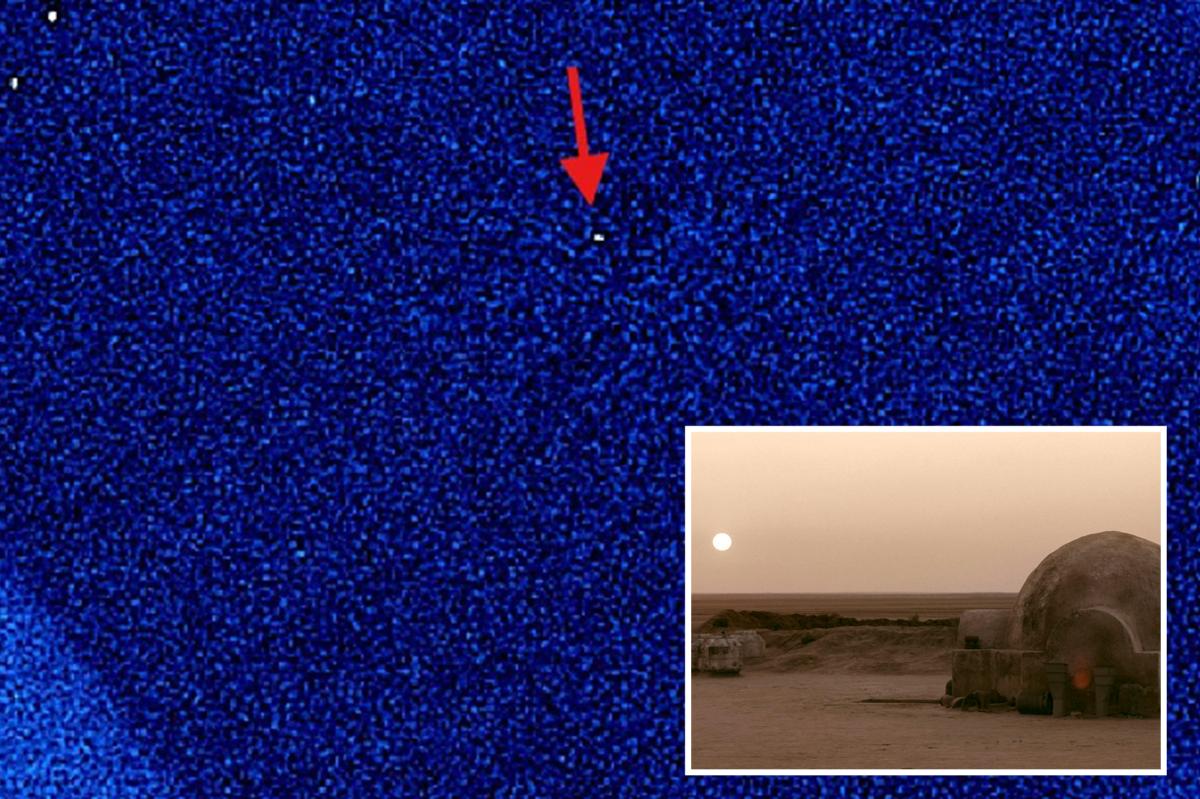
Researchers with Northwestern University in Chicago, Illinois, released a time-lapse showing the planet orbiting around the luminous two-fer, which has been compared to the twin suns over Tattooine — the home planet of Luke Skywalker in “Star Wars.”
“Star War” film set of Tattooine, the home planet of Luke Skywalker. Getty Images
Dubbed HD 143811 AB b, the interstellar entity is a gas giant that’s located some 446 light-years away from Earth in a galaxy far, far away, Space.com reported.
However, it is reportedly six times closer to its twin light sources than any binary system exoplanet imaged prior, offering researchers the rare opportunity to analyze the trajectory of the planets and stars in this system.
“Of the 6,000 exoplanets that we know of, only a very small fraction of them orbit binaries,” team member and exoplanet imaging expert Jason Wang of Northwestern University said in a statement regarding the solar double header. “Of those, we only have a direct image of a handful of them, meaning we can have an image of the binary and the planet itself.”
He added, “Imaging both the planet and the binary is interesting because it’s the only type of planetary system where we can trace both the orbit of the binary star and the planet in the sky at the same time.”
Despite its relative proximity to its suns compared to other exoplanets, HD 143811 AB b is still 80 times further from its light sources than Earth is from the Sun. That means that it takes the planet 300 years to finish a single revolution around the sun, even while the binary stars race orbit each other once every 18 days.
“Of the 6,000 exoplanets that we know of, only a very small fraction of them orbit binaries,” team member and exoplanet imaging expert Jason Wang of Northwestern University said in a statement regarding HD 143811 b (pictured). University of Exeter
The planet is also a whopper — reportedly six times the size of fellow gas ball Jupiter.
Coincidentally, HD 143811 AB is not a new discovery. Rather, it was brought to light, er lights, after Wang and colleagues uncovered HD 143811 AB b in archival data that was originally gathered a decade ago 10 years ago by the Gemini South telescope and its Gemini Planet Imager (GPI) instrument.
“I didn’t think we’d find any new planets,” Wang said. “But I thought we should do our due diligence and check carefully anyway.”
However, after analyzing GPI data gathered from 2016 and 2019 and cross-referencing it with intel collected by the W.M. Keck Observatory, the team picked up a faint dot that was following the trajectory of a star.
HD 143811 b (pictured) is a gas giant six times the mass of Jupiter, and orbits its two suns once every 300 Earth years. University of Exeter
Wang deemed this significant as “stars don’t stand still in a galaxy; they move around,” prompting astronomers to search for them and then revisit their findings later to see if they’ve migrated.
“If a planet is bound to a star, then it will move with the star,” he said. “Sometimes, when we revisit a ‘planet,’ we find it’s not moving with its star. Then, we know it was just a photobombing star passing through.”
He added, “If they are both moving together, then that’s a sign that it’s an orbiting planet.”
In accordance, the team was able to confirm that the entity a deed was indeed a planet — a conclusion that was also arrived at independently by astronomers from the University of Exeter in the UK.
Among the many striking revelations, scientists noted that the exoplanet is 1,416°F — almost twice as hot as Venus, IFL Science reported.
It was also around 13 million years old, which is relatively young by universe standards, especially when one considers that the Earth formed 4.6 billion years ago.
What is yet unclear is how this planet formed around its twin suns in the first place. “Exactly how it works is still uncertain,” Wang said. “Because we have only detected a few dozen planets like this, we don’t have enough data yet to put the picture together.”
The space experts hope to continue tracking the orbits of the planet and its stars so they can “learn more about the interactions between binary stars and planets.”