
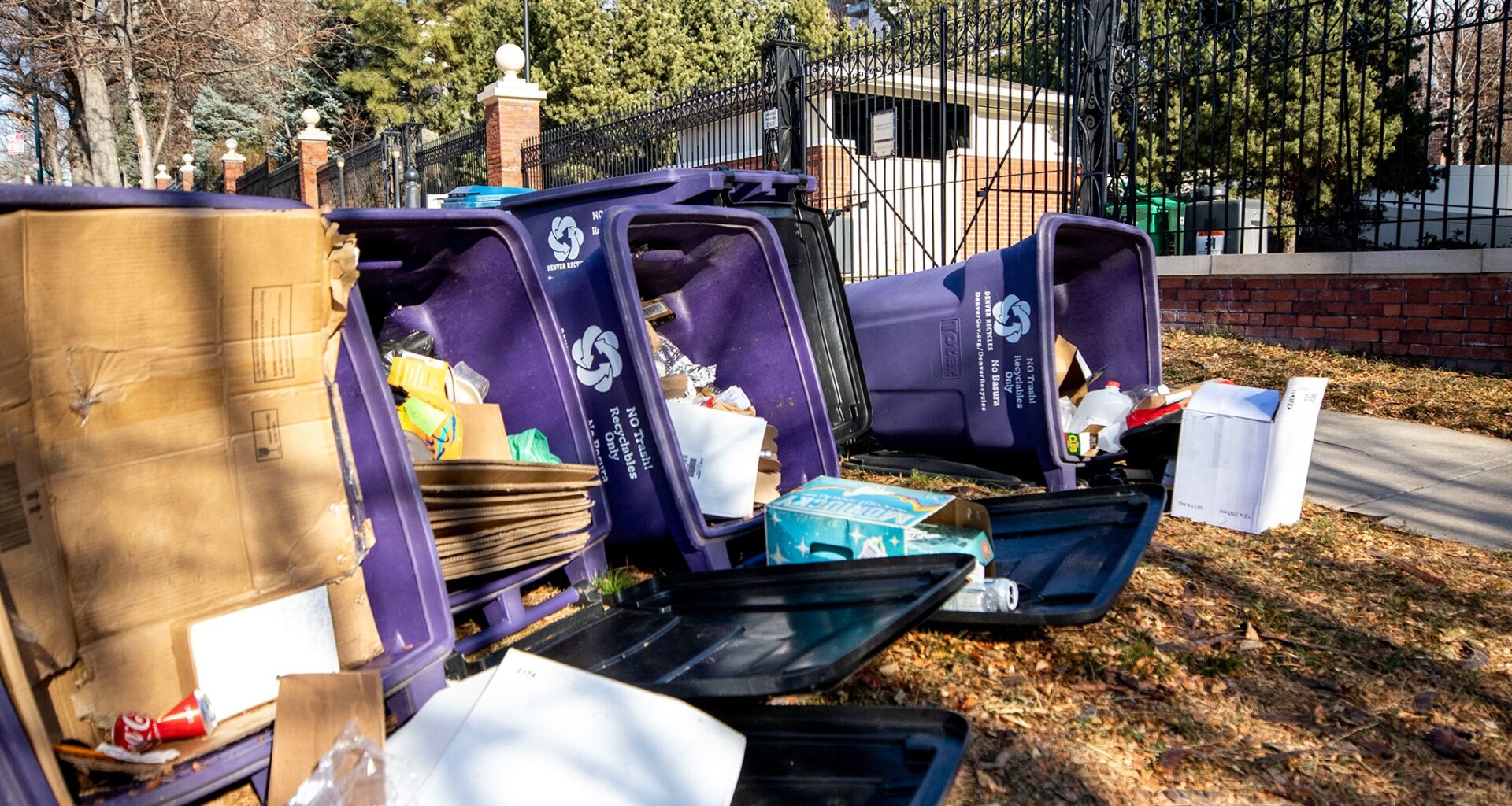
Colorado residents and local governments will soon get a little relief when it comes to recycling costs.
The Colorado Department of Public Health and Environment (CDPHE) approved the Producer Responsibility Program Tuesday. The program shifts recycling costs to the businesses that produce packaging.
“It’s going to simplify recycling, meaning that we’ll have one standardized list of what’s accepted. So, instead of it being different from city to city or different parts of the state, it’ll be standardized,” said Wolf Kray, Materials Management Unit leader at CDPHE. The Management Materials Unit is the regulatory group at the department that oversees their recycling facilities throughout the state.
Previously, residents had to decide on services to pick up their trash and recyclables. In some places in Colorado, local governments provide that service. Kray said the same entities or companies will continue to provide those services, but they will no longer have to foot the bill.
“Recycling will be much more streamlined, much less confusing, and there will be education outreach that will go along with that to ensure folks understand what’s supposed to go in recycling better,” Kray said.
Extended producer responsibility (EPR) programs have been adopted in over 60 countries around the world with Germany launching the first-ever system in 1991. The concept finally made its way to the United States when Maine and Oregon became the first states to pass laws related to extended producer responsibility in 2021.
Circular Action Alliance (CAA) is the organization designated by Colorado to implement the program. The national non-profit organization operates across multiple states to ensure producers comply with EPR laws and work with governments, business, and communities to reduce waste and recycle more.
Colorado joined Maine and Oregon in creating an EPR program when state lawmakers passed HB22-1355 the following year. Unlike Oregon and other states that followed, Colorado’s program is fully funded by producers, who are major brands that represent the food, beverage, consumer goods, and retail industries.
“What that means in Colorado is that producers that supply packaging materials into the state or printed paper, printed goods are responsible for funding 100 percent of the recycling system here in our state,” said Juri Freeman, executive director of CAA of Colorado. “So, this includes from my house, from my curb, all the way to the back of the recycling facility. The full system is funded by producers.”
Producers are companies that sell products in packaging at retail and online stores. Twenty-four of those companies including Amazon, IKEA, PepsiCo, and Walmart founded CAA and govern the organization.
“They’re looking at the EPR walls across the state, and we are working to harmonize as best as possible because obviously Amazon’s selling into multiple states that have EPR,” Freeman said. “So, opportunities for us to harmonize and make it easier for brands to comply with the legislation is one of our charges.”
As part of the program, producers must register and pay dues that go towards funding the entire program. That includes all operations for collections and hauling of recyclables, the processing of the materials. Dues vary by material type and amount supplied to the state. Once the program begins, residential service providers will be reimbursed for recycling costs through CAA.
“So, whether or not you’re provided by a local government, a private hauler, or a nonprofit, we’d work with that service provider to reimburse them for their cost of service,” Freeman said. “Under the state law, the service providers are no longer allowed to charge their customers for recycling if we’re reimbursing those costs.”
In November, CAA opened the process for local governments to enter into service agreements or contracts to be reimbursed for the recycling. Services for non-residential entities such as schools, government and public spaces will be covered in 2028. The program will expand to small businesses in 2030.
Prior to passage of the EPR laws, CAA found that only 22 to 28 percent of consumer packaging and paper products in Colorado were being recycled. Officials hope the program doubles that rate by 2035.
Environmentally, it’s also projected to eliminate 1.3 million metric tons of future greenhouse gas emissions and reduce landfill waste by 410,000 tons annually during that period. Kray said CDHPE is expecting a large number of Colorado residents to participate in the program.
“We’re looking at probably around 700,000 additional households that will now have access to recycling,” Kray said. “And what that’ll translate into is, of course, keeping material out of landfills, but more importantly, the environmental impacts of that.”
Colorado is expected to add 7,900 new direct and indirect jobs in the state as well as a result of the program.
Now that the program is approved, CAA has six months to implement it. Freeman said it’s going to take some time to gradually introduce the program across the state.
“The new recycling system that we are creating will grow and improve over time,” Freeman said. “In parts of Colorado where recycling may not be offered yet, it’s likely that that free service will take longer to arrive as we’ll have to invest in infrastructure to ensure that recycling services can be provided to residents.”
The program is expected to begin in mid-2026.
Colorado still has a middling recycling rate, but residents are wasting less overallWhy Gov. Polis vetoed legislation to end state incentives for ‘advanced recycling’