
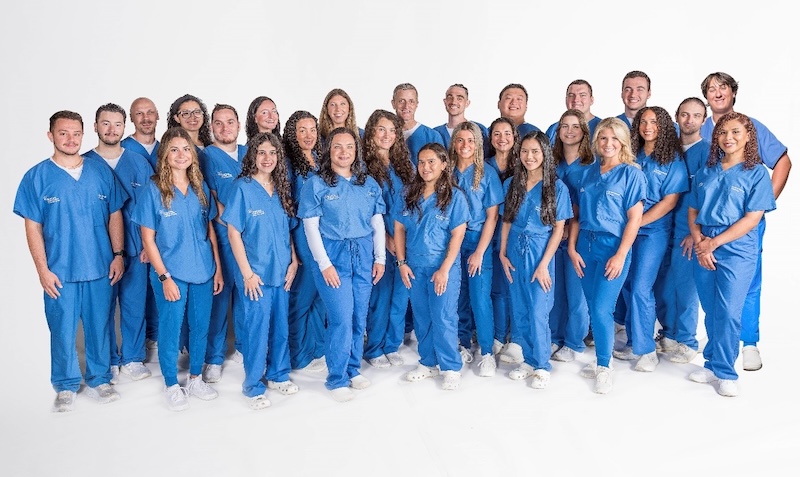
Peconic Bay Medical Center’s radiologic technology school has again turned out a class of graduates with a perfect record on their board exams – and on landing jobs.
All 27 members of the Class of 2025 passed the American Registry of Radiologic Technologists certification exam in radiography, and all have already secured full-time, part-time or per-diem jobs, most of them within the Northwell Health system, according to PBMC and Northwell’s Center for Learning and Innovation.
The program, based at the Riverhead hospital and sponsored by Peconic Bay Medical Center, is Suffolk County’s only JRCERT-accredited, hospital-based radiologic technology program. It has maintained a 100-percent pass rate on the national certification exam since 2017 and a 100-percent job placement rate for six consecutive years, even through the COVID-19 pandemic.
“The continued success of our graduates is a testament to the excellence and dedication of our faculty, clinical partners and the entire PBMC community,” hospital president Amy Loeb said in a prepared statement. “These results demonstrate how PBMC is helping shape the next generation of healthcare professionals who will deliver exceptional care throughout Eastern Suffolk County and beyond.”
A Riverhead path into health care
One of those new professionals is 27-year-old Jasmine Goode, who grew up in East Moriches and now lives in Riverhead. She graduated from SUNY Oneonta in 2020 with a degree in media studies and was studying abroad in Ireland when the pandemic hit.
“I got sent back home and there were no jobs open or anything,” she said in an interview. “I was just at home, so I had more time to do some research into radiology.”
Her inspiration was close to home: her mother, an intensive care nurse at Peconic Bay Medical Center.
“I watched her go through COVID and I thought she was just like a superstar and a hero,” Goode said. “I wanted to be in health care in some sort of way right after that, so I looked into applying right after COVID.”
Today, Goode works in PBMC’s X-ray department, doing general radiography.
“I love it, honestly. It’s so much fun going into work every day,” she said. “I love the patients I get to interact with. I love that I get to make a difference. I really enjoy working in the hospital and interacting with patients.”
A demanding, full-time two-year program
The radiologic technology program is a 24-month, full-time course of study that combines classroom instruction, hands-on clinical training and mentoring across imaging modalities, including CT, MRI, mammography, interventional procedures and general radiography.
Program director Frank A. Zaleski, who has led the school since 2010, said students need at least an associate’s degree to apply, along with a minimum GPA and a medical terminology prerequisite, but the admissions committee looks at more than transcripts.
“We look at the whole picture of what a student can bring to the table,” he said. “One of the major components that we look at with our students is how well they will all integrate together.”
Goode, whose background was in media rather than science, said the program was more challenging than she expected.
“It’s definitely something you have to work for. You have to make a lot of sacrifices in your life and put the time and energy into learning the material, because the material is not easy,” she said. “But it’s so worth it.”
Her media studies experience, she said, helped her pick up the technical side of imaging, even as she caught up on anatomy and other science coursework.
Zaleski said the student body spans a wide range of ages and backgrounds, from recent college graduates to people in their 40s changing careers, including a steady stream of former teachers and business professionals.
“We’re very student-centered,” he said. “We offer opportunities for them to work on their résumés, to network, get your name out to other locations.”
Curriculum growing with technology – and AI
Zaleski said the program recently completed a comprehensive review of its curriculum to incorporate new technology and teaching formats.
When he took over as director, he revamped the program once; now, he said, they are doing it again “with a more modern approach,” including hybrid, online and face-to-face classes to reach more students.
The latest revisions add more content on artificial intelligence and advanced imaging modalities, including CT, MRI, interventional radiology, cardiac catheterization and mammography, so graduates are “more versed in all of the modalities of radiology,” he said.
The program is part of Northwell’s Center for Learning and Innovation, which also houses EMS, paramedic and ultrasound training programs, and is expanding along with Northwell’s footprint. Students rotate through clinical sites from Riverhead to western Long Island and into Westchester County.
Rooted in Riverhead
For Zaleski, the program is also a family and community legacy. He grew up in Riverhead; his aunt was in the radiology school’s first graduating class, and his mother worked as a technologist before there were formal training programs.
That history is reflected in PBMC’s radiology department, he said.
“In the X-ray department, I think there is one person who has not graduated from the program. Everyone else is a graduate of our program,” Zaleski said. Neighboring hospitals, including Mather, also hire PBMC graduates.
“It’s serving the county, the state, because it really is about paying it forward,” he said.
Solid jobs, local careers
Radiologic technologists are “essential workers for the healthcare environment,” Zaleski noted.
“Imaging is substantial for a patient’s diagnosis,” he said. “The fact that Peconic Bay and Northwell are putting forth their own graduates into the workforce says a lot, because we do have high expectations for our students to make sure that they are becoming the most competent they can be to graduate.”
The career also offers a path to a living wage on the East End, he said. Starting salaries for radiologic technologists are around $80,000, and one recent PBMC graduate is earning about $105,000 a year, according to Zaleski.
Tuition for the hospital-based program is roughly $10,000 per year. Because it is not a college-based program, students are not eligible for traditional federal student aid. In response, Zaleski said, the school restructured its payment plan so students can now pay tuition quarterly, about $2,500 every three months, instead of all at once.
“We understand people don’t have that money” up front, he said.
Looking ahead, the school currently accepts 28 students per class and hopes to grow to 30, creating more opportunities for local residents to move into health care careers without leaving the region.
For Goode, that has meant building a life and a career in the same community where she grew up – and now helps care for her neighbors.
“It was a little scary to start over, especially after going to college for four years for something else,” she said. “But there’s so much time to find your dream career and to help your community.”
Information about PBMC’s radiologic technology program is available through Northwell Health’s Center for Learning and Innovation and at pbmc.northwell.edu.
The survival of local journalism depends on your support.
We are a small family-owned operation. You rely on us to stay informed, and we depend on you to make our work possible. Just a few dollars can help us continue to bring this important service to our community.
Support RiverheadLOCAL today.