
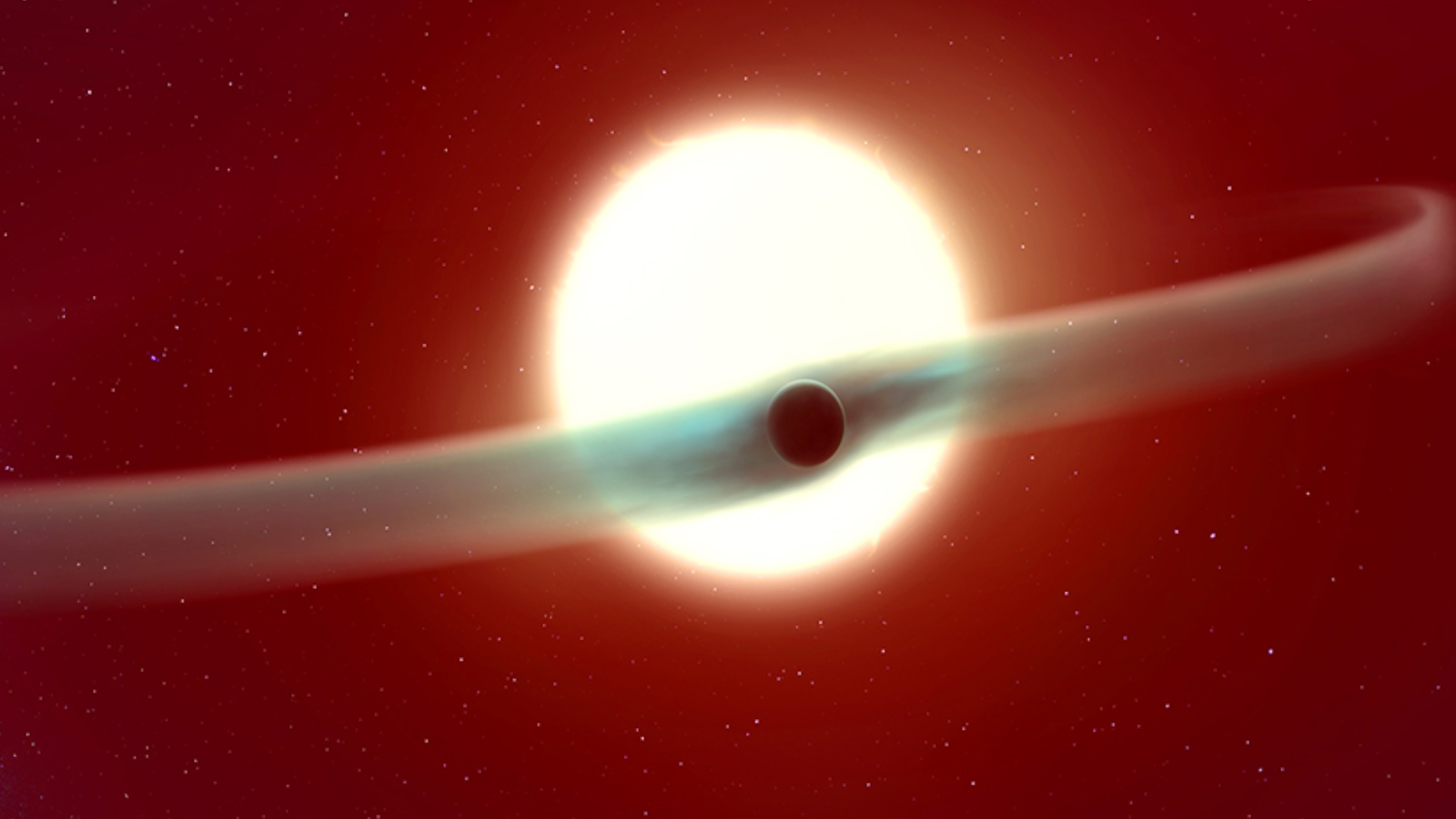
Astronomers have used the James Webb Space Telescope (JWST) to discover that a distant “hot Jupiter” planet has two staggeringly long tails composed of helium that currently defy explanation. The observations represent the first study of gases leaking from a planet beyond the solar system during one of its complete orbits, and help paint the most complete picture of atmospheric escape thus far.
The extrasolar planet, or exoplanet, in question is WASP-121b, also known as “Tylos,” located around 858 light-years away. WASP-121b is an example of an “ultrahot Jupiter,” a massive gas giant planet found so close to its parent star that it can complete an orbit in a matter of hours. As WASP-121b whips around its star once every 30 hours, intense radiation from its stellar parent heats its atmosphere to around 4,200 degrees Fahrenheit (2,300 degrees Celsius).
You may like
“We were incredibly surprised to see how long the helium escape lasted,” team leader Romain Allart, of the University of Montreal, said in a statement. “This discovery reveals the complexity of the physical processes that sculpt exoplanetary atmospheres and their interaction with their stellar environment. We are only beginning to discover the true complexity of these worlds.
A tale of two tails
Helium is one of the most important tracers of atmospheric escape from exoplanets, and the incredible sensitivity of the JWST allows the element to be observed at vast distances. Tracking the light absorbed by helium atoms, the researchers found that the envelope of gas around WASP-121b stretches out far beyond this hot Jupiter. The helium signal lasted for over half the orbit of the planet, making this the longest continuous detection of atmospheric escape yet.
The most remarkable thing about this investigation is the fact that the helium leaking from WASP-121b forms two distinct tails, one of which is pushed back behind the exoplanet by radiation and stellar winds from its parent star. The other tail leads the planet in its orbit, likely pulled forward toward the star by its gravity.
Combined, the helium tails are 100 times as long as WASP-121b is wide, and three times the distance between the hot Jupiter and its star. And the dual tails are something that scientists can’t explain with current models.
“Very often, new observations reveal the limitations of our numerical models and push us to explore new physical mechanisms to further our understanding of these distant worlds,” team member Vincent Bourrier, of the Department of Astronomy at the Faculty of Science of the University of Geneva, said.
The team’s research was published on Monday (Dec. 8) in the journal Nature Communications.