
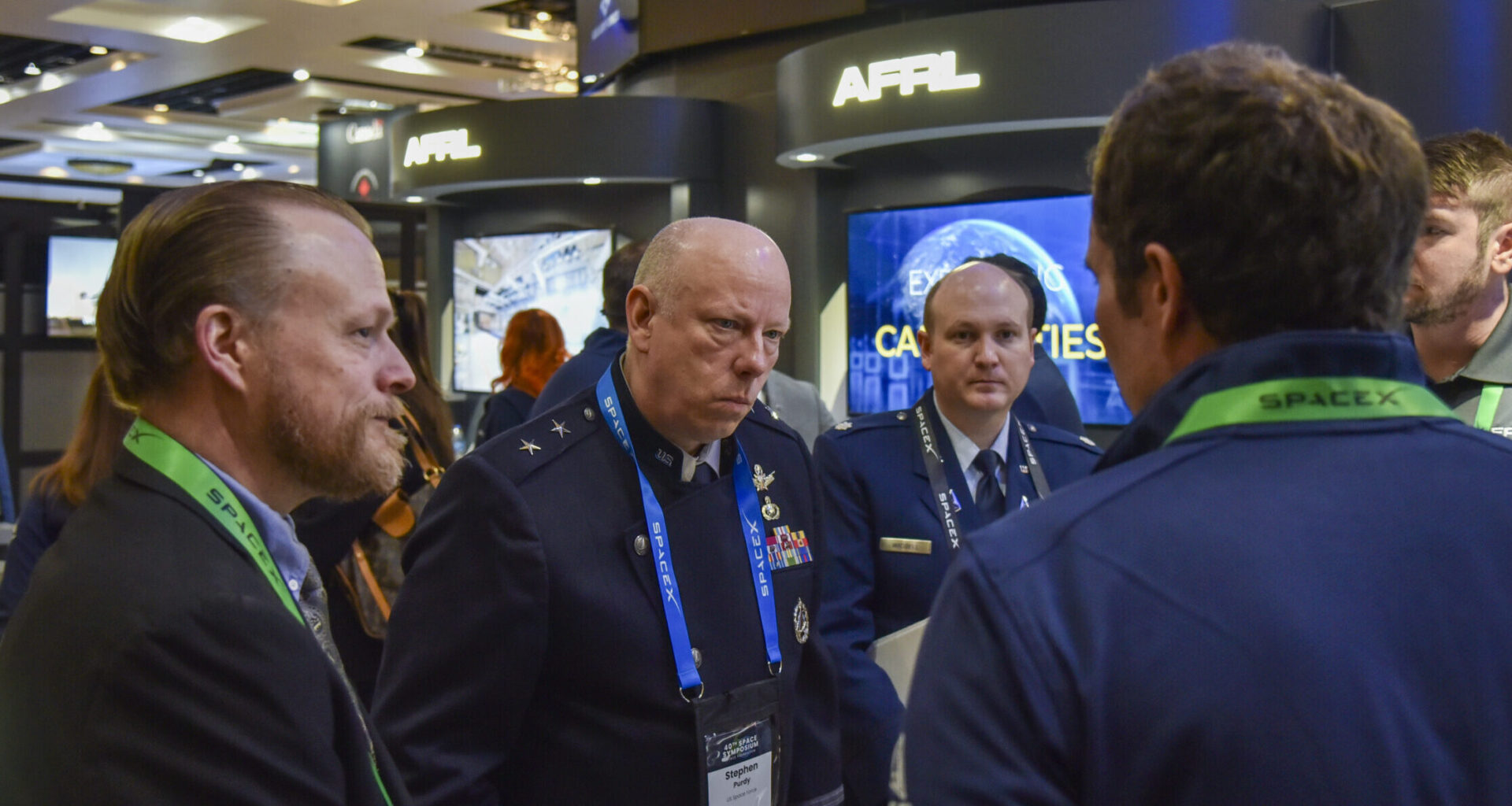
SPACEPOWER 2025 — Senior Space Force acquisition officials are worried about the impact of losing the ability to award Small Business Innovation Research (SBIR) grants as Congress wrestles with reauthorization of Pentagon rights to use the program.
“I’m actually very concerned,” Maj. Gen. Stephen Purdy, acting space acquisition head for the Department of the Air Force, said today.
SBIR grants are widely used by the Space Force to provide seed funds to commercial firms and startups, of which there are many in the space marketplace, he told reporters on the margins of the Space Force Association’s Spacepower 2025 conference here in Orlando.
Purdy explained that he agrees there are parts of the program that “need to be fixed,” but that SBIR grants, along with the Strategic Funding Increase (STRATFI) and Tactical Funding Increase (TACFI) programs, “have been very beneficial to the Space Force” because of the “huge industrial base” of innovative commercial companies.
“My only emphasis is, let’s not throw the baby out with the bath water,” Purdy said.
STRATFI and TACFI were designed by the Air Force to “bridge the valley of death” for small firms between a Phase II SBIR grant and what is called Phase III, which is a contract that follows on from earlier SBIRs grants funded by other sources to transition a program into actual production, according to AFRL’s website.
Pudry stressed that SBIRs not only help the service get new blood and new thinking into the technology development mix, but also benefit companies, especially startups funded by venture capital, by helping them obtain and maintain a stable funding base.
“I think what’s lost sometimes in that whole discussion of the benefit of that whole process is there’s a venture capital or private equity backing that happens to those companies that’s part of that,” he said. “[B]ut venture capital and private equity only go so far. They want to see government interest. … And it turns out the SBIRs in Phase IIs/Phase IIIs and STRATFIs and TACFIs are seen by private equity and venture capital as government interest.
“And so that’s where I’m like, ‘Oh man, I can’t lose that vital feeder,’” Purdy added.
Kelly Hammett, director of the Space Rapid Capabilities Office (RCO), told reporters here Thursday that while he understands the reason for the SBIR debate during the discussions on Capitol Hill about the fiscal 2026 National Defense Authorization Act (NDAA), he also is concerned about the potential negative affects on his program plans.
“This has been one of the contentious issues, and I actually see both sides of that coin. There are those who say you need the SBIR program to seed money into non-traditionals and bring new entrants into the portfolio. And then the critics say, ‘Well, but what are we getting out of that?’ Because the dollar thresholds are so low, you don’t typically get a product out of them. You get a study,” he said.
Space RCO has been “attacking” that problem by trying to raise the funding caps for SBIR awards and focusing its small grants on products and capabilities that are very close to being ready for prime time, Hammett explained.
At least one of the office’s efforts is in a holding pattern due to the congressional impasse, he said: a planned request for proposals (RFP) new program aimed at the development of “agile” satellite busses that enable greater maneuverability on orbit for surveillance and orbital warfare purposes.
“[W]e’ve been trying to stimulate both industry interest in self-investment in IRAD [independent research and development], as well as tech maturation interest from AFRL [Air Force Research Laboratory] and SpaceWERX to start building out and developing and actually getting flight pedigree on systems that can move around in orbit,” Hammett said.
He explained that such highly maneuverable satellites “can do reconnaissance in space” and provide more timely intelligence than the current constellation of Geosynchronous Space Situational Awareness Program (GSSAP) birds, which are “not very agile” and take “a long time to creep around the belt and take a look at things.”
Further, Hammett said, maneuverability is going to be key to fighting in space.
“[W]e need to be able to run away if bad guys are coming at us, and we need to chase them down if we’re trying to conduct offensive space operations,” he said.
Hammett said that Space RCO held an industry day back in August that served as a “kind of curation of vendors who were working on bus technology that’s like this. And there are largely a bunch of new entrants; it’s not your traditional defense primes. A number of them are here today: K2; Turion.”
K2 Space, headquartered in California, was founded in 2022 to build very large satellites that can be used in any orbit, and intends to launch its first “mega-class” satellite next March, according to a Dec. 11 company press release.
Turion Space, founded in 2020, also is based in California. It is focused on building a series of different sized spacecraft called DROIDs designed for (relatively) rapid and/or long-duration maneuvering, as well as rendezvous and proximity operations, according to the firm’s website.
Hammett said the reason his office has not yet released the RFP is because they are not sure what the status of SBIR and TACFI funding for FY26 and beyond is going to be.
That said, he noted that he believes there is a “commitment” from AFRL and SpaceWERX to publish requests for information and fund “a couple of STRATFI efforts” if and when the SBIR authority is reauthorized.