
Stay informed with free updates
Simply sign up to the Airlines myFT Digest — delivered directly to your inbox.
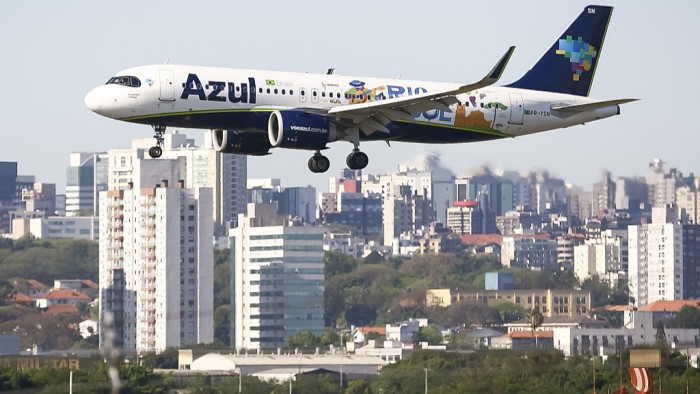
United Airlines and American Airlines will take stakes in Brazil’s Azul after a New York judge backed a restructuring plan that would see the carrier leave Chapter 11 within weeks.
On Friday, judge Sean Lane of US bankruptcy court in Manhattan approved Azul’s proposal to convert debt to equity and reduce the equity interest of other shareholders as part of a $950mn fundraising that will lower the company’s overall debt burden.
Its plan to restore its financial health has seen it cut some routes and reduce the number of older aircraft in its fleet to shave leasing costs that had hamstrung it before its bankruptcy.
“I believe that Azul is fixed,” chief executive John Rodgerson told the Financial Times, adding the company would take a “more conservative” approach to growth targets in the future.
Azul has shaved some $300mn from its leasing costs, he added.
The Brazilian carrier entered bankruptcy protection in May, the last of the country’s major airlines to opt for reorganisation, following rivals Gol and LatAm, the region’s dominant brand. After Friday’s ruling Azul expects to formally exit Chapter 11 by the end of January or early February.
When it entered Chapter 11, it had about $6.5bn in total debt and leases, and is expected to emerge with around $3.7bn.
Latin America’s aviation sector is still recovering from the lingering effects of the Covid-19 pandemic, which have been compounded by currency volatility and higher costs.
Unlike peers in the US and many European countries, the region’s airlines did not receive direct state assistance during the pandemic, leading many to enter bankruptcy proceedings.
United already holds a stake of about 2 per cent in Azul, but will increase its holding as part of the process, while American Airlines will acquire a stake as part of the deal. Both airlines would hold less than 10 per cent and would each have a board seat, Rodgerson added.
American Airlines will also sign a “code sharing” agreement with Azul, a standard airline deal that sees each partner run flights on behalf of the other on relevant routes. United already has such a deal with Azul.
About $3bn of debt would get converted into equity as part of the process, Rodgerson added. Existing shareholders will see their holdings significantly devalued. Some 90 per cent of Azul’s creditors have approved its plan, he added.
The bankruptcy process also saw merger talks terminated between Azul and Gol, which is owned by Colombia’s Abra Group. The combination would have created Brazil’s largest carrier.
Although Abra at the time said it still believed in the future of the combination, Rodgerson stressed Azul was “focused on our core business”, and ruled out further talks for the time being.
“I’m excited to have a couple of boring years in front of us,” he added. “We were in this survival mode for the better part of five years”.
Azul will leave Chapter 11 with net debt at about 2.5 times its earnings — compared with more than 3 times when it entered. It has a plan to cut that to 2 times by the end of 2026, and then again to 1.5 times by 2027.
Rodgerson said Azul, whose stock is quoted on São Paulo’s B3 exchange, planned to eventually relist its shares in the US. Founded in 2008, Azul challenged LatAm and Gol’s dominance of Brazilian aviation by focusing on smaller cities not served by competitors.