
COLUMBUS, Ohio — Cleveland State University’s radio station transfer to Ideastream is just the latest Ohio student-radio station to switch hands to nonprofit control.
In recent years, the terrestrial signals for Denison and Wittenberg universities were transferred to public radio operators. Ohio Northern University sold its station and frequency to the Diocese of Toledo. Currently, there are about 18 student-run college radio stations in Ohio.
Since the 1990s, dozens of universities across the country have sold or leased their FM signals, citing budget pressures or “strategic partnerships.”
This includes St. Olaf College’s WCAL, which was sold to Minnesota Public Radio in 2004; University of San Francisco’s KUSF, was abruptly pulled off air in 2011 and sold to the Classical Public Radio Network; and Georgia State’s WRAS, which was given to Georgia Public Broadcasting for daytime hours in 2014, negotiated without student input.
But it is a disturbing trend, said Rob Quicke, founder of the College Radio Day and the College Radio Foundation, and director of the W. Page Pitt School of Journalism and Mass Communications at Marshall University in Huntington, West Virginia.
Quicke and others began College Radio Day, observed every Oct. 3 — coincidentally the same day as when CSU pulled the plug on WCSB — to celebrate the contributions of college radio.
“We’ve seen this happen again and again, and this is a disturbing trend from my perspective, because once a university decides to take away the radio station from the students and give it to another entity, that’s a huge ongoing loss that’s going to affect future generations who won’t have their voices heard,” Quicke said.
College administrators, including those at CSU, hand off student stations without fully realizing the value they provide to students, the university and the community. At the same time, public radio organizations – which most frequently take over the stations – are eager, Quicke said.
”There’s clearly value in these college radio stations. Otherwise, these public radio stations wouldn’t want them,” he said.
WCSB programming was “flash cut” to Ideastream at 11 a.m. on Oct. 3, meaning the signal stopped originating from the WCSB Broadcast Operations Center in the Cole Center at 3100 Chester Ave. in Cleveland and immediately began airing from Ideastream Public Media’s studio in Cleveland’s Idea Center, 1375 Euclid Ave.
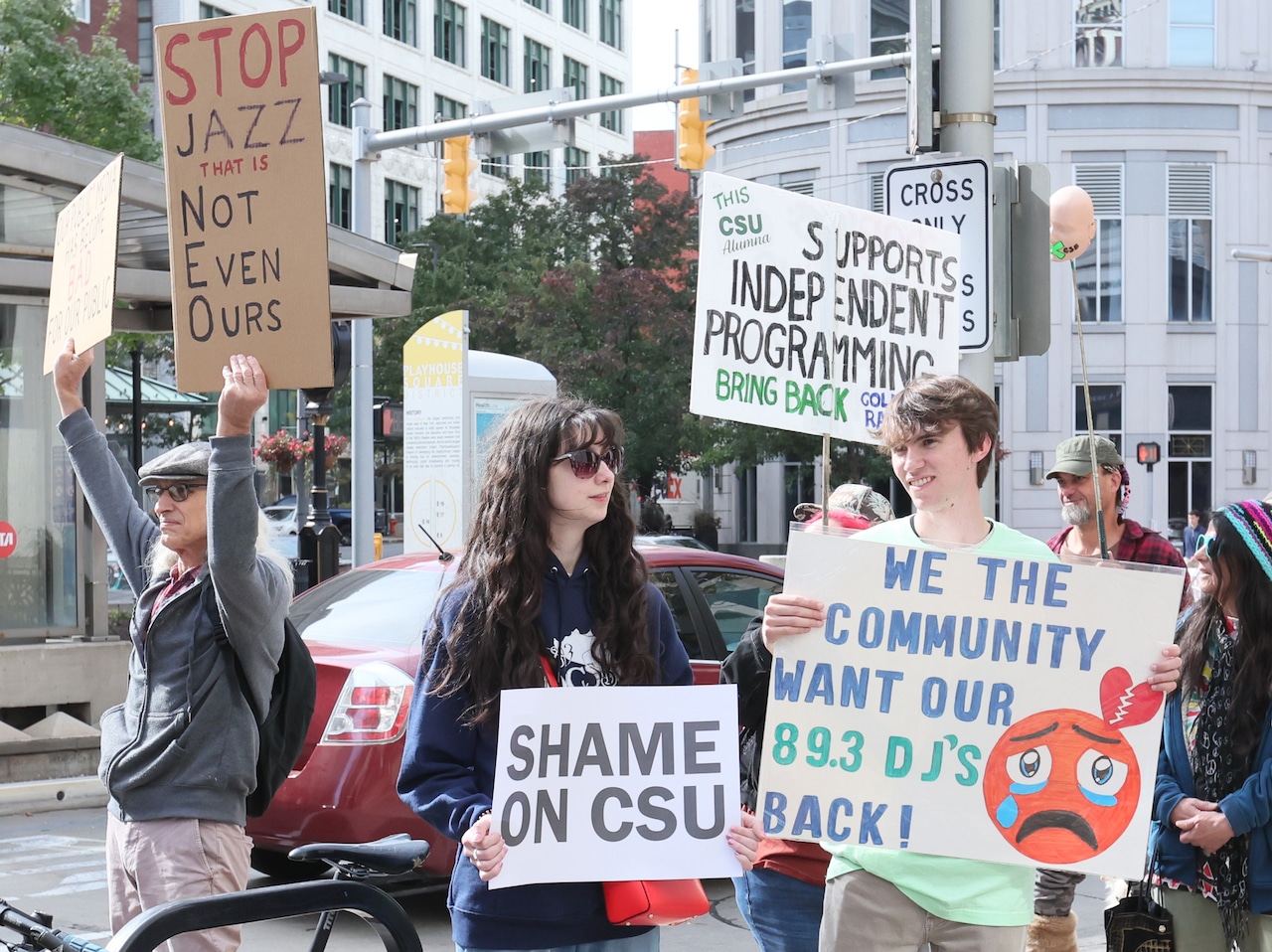
While students and community volunteers aired a variety of music and talk programs on WCSB – 89.3 FM, Ideastream converted the station to JazzNEO, a 24/7 jazz station that had digitally broadcast since February 2024.
For students and community members, the announcement was unexpected, as the school provided no warning they were pulling the plug until the transfer occurred.
Since then, students and community members have protested the decision. New information shows that CSU may have violated state sunshine laws in closed-door meetings with Ideastream. CSU signed a nondisclosure agreement six months before the transfer, which kept discussions over the transaction under wraps.
University officials tend to underestimate the value of their student radio stations, said Quicke of College Radio Day.
“A university could spend $10,000 on a mail drop of leaflets or postcards, or you can actually put that money into the college radio station, which often is broadcasting athletics and culture programs and talk shows and local music and events,” he said. “You’re going to end up having a far larger reach.”
There’s still a lot of people who listen to the radio, Quicke said.
“This is one of the things that we fight against continually, not just for the College Radio Foundation, but generally, even within my academic field of radio and audio, the idea that radio is dead.
“It’s not dead just because it’s an old medium with a storied legacy and history. Radio is a place that people turn to in times of crisis,” Quicke said.
This lack of understanding of the station’s value is why CSU didn’t demand any money from Ideastream, Quicke said.
CSU is only getting 1,000 aired announcements that the university is the station’s licensee and underwriter of WCSB, Ideastream’s classical station WCLV and television station WVIZ. CSU President Laura Bloomberg gets a seat on Ideastream’s board. Additional aired messages will recognize CSU and Ideastream’s strategic collaborations.
“That pales in value to what the students actually had, which was their own broadcast entity,” Quicke said.
Denison’s The Doobie
While CSU handed WCSB operations to Ideastream without receiving a dime, WOSU Public Media paid Denison University $5,000 to purchase some equipment for the 2020 transfer of WDUB-91.1 FM, the Columbus Dispatch reported.
Denison is a liberal arts school in Granville, about an hour east of Columbus.
Furthermore, WOSU was to provide paid internship opportunities to Denison students – a provision that was not guaranteed in the CSU-Ideastream agreements. In late October, as public outrage against CSU continued, the university announced a committee that would design experiences for students to participate in the radio station.
Perhaps most importantly, the Denison student-run station – known as “The Doobie,” after its former call signals of WDUB – lives on with online streaming. At the time of the station transfer to WOSU, the station was off air due to new Federal Communications Commission regulations the school considered too burdensome. Programming had already been streaming online.
Quicke of College Radio Day said that the programming on college radio stations that solely broadcast online remains solid. But there are drawbacks, even if a college no longer has to comply with FCC regulations.
“When you (online) stream only there’s a high degree of intentionality that the audience has to have in order to find you,” he said. “When you’re on the radio, people can stumble upon you. They can still go through the dial and find you that way. I think colleges and universities disingenuously say, ‘Well, listen, you can stream.’ It’s a huge loss to a radio station if you had the FM terrestrial license. That’s as legitimate as you can get as a broadcasting entity.”
Today, The Doobie continues to host its annual music festival, Doobie Palooza, and publishes Doobie Magazine, about music trends and the Central Ohio music scene.
Cleveland.com | The Plain Dealer reached out to CSU spokespeople, asking why the WCSB wasn’t streaming online at the time of the transfer, and whether that could be a way to resurrect the station.
“The former student run radio station at CSU functioned as a recognized student organization,” said Kristin Broka, CSU’s associate vice president of marketing and communications. “Like all student organizations, there are practices, guidelines, policies and procedures that they are required to follow. The student organization can and will determine their preferred activities to advance student engagement on our campus.”
Wittenberg and ONU
Wittenberg University, based in Springfield, reached an agreement in 2017 with Dayton Public Radio Inc. for WUSO – 89.1 FM to broadcast the public radio station’s content eight hours a day, from 6 a.m. until 2 p.m., seven days a week, said Karen Gerboth, Wittenberg’s vice president of marketing and communications.
Dayton Public Radio eventually expanded to full-day simulcasting with the signal. In 2023, the college transferred the FCC license to the organization. Today, Dayton Public Radio broadcasts classical music from the signal.
“We had considered a digital station back in 2023, but we never moved forward as student interest was not there to pursue this extracurricular option,” Gerboth said.
An hour southwest of Toledo in Hardin County, students ran WONB- 94.9 FM from campus at Ohio Northern University, from 1991 through 2020. Then it closed the station and sold the frequency, said Dave Kielmeyer, Ohio Northern’s executive director of the college’s Office of Marketing and Brand Strategy.
“The University had eliminated its minor in media broadcasting several years earlier,” Kielmeyer said.
The Diocese of Toledo operates 94.9 FM, with content from Holy Family Radio, with syndicated Catholic programming, he said.