
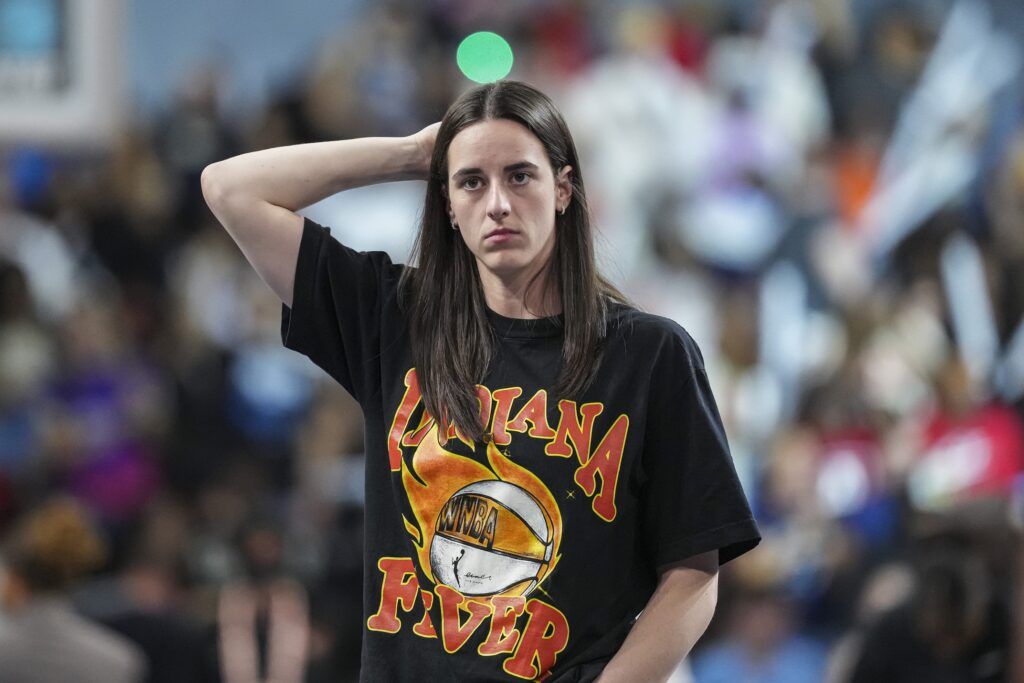
Despite being out of action for a majority of the last WNBA season, Caitlin Clark is still a central talking point in the basketball community.
A major subject of debate in this discourse is whether Clark has single-handedly brought significant attention to women’s basketball and whether acknowledging her impact diminishes the efforts of those who came before her.
Stephen A. Smith and Cori Close Push Back Against Caitlin Clark Criticism
UCLA’s women’s basketball head coach, Cori Close, recently appeared on “The Stephen A. Smith Show,” where they discussed the impact of Caitlin Clark on the WNBA.
“I am a Caitlin Clark fan. I’m not talking about her just as a player. I am talking about the marketing wizardry that comes associated with her,” Smith admitted.
“I believe in the saying, ‘A rising tide lifts all boats.’ Even though I am certainly not speaking about most or all, there were some who were resistant to the impact that she was bringing to the WNBA, and I was like, ‘You’re not seeing the big picture.’ That’s where I was coming from. Was I wrong in feeling that way?” he asked Close.
“I actually had the opportunity to coach Caitlin Clark in USA basketball,” Close responded. “Even back then, she had a charisma about her that was infectious around everyone she came in contact with.”
Close highlighted that belonging to rival teams should not necessarily hinder one’s ability to appreciate the impact of others. She brought up examples of her own squad acknowledging what JuJu Watkins is doing over at USC, while the Trojans return the favor for UCLA’s Lauren Betts.
“I think that you have to have a broader view of growing the game if you’re really gonna appreciate it, as you referred to,” Close continued. “The reality is that Caitlin Clark has raised a level of fan base that has broadened and deepened it, and we’re all benefiting from it.”
Close and Smith’s comments come amid growing arguments around the alleged erasure of the WNBA’s history. Critics continue to argue that in the rush to crown a new face of the league, the narrative has often framed Clark as a “first” rather than a continuation of greatness built by former players.
A’ja Wilson’s recent comments for her Time 2025 Athlete of the Year cover further stoked the argument. The claim that Clark singularly salvaged the league bothered the four-time MVP winner.
“Let’s not lose the history,” Wilson said. “It was erased for a minute. And I don’t like that. Because we have tons of women that have been through the grimiest of grimy things to get the league where it is today.”
What makes this argument particularly fraught is that Clark herself has repeatedly acknowledged the players who paved the way. The disconnect lies less with the athlete and more with the ecosystem around her–television segments, debate shows, and social media discourse that flatten history into a single storyline for more palatable, bite-sized narratives.