
Last updated on Dec. 13, 2025 at 04:37 p.m.
In the fall of 2024, Wilbur Milhouse III, a member of the University of Illinois Board of Trustees, visited the University’s Prairie Research Institute and was shown the Net-Zero Center of Excellence, described as a “hub” for cutting-edge decarbonization technologies.
He saw firsthand, as the press release stated, how the PRI is tackling some of the world’s most pressing environmental challenges and elevating the University as a “leader” in sustainable energy.
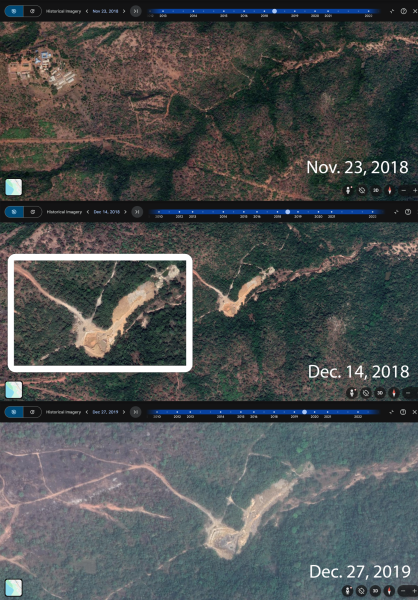 Satellite images taken from Google Earth show the mine during 2018 and 2019.
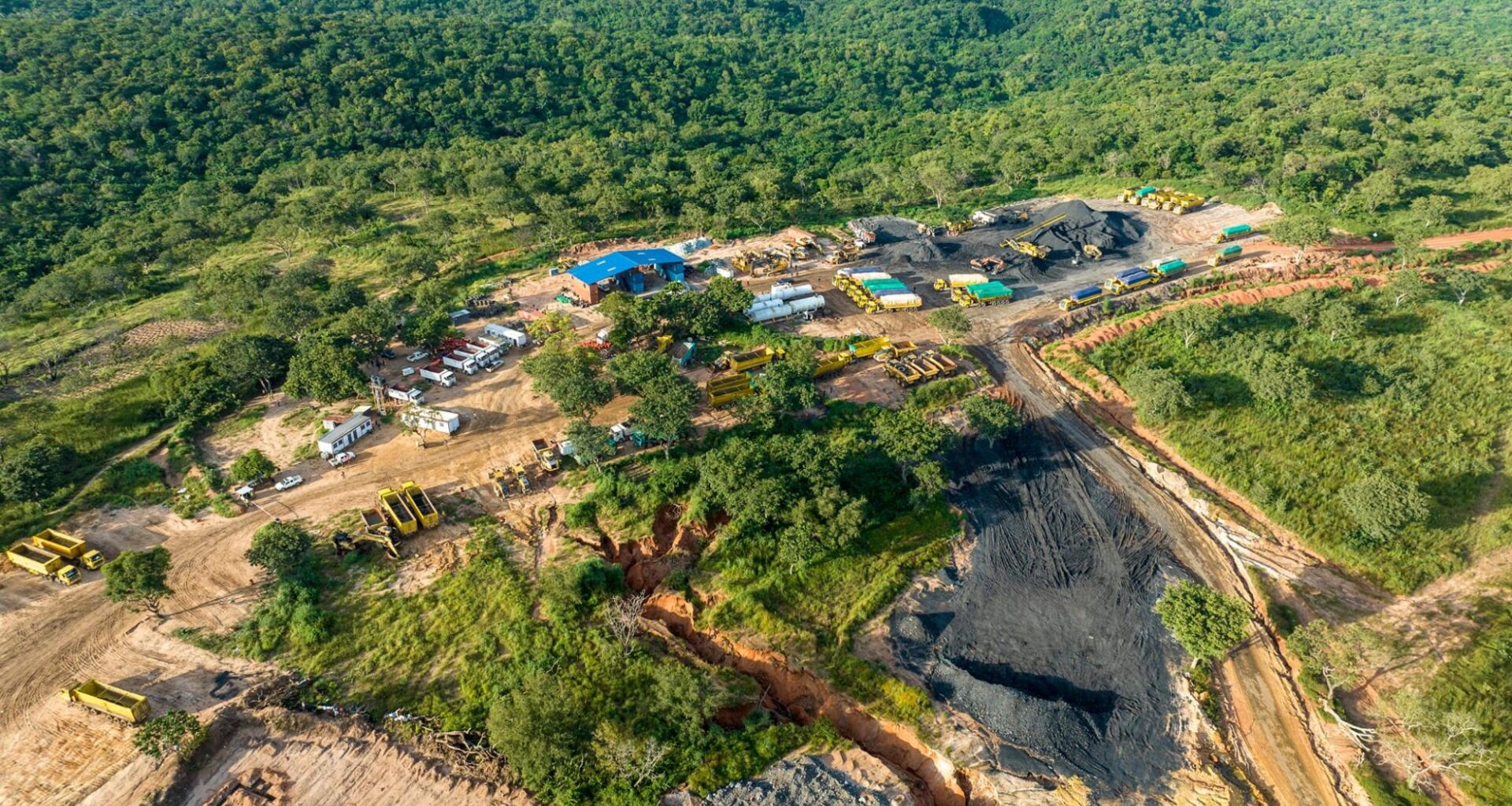
But thousands of miles away in the Nigerian state of Enugu, Milhouse III and one of his namesake companies, Milhouse Energy, own a coal mine that has itself been accused of environmental degradation and other illegal operations, The Daily Illini has found.
Despite being briefly shut down after allegedly falling into the control of a “rogue” mining operation that the company contracted with to run the mine, Milhouse III’s company is said to be trying to continue with the project.
The trustee has said he views it as a way to bring power to a country in critical need of consistent electricity. As of 2023, according to the World Bank’s global electrification database, 61.2% of Nigeria’s population had access to electricity, compared to 100% in the United States.
The Enugu mine, located in the Awhum area of the state, is part of a broader Nigerian coal venture by the trustee’s company — a plan which was at one point expected to reach billion-dollar investment sums.
Milhouse III’s coal development has also raised questions about his commitment to clean energy goals.
Activists have called for system-wide divestment from fossil fuels. The broader UI System has signed on to commitments recognizing climate change as a climate emergency, but has not committed to forms of fossil fuel divestment.
Milhouse III is not alone in investing in foreign mining ventures, however. According to public investment reports, the UI System since 2022 has invested millions of dollars annually in Tembo Capital Mining Fund, a private equity firm that supports mining projects around the world, specifically the extraction of materials such as copper and critical minerals.
The UI System told The DI in a written statement that its investment in Tembo “recognizes the role that innovation and emerging technologies play in the transition to a lower-carbon economy,” and highlighted Tembo’s support of mining projects that supply minerals used in clean energy and renewable technologies.
Divestment from fossil fuels by 2025 was one of the main objectives for the University in the 2020 Illinois Climate Action Plan, though it has since changed stances.
A University web page on divestment states, “There is little evidence or research indicating that divestment or other exclusionary strategies meaningfully achieve the goals of such campaigns,” adding that the University and the University of Illinois Foundation — the fundraising and gift-receiving arm of the UI System — invest in funds that support, among other things, renewable energy.
University pages about Milhouse III mention his Nigerian energy ventures, but refer to plans for plants as “thermal” rather than coal projects.
Lincoln Dean, a representative for activist group Fossil Free Illinois and sophomore in ACES, said that the mining of coal is an “inherently problematic process.”
“The evacuation of coal will produce fossil fuels that damage the whole world and are costing lives,” Dean said. “The climate crisis is happening right now … I don’t think it’s a good sign for his leadership on the board.”
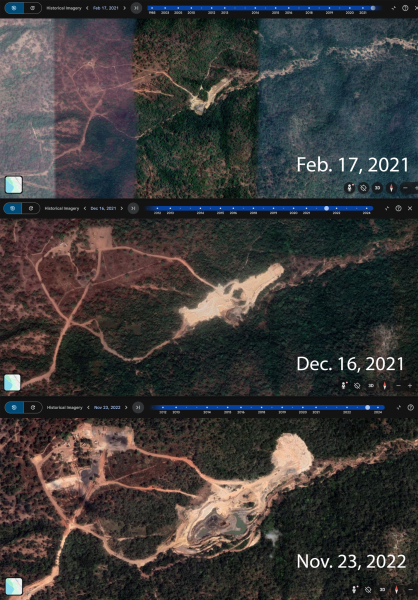 Satellite images taken from Google Earth show the mine in 2021 and 2022.
According to the United Nations, coal is a fossil fuel that is among the energy sources most responsible for climate change and global emissions.
Milhouse III did not comment for this story.
His main company, Milhouse Engineering and Construction, is behind high-profile construction projects both nationally and in Illinois, such as developments at the O’Hare and JFK International Airports, the upcoming Bally’s casino in downtown Chicago and various buildings throughout the UI System.
Representatives made clear to The DI that Milhouse Energy, a company referred to throughout this article, is a separate entity from Milhouse Engineering and Construction, although they are still under the primary ownership of Milhouse III.
Along with serving on the Board of Trustees, Milhouse III is also the director of an energy procurement corporation run by the UI System. In October 2024, he was also appointed as chairman of the board for the Illinois Quantum and Microelectronics Park.
During an interview with The DI shortly after he was appointed in Spring 2023, Milhouse III said the Enugu mine project was “stalled.”
Both before and after that initial interview, the mine developed significantly, as satellite images show. (The satellite images and coordinates of the mine have been independently confirmed by matching them to available photos shared online by the Enugu state government.)
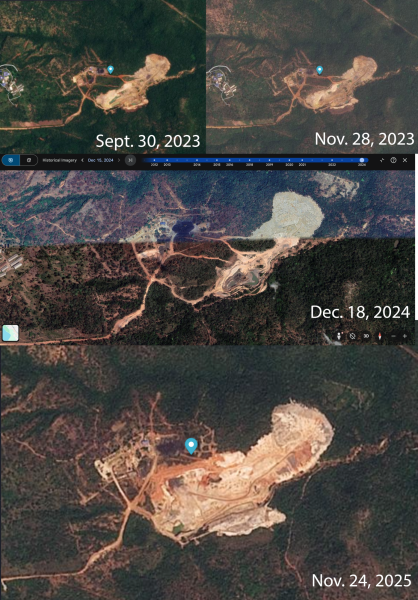 Satellite images from September and November 2023 as well as photo from Nov. 24, are via Planet Labs satellite imagery, while others are taken from Google Earth.
Later, in September 2023, the mine was briefly shut down. Milhouse Energy, along with another company, African Pits & Quarries Limited, or APQ, was punished by government authorities for a range of illegal operations, including environmental, labor and tax violations.
Cory White, chief legal officer for the Milhouse family of companies, said in an interview with The DI that Milhouse Energy owns but does not currently have control of the mine. He added that any alleged violations and any mining done so far at the site has been done under the purview of APQ, a mining company that Milhouse Energy contracted with several years earlier to run the operations and construction of the mine.
APQ declined to comment for this story.
White called APQ a “rogue mining operation,” which he says is squatting on the development and has not been giving agreed-upon shares of proceeds or oversight. The two companies, he said, are currently embroiled in a legal dispute over control of the coal mine.
White told The DI that Milhouse Energy, which he says is a Nigerian company organized in Delaware, started in 2016.
Philanthropy and profit
In the 2023 interview, Milhouse III, a University alum, talked about his primary reasons for the project.
“From a philanthropic standpoint, I want to help people,” Milhouse III said. “When you see the intense poverty there, you want to figure out, well, how can we help (Nigeria) grow? You look for ways to be able to do that, and frankly, there’s a lot of money to be made in producing power, producing development.”
In the same interview, Milhouse III mentioned meeting with people in Nigeria who said they didn’t even bother to refrigerate food due to inconsistent and costly diesel generation. He added that the village his company was operating in is very poor.
“Most of the villagers don’t have power,” Milhouse III said. “If the grid comes on, it probably comes on for about two hours, three hours a day (or) week.”
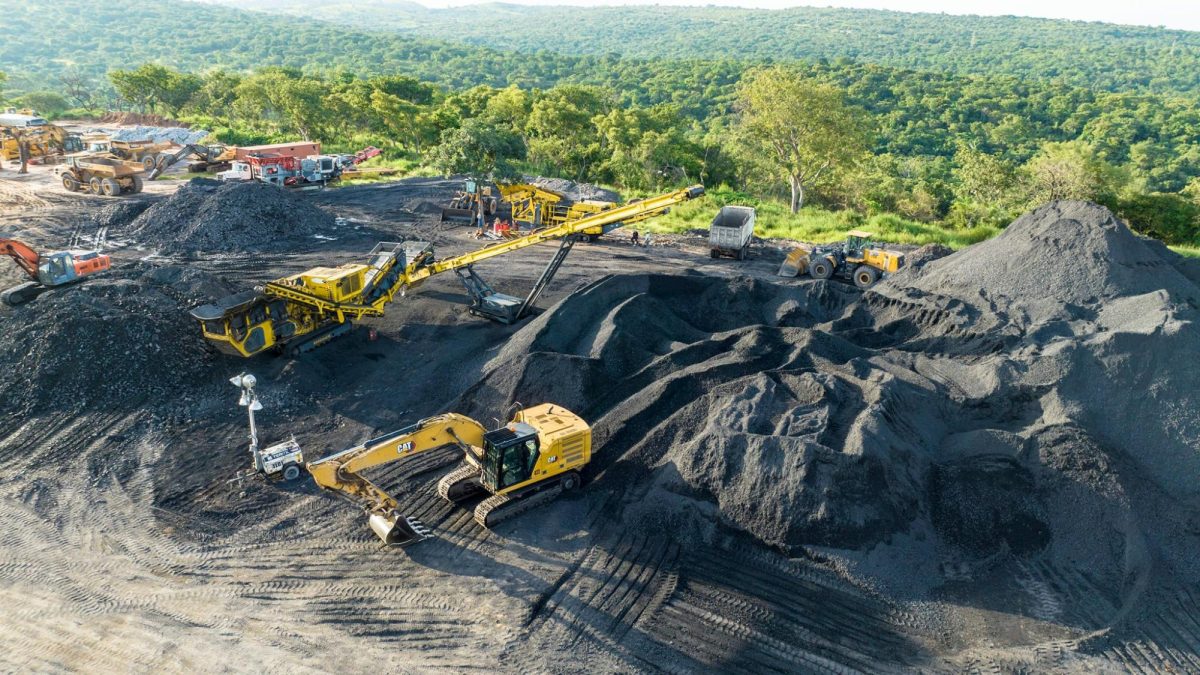 Photos of the mine released by an Enugu government spokesperson via Facebook after the mine was shut down for illegal operations in September 2023.
An initial plan, according to media reports and press releases including a since-removed Chicago Tribune article, involved building 100 “mini-plants” that would be part of a wider network of coal infrastructure in Nigeria. Milhouse Engineering and Construction signed an agreement with the Nigerian government for the project in 2015.
In a 2015 YouTube video, Milhouse III told reporters that the investment in the larger project, which would start with a planned plant located at the University of Nigeria, Nsukka, that would convert coal from a mine into energy, could eventually end up being in excess of $2 billion.
Milhouse Charities, a philanthropic arm of the Milhouse family of companies, has also expanded operations from the United States and Chicago area to Enugu.
White told The DI that Milhouse Energy has agreements to improve water and infrastructure in the area, as well as ensure that a certain percentage of the people working at the mine are from the surrounding region.
Enugu State has a history of coal production that extends back to colonial times. Abandoned mines — which have harmful effects on both human health and the state’s natural resources — are found throughout the region. Erosion, just one of the local environmental effects of coal mining, has led to the flooding and displacement of farmlands and communities in Enugu.
Despite this, some, like Enugu Gov. Peter Mbah, view the revival of mining and subsequent infusion of investment as a route to development for the state.
Enugu’s situation is only one story in a debate about whether African countries seeking paths to greater prosperity should invest in the extraction of fossil fuels despite environmental concerns.
Recently, mineral and fossil fuel exploitation in Africa has been encouraged by financial interests in Washington, D.C. and Trump administration officials like Secretary of Energy Chris Wright, who spoke to a group of African leaders at a conference in March.
White told The DI the current goal for the project is “to mine this coal and then work with the existing power infrastructure in Nigeria to supply viable coal for power plants that already exist as a method of getting fast, reliable energy to the country.”
The struggle for Enugu’s coal
White said he couldn’t pinpoint how much money has been invested in the Enugu project to date but said it was a significant amount.
“Over the past 10 years, when you look at total investment, it is substantial, because it’s not just a matter of investing money to pay folks in Nigeria, but it’s also the investment of time with infrastructure here in the United States,” White said.
White said Milhouse Energy drilled for four years in exploration at the Enugu mine around the period from 2016-2020, and partnered with APQ in 2021 to handle mining operations.
According to a page on the Milhouse family of companies website published in 2022, Milhouse Engineering and Construction sent officials to Nigeria in order to offer environmental compliance and training.
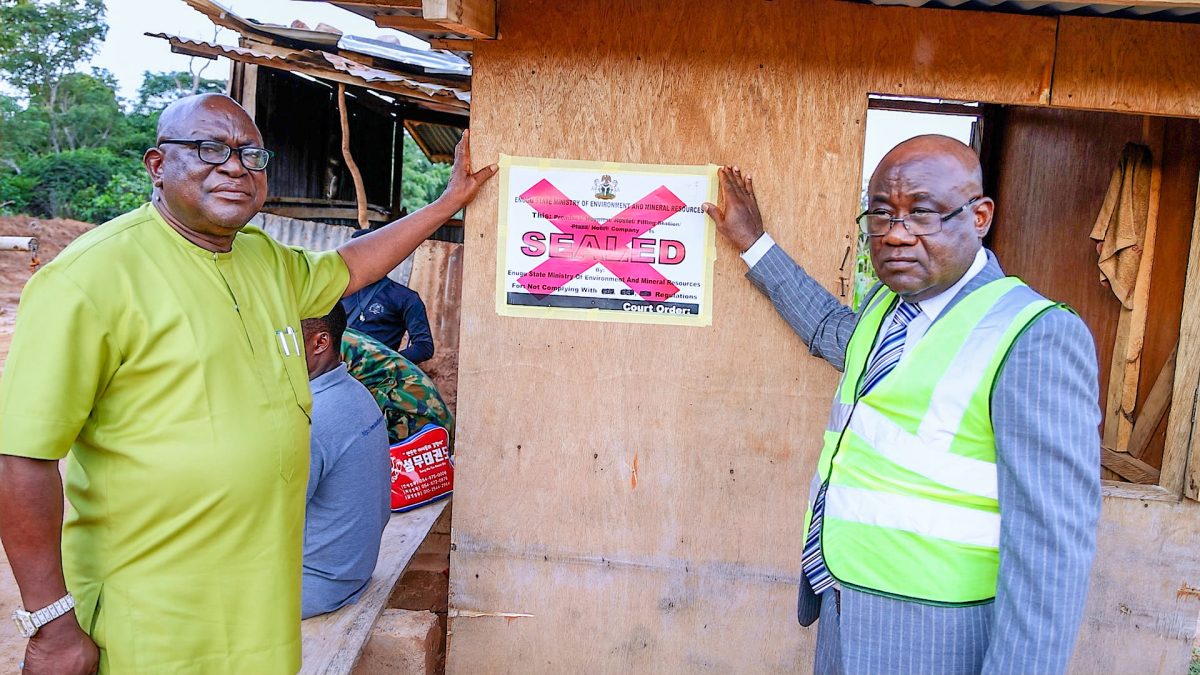 Officials in front of an order to seal the mine in September 2023. (Photo courtesy of Dan Nwomeh via Facebook)
In 2023, White said, APQ decided it would not honor terms of its contract with Milhouse Energy and would start selling and mining coal without Milhouse Energy’s involvement.
In September 2023, as part of Mbah’s campaign to shut down illegal mining activity and foster “government inclusion” in mining activities, officials from the government closed down the mine. The Enugu High Court also placed a restraining order on the two companies, restricting them from using it.
The government accused Milhouse Energy and APQ of “environmental degradation to blasting without approval and due regulations, non-remittance of staff tax to the state government despite deducting same from the staff as well as non-remittance of pension contributions to the pension scheme despite deducting same from the staff, among others.”
White said Milhouse Energy is not to blame for any alleged violations at the mine, but the company still had to deal with the punitive measures and is still connected to the situation, as it is the owner of the mine.
Professor Sam Ugwu — a government commissioner for environment and climate change who was part of the raid that shut down the mine — was quoted in Nigerian media reports as saying that the Enugu environment “is still bearing the scars and brunt” of historical mining activities.
“We will not fold our hands and watch that happen all over again,” Ugwu said.
Some Nigerian news reports said local community members believed 50 truckloads of coal were leaving the site per day.
The following month, Milhouse Energy and the government came to a billion-Naira settlement (under $1 million) as well as a N100,000 (under $70) tax on every truckload of coal.
A government statement said that the money will be transparently managed by an independent committee of professionals specifically for the remediation and healing of the affected environment.
Although it is difficult to identify the average price of a ton of Nigerian coal around fall 2023, a South African mining company featured in a June 2023 Reuters article said its average coal export price per ton for the first half of 2023 was $127.
With the settlement, the mine was able to resume operations, according to the Enugu government and media reports.
Though a Nigerian news article in June 2025 alleged that Milhouse Energy was still extracting, White said Milhouse Energy is still not in control of the mine, and thus couldn’t be the ones doing the mining.
“APQ is still on our mind, still mining there,” White said.
White told The DI that Milhouse Energy has a 100-year lease on the land, though that hasn’t been confirmed. He said the goal in getting the mine back “(is) to continue to work towards providing energy to a region in need of it.”
The mining title for a Milhouse Energy mine, outlined in an index released by the Nigerian Mining Cadastre Office, expires in 2042. It is unclear whether the mine listed in the index is the same mine described in this article.
White said Milhouse Energy took APQ to court in February to remove them from the mine and won an initial decision, an excerpt of which was shared with The DI.
“Unfortunately, (APQ) appealed that, which means that judgment has stayed, and they get to continue to operate until we go through the appeals process,” White said. “If we can find a way to force the injunctive relief to get them off the site … we’ll do that.”
Back to the University
According to Dean, the Fossil Free Illinois representative, students don’t want the University or its leaders to be invested in fossil fuel projects.
In a Spring 2025 student referendum, 72.94% of student voters, or 3,178 voters, were in favor of University divestment from the fossil fuels industry, though the total student population on campus is around 60,000 people.
“Why should we trust him to represent the student body and look out for our interests if (Milhouse is) actively going against them in his own work?” Dean said.
Milhouse III, in his 2023 interview with The DI, said he viewed the utilization of fossil fuels as an important tool in bringing Nigeria into the next stage of development.
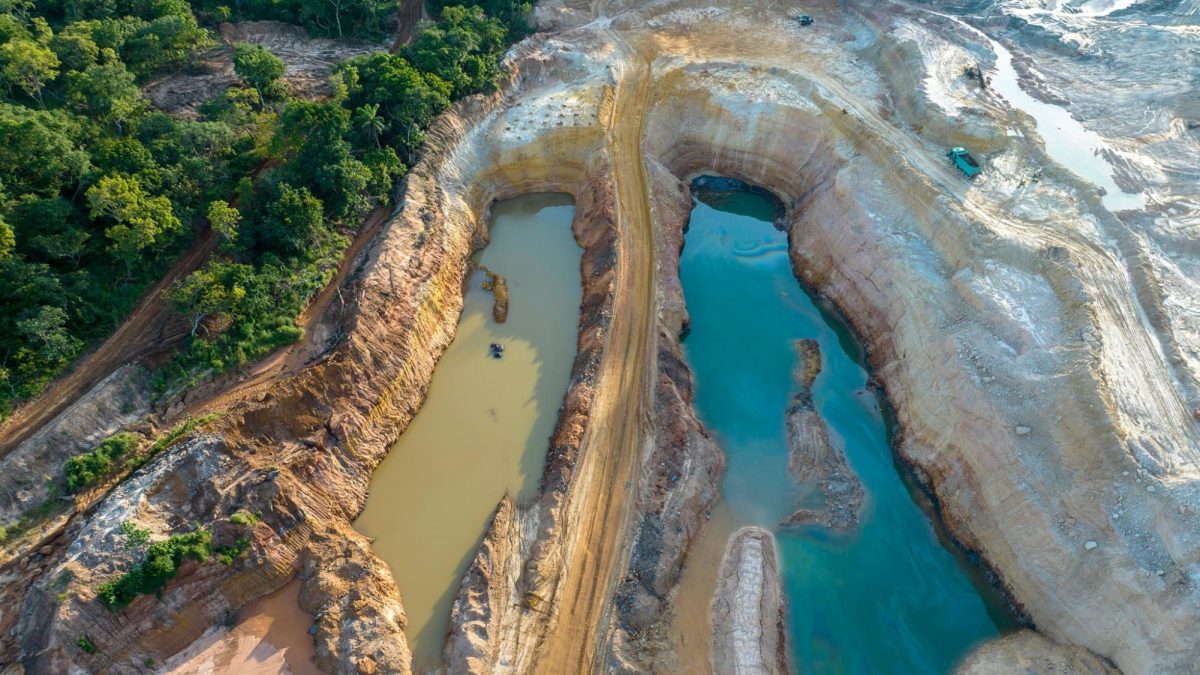 An aerial photo of the mine released by an Enugu government spokesperson via Facebook after the mine was shut down for illegal operations in September 2023. (Photo courtesy of Dan Nwomeh via Facebook)
“Many people feel that any fossil fuel is dirty,” Milhouse III said. “I’m 100% behind figuring out ways to create power that is definitely clean, stable and sustainable, but like with any developing country, Nigeria is about 100 years behind America … We built our country on being able to find ways to utilize fossil fuels.”
Steve Witmer, a spokesperson for the UI System, told The DI in an email that the system does not comment on the personal business dealings of trustees, but wrote that the Board “has policies and procedures in place for board members and staff that help guard against conflicts of interest, including a requirement that board members abstain from deliberations and voting if it would create a conflict of interest — or even the appearance of such.”