
Jeniffer Solis
| Nevada Current
A former mineral processing site in the middle of a treasured desert wetland habitat will soon be cleaned up and restored after a conservation group reached a deal to buy the 18-acre industrial site.
The Conservation Fund — in partnership with the U.S. Fish and Wildlife Service — purchased the longtime industrial processing site within the Ash Meadows National Wildlife Refuge from zeolite manufacturer KMI Zeolite in October for $900,000, according to Nevada Current.
Under the purchase agreement, KMI Zeolite agreed to remove industrial equipment from the site by October 2026. The Conservation Fund said their ultimate goal is to transfer ownership of the property to the U.S. Fish and Wildlife Service, which manages the national refuge.
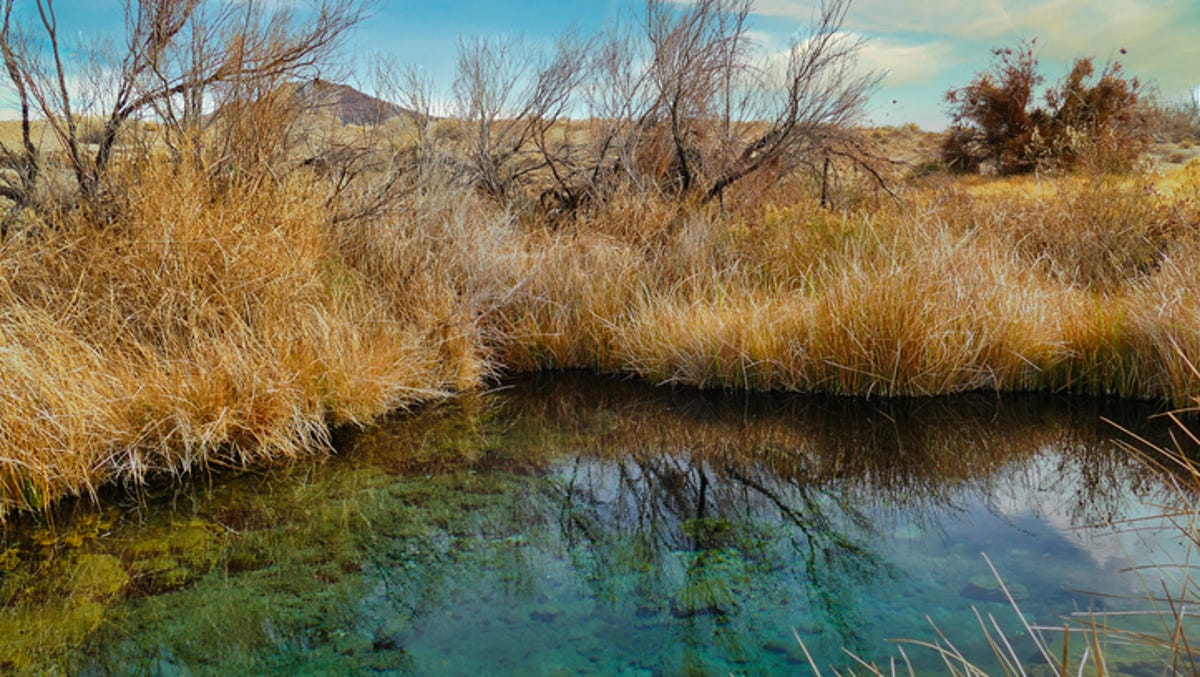
The Ash Meadows National Wildlife Refuge was established in 1984 to protect the desert oasis’ natural springs, and significant populations of threatened and endangered species found nowhere else in the world. However, several swaths of private land purchased before the refuge was established are scattered throughout the area.
The property purchased by the fund has been in private ownership since 1914. Remnants of a former dude ranch that catered to divorce seekers, a motel, and a bar built on the site before it became an industrial site are still present.
While the site is not the largest parcel of private property located in the refuge – that honor goes to a 40-acre Christian camp dubbed “Patch of Heaven” – it is a significant site due to the presence of a spring that supports a large swath of riparian habitat.
It’s also one of the few sites in the refuge still being used for industrial purposes.
“It’s highly visible because it’s right on the entrance road coming in from the south, so you have to drive right past it. Everybody sees it and they wonder what those big buildings are,” said John Hiatt, one of the founding board members of the Amargosa Conservancy.
The Ash Meadows National Wildlife Refuge and surrounding area have a large concentration of zeolite, a clay-like mineral used in water filtration, odor control and soil conditioner. The area has recently attracted applications for new zeolite exploration projects, which received strong pushback from locals and conservation groups.
“They basically had trucks hauling it in, trucks hauling it out, and whatnot, which really is not a use that’s necessarily compatible with a wildlife refuge and they had no interest in maintaining the riparian portion of the property,” Hiatt said of the former zeolite processing site.
KMI Zeolite confirmed they sold their former Ash Meadows National Wildlife Refuge parcel but declined to make an official statement. The company recently relocated its main refinement center to Pahrump, in order to build newer facilities and be closer to a population center.
Gavin Kakol, the Nevada field representative for the Conservation Fund, said when he first visited the site in January there were remnants of materials and debris.
Kakol said the site is significant because of its proximity to habitat with known populations of the endangered Ash Meadows speckled dace and Ash Meadows pupfish.
“We’re dealing with a wetland system here. After large rains this whole area becomes interconnected, and there’s the potential for these fish to flow even onto the property itself, and for water to move in between the refuge itself and the private property,” Kakol said.
Kakol said there are several other endangered groundwater dependent plants with known populations within a quarter mile of the former industrial site, including Ash Meadows Gumplant, Tecopa Birdbeak, and the spring-loving centaury.
“We are actively working with the Nevada Heritage Foundation to do habitat surveying this spring and upcoming summer. We hope to get a good handle on the other potential endangered species that are actually on site or in close proximity to it,” Kakol said.
The Conservation Fund’s purchase of the KMI Zeolite processing site is “a victory for conservation,” said Hiatt.
“Now we have an opportunity to restore the riparian habitat in that area for which the entire refuge was created. Ash Meadows is just this unique place. It’s the largest oasis in the Mojave Desert, and this is just one of the springs that constituted that oasis,” Hiatt said.
The Conservation Fund has conserved over 1.2 million acres of habitat in the State of Nevada. The fund also worked with the Fish and Wildlife Service on several other acquisitions, including a 120-acre Ruby Lake Refuge acquisition in 2022 and a 433-acre Stillwater National Wildlife Refuge acquisition in 2020.