
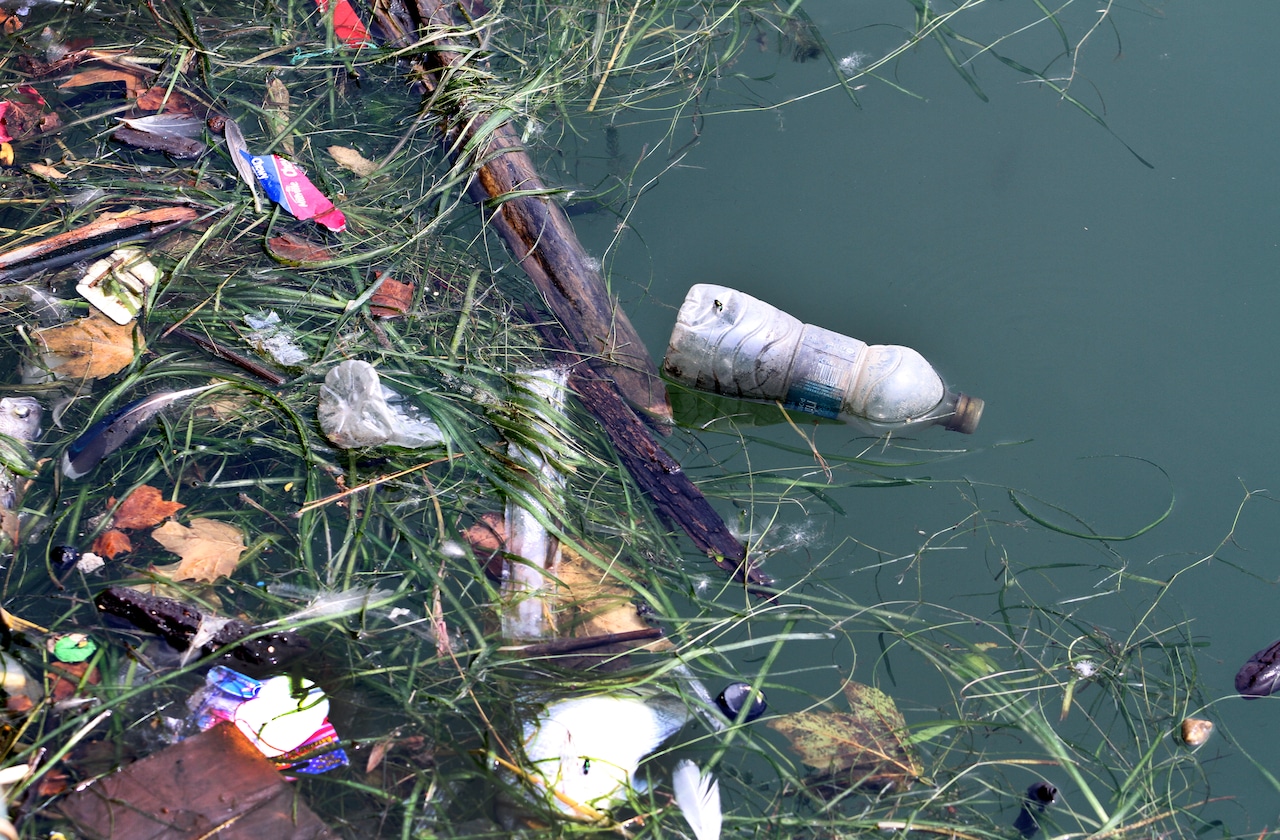
CLEVELAND, Ohio – The plastic showing up in the Great Lakes doesn’t arrive in one dramatic spill. It slips in piece by piece — blown off land, flushed through sewers, shed from everyday products and often weathered to bits — until it becomes nearly impossible to track.
Scientists agree on the source of the pollution: people. What remains far less clear is how microplastics move through the Great Lakes system, where they collect, and why some waters appear far more contaminated than others.
“Right now, we have enough of a picture to say we need to be worried,” said Rebecca Rooney, an ecology professor at University of Waterloo.
Studies across all five lakes have generated their share of water quality data, but what’s missing is regular monitoring and standardized reporting that will permit place-to-place comparisons and allow for trends to emerge, according to experts.
What we know is that the bulk of the pollution is primarily generated locally from population centers around each lake, though it can also move from one lake to another.
In many cases there are hotspots, dictated by where the plastic is coming from, along with the dominant currents in the lakes and even the presence of algae that can collect microplastics and then release them when the vegetation dies, said Sherri Mason, a researcher who conducted a noteworthy survey of Lake Erie in 2024.
Mason trawled sites previously sampled in 2014 and found the number of tiny plastic particles floating on the surface had increased astronomically over the decade.
But the study “was not as rigorous an endeavor” as she would have liked, said Mason, who now conducts research for Gannon University in Erie, Pennsylvania, as it only included five sample locations.
Still, the report was “eye-popping,” said Andrea Densham, a policy analyst who consults with the Alliance for the Great Lakes, a nonprofit devoted to the health of the Great Lakes ecosystem.
Her impression: “We are going absolutely in the wrong direction.”
Mason said the apparent increase in plastic in Lake Erie can be attributed to a combination of factors, including more manufacturing of plastic products – bolstered by the COVID-19 pandemic – and usage by consumers. But some of the detritus flows into Lake Erie from lakes further upstream, she said.
“It is a complicated story, but the numbers tend to bear out that you are seeing an increase as you move through the Great Lakes,” said Mason.
Comparing the lakes
A 2024 report prepared by a microplastics work group for the International Joint Commission, a binational organization that monitors U.S.-Canada boundary waters, looked at several years of prior research. It found the highest concentrations in Lake Michigan and Lake Ontario, with lesser amounts in Lake Superior, Lake Huron and Lake Erie.
A prior compilation of research by Mason and others had Lake Erie second to Lake Ontario in estimated microplastics, but everyone’s data is relatively old, she said. Plus, the IJC report took into account plastics found in feeder streams and rivers.
Higher concentrations in some lakes stand to reason, given the number of people living around them, said Chelsea Rochman, an associate professor of aquatic biology at University of Toronto and co-author of the IJC report.
Lake Michigan has two major cities, Chicago and Milwaukee, while Lake Ontario is home to Toronto, with a metro population of more than 7 million people.
The Lake Erie watershed has close to 12 million inhabitants, mostly in the United States.
Lake Ontario not only has a lot of people living around it, but it is the final collection point for water flowing through all five of the Great Lakes. Lake Superior flows into Lake Huron and from there into Lake Erie before cascading over Niagara Falls, or stair-stepping down the Welland Canal, into Lake Ontario.
“Lake Ontario gets it all and it is the most contaminated of the five,” Rochman said.
While the downstream effect is a factor, it is tempered by the fact that microplastics don’t necessarily move with the flow of water, said Rooney, the University of Waterloo professor and an IJC report co-author. They can sink to the bottom of the lake and become buried in sediment or gobbled up by fish.
There are far more microplastics on the bottom of Lake Erie than floating on the water, said Mason.
Pathways for plastic
Plastic gets into the Great Lakes in a variety of ways. Boaters may chuck their refuse overboard, but more likely it blows off the land, flows down tributaries, or is flushed from storm and sanitary sewers, which can go untreated during heavy storms.
Rochman said it may be that Canada contributes less than the U.S. to the overall plastic problem in the Great Lakes. But that’s certainly not the case in Lake Ontario, where Toronto sends large amounts of plastic into the water despite efforts to trap the trash before it gets there.
She said Toronto is probably as big a contributor to the plastic in Lake Ontario as Chicago is to the pollution in Lake Michigan.
Rochman said the primary culprits are the same all over, namely single-use containers such as coffee cups, drink bottles, clamshells, straws, cutlery and plastic bags. Cigarette butts, which include plastic filters, are also commonly found along beaches.
Another major contributor is foam from the construction industry that gets cut away and discarded, eventually winding up in storm drains and then the lakes.
Also found in the lakes and beaches are tiny industrial pellets that are produced by petrochemical companies and then melted down by manufacturers into plastic parts.
The pellets have been given the cute name “nurdles,” said Densham. “And these are anything but cute.” They are especially toxic because of the chemical coatings designed to give certain properties to the plastic parts.
Nurdles get into the environment when they spill from train cars and large trucks while being transported to factories that convert them into products.
“If this were oil they would be getting fines on it,” she said.
Better monitoring needed
The International Joint Commission report has called on both the United States and Canada to coordinate efforts to better monitor microplastics in the Great Lakes.
That includes amending their Great Lakes Water Quality Agreement to have microplastics categorized as a “chemical of mutual concern,” similar to PFAS, mercury, PCBs and other hazardous contaminants.
What’s needed is an ability to make apples-to-apples comparisons, Rooney said, and until that happens, it’s hard to draw definite conclusions.