
When President Donald Trump signed H.R. 1 — the “Big Beautiful Bill” — in July, he touted it as one of the largest tax cuts in U.S. history. The law would restore “fiscal sanity,” he said, by eliminating over $1.5 trillion in federal spending. And it boosted military spending while ramping up the hiring of ICE agents, among other Republican priorities.
But healthcare advocacy groups warned from the start that the budget bill would also enact unprecedented cuts to Medicaid, the nation’s health insurance program for roughly 70 million people who have limited incomes and resources. The Center for Medicare Advocacy called H.R. 1 “the largest rollback of federal support for health care in American history,” and the California Budget and Policy Center wrote in an analysis that the law “strips billions in federal support” for healthcare providers that rely on Medicaid.
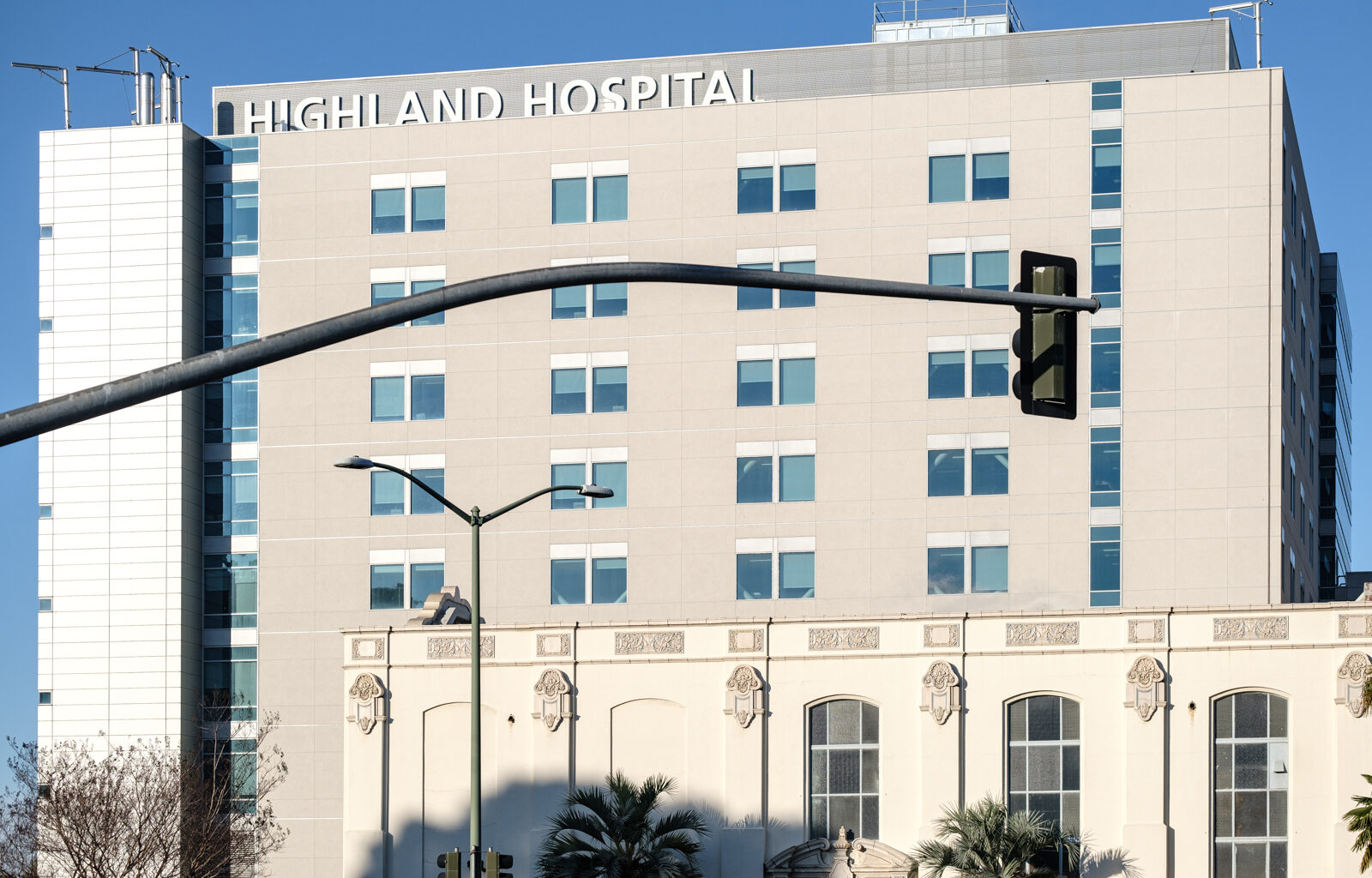
That rollback is now starting to affect the Alameda Health System, which operates Alameda County’s public safety net hospitals and clinics, like Highland in Oakland. The system stands to lose up to $30 million next year, $100 million in 2027, and a projected $150 million in 2028 from the Medicaid cuts, according to AHS.
Last Friday, word began to spread among employees that some staff jobs across health centers were being eliminated.
The healthcare system’s administration confirmed to The Oaklandside that AHS’ board of trustees decided in November to shed hundreds of jobs. The statement did not say which positions will be affected. But AHS acknowledged that the downsizing is a result of changes at the federal level.
“Due to these significant external cuts in funding, AHS must prepare itself for a reduction in the labor force,” the health system’s administration said today. AHS said it will offer severance and extra retirement benefits for employees who volunteer to leave. “Additionally, we have identified 372 positions that are projected to be impacted. This number may change as the public funding environment changes. The federal and state health care fiscal environment continues to be fluid.”
SEIU 1021, which represents many AHS employees, is currently in talks with the administration about which specific jobs will be cut and how services could be impacted.
“The union is heartbroken not just for our members, but for what this will do to the community,” Veronica Palacios, a Highland worker and former union chapter president, told The Oaklandside on Monday. “This will affect our whole community. It will affect our loved ones and it will affect healthcare moving forward.”
Alameda Health System relies heavily on Medicaid
 Ouside the Eastmont Mall August 20, 2020. Photo: Pete Rosos
The Alameda Health System, which has a $1.4 billion budget and approximately 5,000 employees, operates the Wilma Chan Highland Hospital Campus and Eastmont Wellness center in Oakland, Alameda Hospital, San Leandro Hospital, St. Rose Hospital, the John George Psychiatric Hospital, and other clinics and care centers across Alameda County. It is one of the primary health care providers for the roughly 242,000 Alameda County residents who are enrolled in Medi-Cal, the state Medicaid program funded mostly by the federal government.
Because AHS cares for the county’s low-income communities, it is extremely reliant on the Medicaid program. Roughly 60% of the system’s revenues come from Medi-Cal.
In August, one month after H.R. 1 was signed into law, the hospital system’s executive team and trustees were told at a board meeting that they would soon be hit by two provisions in the law.
First, new work requirements for Medicaid recipients would “throw millions off Medi-Cal” statewide, including thousands of Alameda County residents who are AHS patients. Medicaid recipients would also be required to re-verify their eligibility for the program every six months.
When similar rules were implemented in Arkansas seven years ago, about 10% of enrollees subject to the work requirements lost their Medicaid coverage, according to a National Institutes of Health study. A similar drop in Alameda County is projected to cut into the Alameda Health System’s revenues by as much as $90 million, according to an AHS analysis.
Another complex feature of the new federal rules means that the state of California cannot make additional payments to AHS above a certain threshold for Medicaid-provided care. AHS received around $180 million in these types of state payments this year. This cap could mean an additional loss to AHS of $20 million in 2028, rising to $60 million in 2030.
In November, AHS Chief Financial Officer Kim Miranda told the hospital system’s trustees that they need to identify $235 million in reductions by 2027.
Palacios, the Highland Hospital worker, said all kinds of AHS staff will be affected, including nurses, nurse assistants, social workers, physicians, and therapists.
“Impacted employees are from all departments and disciplines across the system including management, support and administrative services, and clinical care,” the administration said in a statement.
“*” indicates required fields