
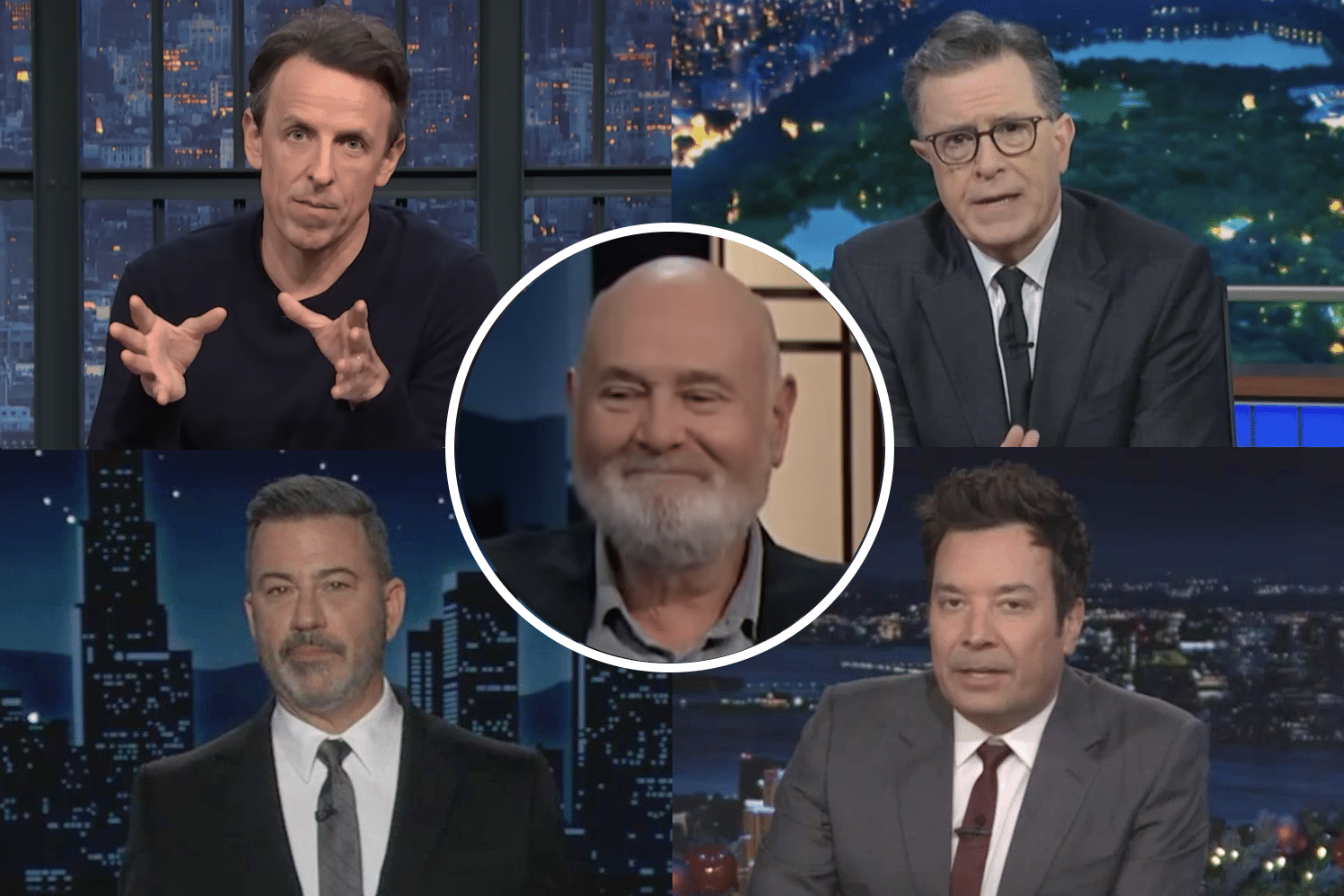
Photo: NBC (2), ABC (2) and CBS screenshots
The advantage that late-night shows have over every other kind of entertainment on television is that they can be a nightly chronicle of what America is thinking about—and going through.
We went through a lot this past weekend, a stunning round of truly dark events—two mass shootings, a manhunt for a gunman, another school dragged into gun violence, and a double murder involving an iconic name in television and film for more than a half century.
The result was late-night shows playing a familiar role Monday night: gathering places for shell-shocked viewers.
What made this night different from others that have turned funny hosts into reflective observers of trauma and tragedy is that, for the quartet of hosts who went on the air last night, this one was personal.
Rob Reiner had not only been a favorite late-night guest across the wide landscape of late-night shows going back to the early Carson era, he was also an admired figure in the greater comedy community, a prince of a royal television comedy family started by his father, the legendary Carl Reiner.
His passing, and the gruesome, troubling manner of his passing, forced its way to the front of every late-night show’s content for the night. Partly that had to do with Reiner’s association as an on-air guest with each of the hosts.
But the story also crossed over into the ongoing raison d’être for much of the monologue material delivered by the shows every night: the saga of the Trump presidency.
Why? Because Trump chose to comment on the murder of Reiner and his wife, Michele Singer Reiner, in a manner so toxically ugly it became a news story by itself.
Late-night shows feed off news stories. And they give back. They supply satire and skewering, but also context for those tuning in—like a communal assembly or a trip to a therapist.
In the current era, when virtually everything, including a savage killing that ripped a family apart, is subject to partisan confrontation, late night has been functioning not so much as the town square but rather the underground press room, editorializing to hold the regime to account.
Monday night, four shows made four different choices in how they would deal with topical news this disturbing.
One host took the opportunity to go after Trump relentlessly. That would be Jimmy Kimmel, who for months has pushed pedal to the metal with Trump in the middle of the roadway. He didn’t just refer to Trump’s social media comments about Reiner; he read them in their entirety, the better to illustrate what he called Trump’s complete absence of “compassionate leadership.”
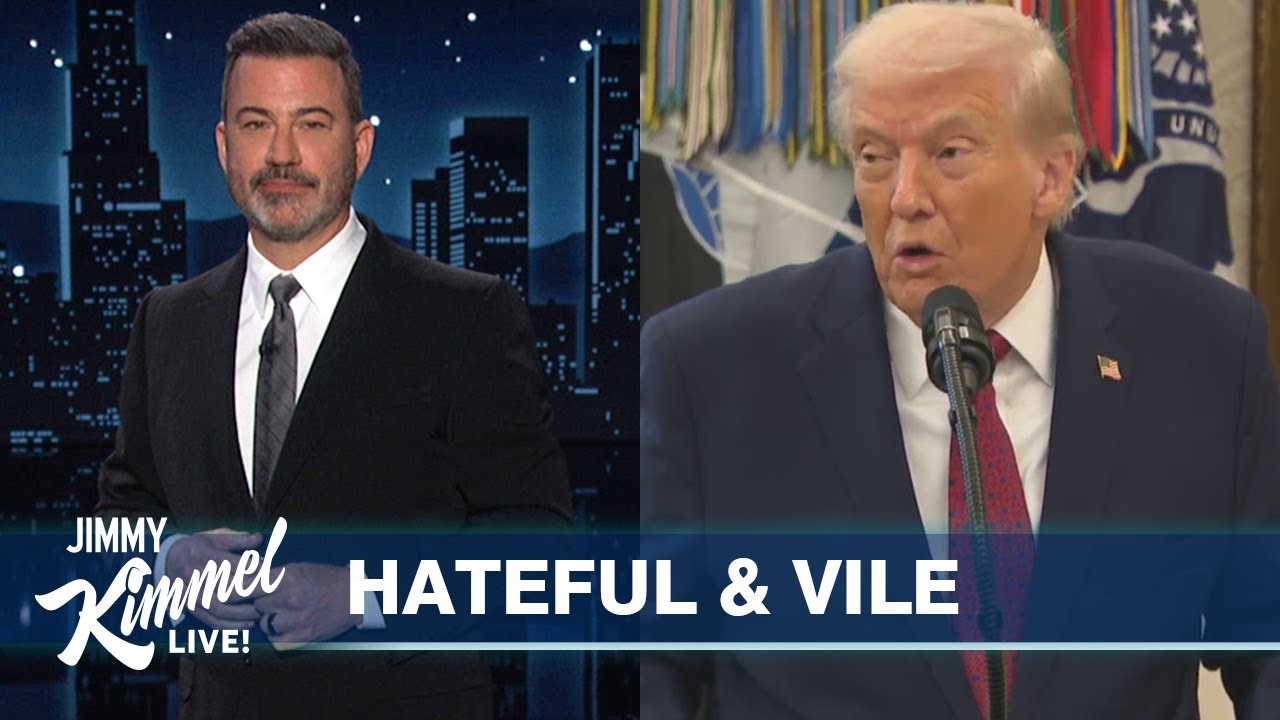
Kimmel chose to make points and still get laughs, a delicate balance with content this gut-wrenching. But he’s had a lot of experience walking that line in recent months, speaking comedy to power even while facing an overt government threat to silence him.
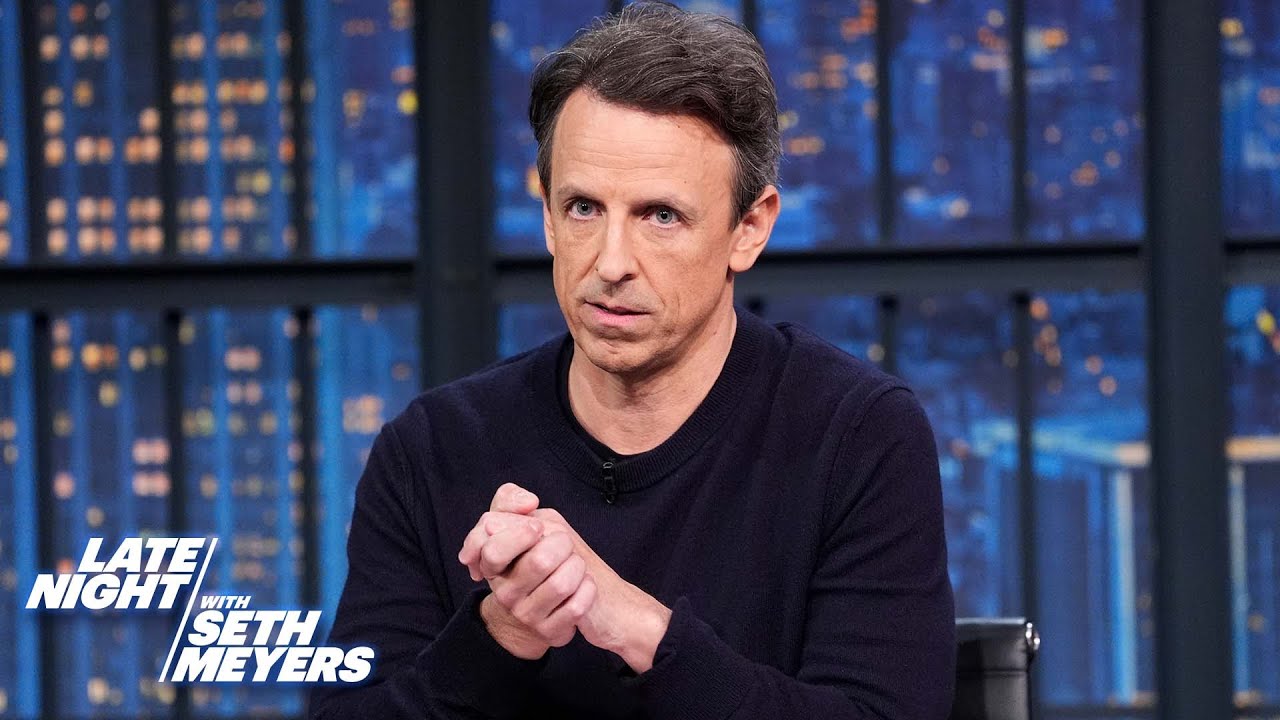
Seth Meyers made a decision to consciously pull back, offering a sobering, muted assessment of Trump’s comments on Reiner, whom Meyers eulogized for his achievements and his personal appeal, based on his own interactions with the actor-director.
We’ve seen late-night hosts speak this way before, addressing an event too fraught to try to make jokes about, like David Letterman’s celebrated attempt to put the 9/11 attacks into some kind of context.
Meyers was both emotional and clearly angry about the things Trump said about Reiner, and he quietly—but devastatingly—called him out, musing about how beneficial it would be to have a leader with a “moral compass” at such a moment.
With the element of a troubled family member suspected of such a violent act, this was even more of a tragedy, Meyers said, “if you are a person with even an ounce of humanity—but you do need at least that one ounce.”
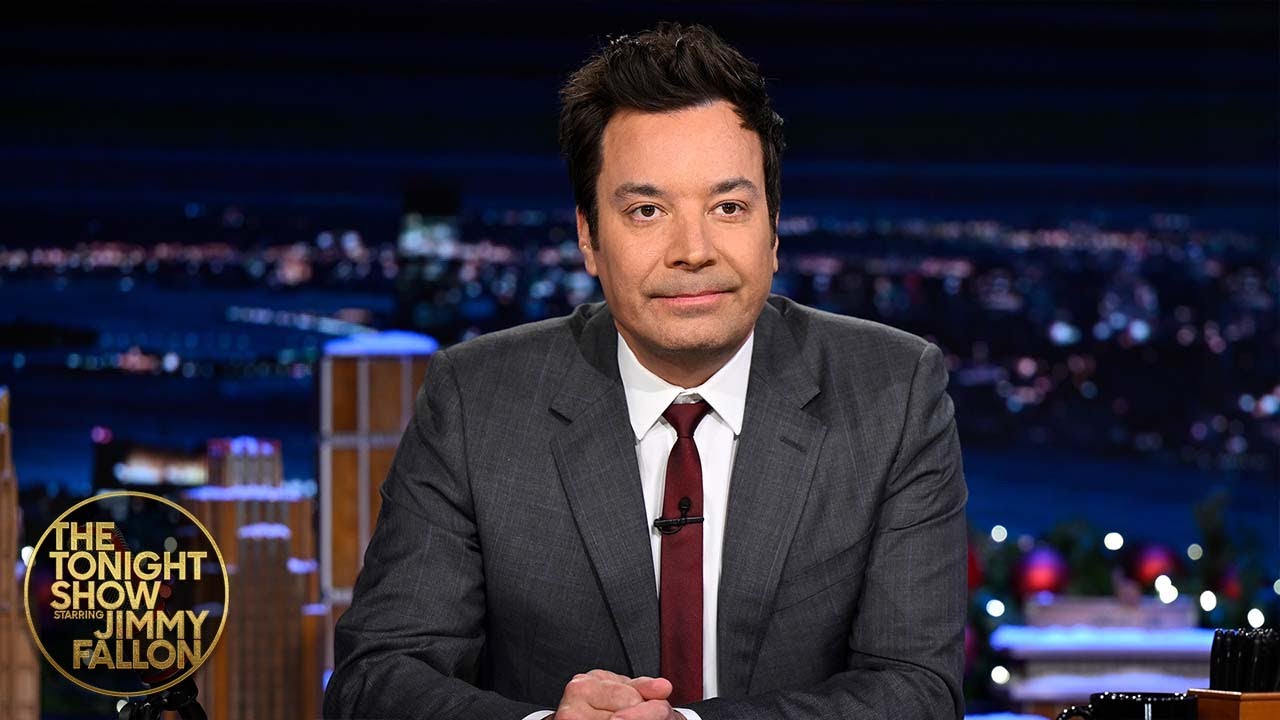
Meyers’ NBC lead-in, Jimmy Fallon, who has made a conscious decision to steer away from political confrontation, remained true to that commitment. He told a series of rapid-fire monologue jokes about Trump, staying away from the Reiner story entirely. But he addressed it directly in a straightforward, post-monologue expression of sadness about the event, without any mention of Trump’s accompanying comments.
Stephen Colbert looked to separate the tragic from the comic, dropping the show’s usual satirical cold open—invariably some mocking of a Trump administration outrage—and replacing it with a direct-to-camera explanation that the events of the past weekend were too dark to address comedically because “other people’s tragedies” were “sacred ground.”
Stephen Colbert at the start of tonight’s Late Show: “Other people’s tragedy is sacred ground and we try not to walk there. But we are going to do a comedy show tonight, in light of—and in spite of—the darkness.” pic.twitter.com/feOpoBlFXi
— LateNighter (@latenightercom) December 16, 2025
He then delivered a laugh-out-loud monologue heavily concentrated on some truly bonkers Trump comments about wildlife in Peru. The one common joke of the night was both Kimmel and Colbert utterly destroying Trump’s typically absurd math about 28,000 people a year dying of snake bites in Peru, when the official number for a 15-year period was 10.
You could see all of that and more on late-night television in the wake of a weekend of distressing events—even a spectacularly appealing guest appearance by Michelle Obama.
And nowhere else.
Get stories like this in your inbox: Sign up for LateNighter’s free daily newsletter.