
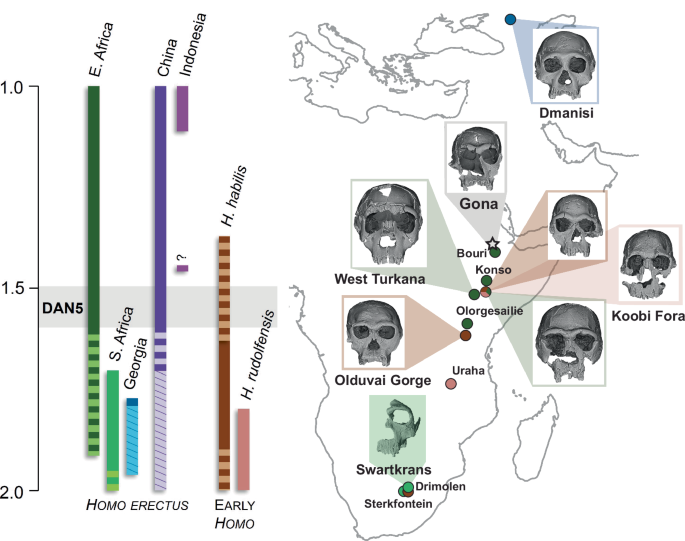
Kimbel, W. H., Johanson, D. C. & Rak, Y. Systematic assessment of a maxilla of Homo from Hadar, Ethiopia. Am. J. Phys. Anthropol. 103, 235–262 (1997).
Villmoare, B. et al. Early homo at 2.8 Ma from Ledi-Geraru, Afar, Ethiopia. Science 347, 1352–1355 (2015).
Suwa, G., White, T. D. & Howell, F. C. Mandibular postcanine dentition from the Shungura Formation, Ethiopia: crown morphology, taxonomic allocations, and Plio-Pleistocene hominid evolution. Am. J. Phys. Anthropol. 101, 247–282 (1996).
Baab, K. L. Defining Homo erectus. In Handbook of Paleoanthropology Vol. III: Phylogeny of Hominids (eds Henke, W. & Tattersall, I.) 2189–2219 (Springer Berlin Heidelberg, 2015).
Leakey, M. G. et al. New fossils from Koobi Fora in northern Kenya confirm taxonomic diversity in early Homo. Nature 488, 201 (2012).
Spoor, F. et al. Reconstructed Homo habilis type OH 7 suggests deep-rooted species diversity in early Homo. Nature 519, 83 (2015).
Antón, S. C. Early Homo: Who, When, and Where. Curr. Anthropol. 53, S278–S298 (2012).
Antón, S. C., Potts, R. & Aiello, L. C. Evolution of early Homo: an integrated biological perspective. Science 345, 1236826 (2014).
Antón, S. C. The Middle Pleistocene record: on the ancestry of Neandertals, modern humans and others. In A Companion to Paleoanthropology (ed. Begun, D. R.) 497–516 (Wiley, 2013).
Bilsborough, A. & Wood, B. A. Cranial morphometry of early hominids: facial region. Am. J. Phys. Anthropol. 76, 61–86 (1988).
Rightmire, G. P. & Lordkipanidze, D. Comparisons of early Pleistocene skulls from East Africa and the Georgian Caucasus: evidence bearing on the origin and systematics of genus Homo. In The First Humans–Origin and Early Evolution of the Genus Homo (eds Grine, F. E., Fleagle, J. G. & Leakey, R. E.) 39–48 (Springer, 2009).
Wood, B. A. Koobi Fora Research Project: Hominid Cranial Remains. Vol. 4 (Oxford University Press, 1991).
Hammond, A. S. et al. New hominin remains and revised context from the earliest Homo erectus locality in East Turkana, Kenya. Nat. Commun. 12, 1939 (2021).
Herries, A. I. R. et al. Contemporaneity of Australopithecus, Paranthropus, and early Homo erectus in South Africa. Science 368, https://doi.org/10.1126/science.aaw7293 (2020).
de Lumley, M.-A. & Lordkipanidze, D. L’Homme de Dmanissi (Homo georgicus), il y a 1810000 ans. Comptes Rendus Palevol 5, 273–281 (2006).
Rightmire, G. P., Lordkipanidze, D. & Vekua, A. Anatomical descriptions, comparative studies and evolutionary significance of the hominin skulls from Dmanisi, Republic of Georgia. J. Hum. Evol. 50, 115–141 (2006).
Baab, K. L., Rogers, M., Bruner, E. & Semaw, S. Reconstruction and analysis of the DAN5/P1 and BSN12/P1 gona early Pleistocene Homo fossils. J. Hum. Evol. 162, 103102 (2022).
Bruner, E., Holloway, R., Baab, K. L., Rogers, M. J. & Semaw, S. The endocast from Dana Aoule North (DAN5/P1): a 1.5 million year-old human braincase from Gona, Afar, Ethiopia. Am. J. Biol. Anthropol. 181, 206–215 (2023).
Kaifu, Y. et al. Primitive dentognathic morphology of Javanese Homo erectus. Am. J. Phys. Anthropol. 36, 125 (2003).
Bermúdez de Castro, J. M., Martinón-Torres, M., Sier, M. J. & Martín-Francés, L. On the variability of the Dmanisi mandibles. PLoS ONE 9, e88212 (2014).
Semaw, S. et al. Co-occurrence of Acheulian and Oldowan artifacts with Homo erectus cranial fossils from Gona, Afar, Ethiopia. Sci. Adv. 6, eaaw4694 (2020).
Kaifu, Y. et al. Taxonomic affinities and evolutionary history of the early Pleistocene hominids of Java: dentognathic evidence. Am. J. Phys. Anthropol. 128, 709–726 (2005).
Lautenschlager, S. Reconstructing the past: methods and techniques for the digital restoration of fossils. R. Soc. Open Sci. 3, 160342 (2016).
Kimbel, W. H., White, T. D. & Johanson, D. C. Cranial morphology of Australopithecus afarensis: a comparative study based on a composite reconstruction of the adult skull. Am. J. Phys. Anthropol. 64, 337–388 (1984).
Franciscus, R. G. & Trinkaus, E. Nasal morphology and the emergence of Homo erectus. Am. J. Phys. Anthropol. 75, 517–527 (1988).
Laird, M. F. et al. The skull of Homo naledi. J. Hum. Evol. 104, 100–123 (2017).
Rightmire, G. P., Ponce de León, M. S., Lordkipanidze, D., Margvelashvili, A. & Zollikofer, C. P. E. Skull 5 from Dmanisi: descriptive anatomy, comparative studies, and evolutionary significance. J. Hum. Evol. 104, 50–79 (2017).
Walker, A. C. & Leakey, R. E. F. The skull. In The Nariokotome Homo erectus Skeleton (eds Walker, A. L. & Leakey, R. E. F.) 63–94 (Harvard University Press, 1993).
Clarke, R. J. A Homo habilis maxilla and other newly-discovered hominid fossils from Olduvai Gorge, Tanzania. J. Hum. Evol. 63, 418–428 (2012).
Huguet, R. et al. The earliest human face of Western Europe. Nature https://doi.org/10.1038/s41586-025-08681-0 (2025).
Rightmire, G. P. The Evolution of Homo erectus: Comparative Anatomical Studies of an Extinct Human Species (Cambridge University Press, 1990).
Baab, K. L. The role of neurocranial shape in defining the boundaries of an expanded Homo erectus hypodigm. J. Hum. Evol. 92, 1–21 (2016).
Trauth, M. H. et al. Human evolution in a variable environment: the amplifier lakes of Eastern Africa. Quatern Sci. Rev. 29, 2981–2988 (2010).
Bobe, R. & Carvalho, S. Hominin diversity and high environmental variability in the Okote Member, Koobi Fora Formation, Kenya. J. Hum. Evol. 126, 91–105 (2019).
Wood, B. Human evolution: fifty years after Homo habilis. Nature 508, 31–33 (2014).
Potts, R., Behrensmeyer, A. K., Deino, A., Ditchfield, P. & Clark, J. Small mid-pleistocene hominin associated with East African Acheulean technology. Science 305, 75–78 (2004).
Antón, S. C. The face of olduvai hominid 12. J. Hum. Evol. 46, 335–345 (2004).
Spoor, F. et al. Implications of new early Homo fossils from Ileret, east of Lake Turkana, Kenya. Nature 448, 688–691 (2007).
Tappen, M., Bukhsianidze, M., Ferring, R., Coil, R. & Lordkipanidze, D. Life and death at Dmanisi, Georgia: taphonomic signals from the fossil mammals. J. Hum. Evol. 171, 103249 (2022).
Pontzer, H., Scott, J. R., Lordkipanidze, D. & Ungar, P. S. Dental microwear texture analysis and diet in the Dmanisi hominins. J. Hum. Evol. 61, 683–687 (2011).
Lordkipanidze, D. et al. A complete skull from Dmanisi, Georgia, and the evolutionary biology of early Homo. Science 342, 326 (2013).
Elliott, M., Kurki, H., Weston, D. A. & Collard, M. Estimating fossil hominin body mass from cranial variables: an assessment using CT data from modern humans of known body mass. Am. J. Phys. Anthropol. 154, 201–214 (2014).
Simpson, S. W. et al. A female Homo erectus pelvis from Gona, Ethiopia. Science 322, 1089–1092 (2008).
Pontzer, H. Ecological energetics in early Homo. Curr. Anthropol. 53, S346–S358 (2012).
Dennell, R. & Roebroeks, W. An Asian perspective on early human dispersal from Africa. Nature 438, 1099–1104 (2005).
Kaifu, Y. et al. Cranial Morphology and Variation of the Earliest Indonesian Hominids. In Asian Paleoanthropology, 143–157 (Springer Netherlands, Dordrecht, 2011).
Berger, L. R. et al. Homo naledi a new species of the genus Homo from the Dinaledi Chamber South Africa. eLife 4, e09560 (2015).
Kaifu, Y. et al. Craniofacial morphology of Homo floresiensis: description, taxonomic affinities, and evolutionary implication. J. Hum. Evol. 61, 644–682 (2011).
Schlager, S., Profico, A., Di Vincenzo, F. & Manzi, G. Retrodeformation of fossil specimens based on 3D bilateral semi-landmarks: Implementation in the R package “Morpho”. PLOS ONE 13, e0194073-10 (2018).
R Core Team. R: A Language and Environment for Statistical Computing (R Foundation for Statistical Computing, Vienna, Austria, 2023).
Baab, K. L. A fresh look at an iconic human fossil: Virtual reconstruction of the KNM-WT 15000 cranium. J. Hum. Evol. 202, 103664-10 (2025).
Wiley, D. F. et al. Evolutionary morphing. In IEEE Visualization Conference 1–8 (IEEE, Minneapolis, MN, 2005).
Posit team. RStudio: Integrated Development Environment for R (Posit Software, PBC, Boston, MA, 2025).
Schlager, S. Morpho and Rvcg – shape analysis in R: R-packages for geometric morphometrics, shape analysis and surface manipulations. In Statistical Shape and Deformation Analysis (eds Zheng, G., Li, S. & Szekely, G.) 217–256 (2017).
Adams, D., Collyer, M., Kaliontzopoulou, A. & Baken, E. Geomorph: Software for Geometric Morphometric Analyses v. R package version 4.0.10. https://cran.r-project.org/package=geomorph (2025).
Baken, E. K., Collyer, M. L., Kaliontzopoulou, A. & Adams, D. C. geomorph v4.0 and gmShiny: enhanced analytics and a new graphical interface for a comprehensive morphometric experience. Methods Ecol. Evol. 12, 2355–2363 (2021).
Wickham, H. ggplot2: Elegant Graphics for Data Analysis (Springer-Verlag, New York, 2016).
Gunz, P., Mitteroecker, P., Neubauer, S., Weber, G. W. & Bookstein, F. L. Principles for the virtual reconstruction of hominin crania. J. Hum. Evol. 57, 48–62 (2009).
Hanegraef, H., David, R. & Spoor, F. Morphological variation of the maxilla in modern humans and African apes. J. Hum. Evol. 168, 103210-10 (2022).
Collyer, M. L. & Adams, D. C. RRPP: Linear Model Evaluation with Randomized Residuals in a Permutation Procedure. R package version 2.1.0. https://CRAN.R-project.org/package=RRPP (2024).
Collyer, M. L. & Adams, D. C. RRPP: an R package for fitting linear models to high-dimensional data using residual randomization. Methods Ecol. Evol. 9, 1772–1779 (2018).
McNulty, K. P., Frost, S. R. & Strait, D. S. Examining affinities of the Taung child by developmental simulation. J. Hum. Evol. 51, 274–296 (2006).
Aiello, L. C. & Wood, B. A. Cranial variables as predictors of hominine body mass. Am. J. Phys. Anthropol. 95, 409–426 (1994).
Grabowski, M., Hatala, K. G., Jungers, W. L. & Richmond, B. G. Body mass estimates of hominin fossils and the evolution of human body size. J. Hum. Evol. 85, 75–93 (2015).
Irish, J. D., Hemphill, B. E., de Ruiter, D. J. & Berger, L. R. The apportionment of tooth size and its implications in Australopithecus sediba versus other Plio-pleistocene and recent African hominins. Am. J. Phys. Anthropol. 161, 398–413 (2016).
Kaifu, Y. et al. Descriptions of the dental remains of Homo floresiensis. Anthropol. Sci. 123, 129–145 (2015).
Iwata, H. & Ukai, Y. SHAPE: a computer program package for quantitative evaluation of biological shapes based on elliptic Fourier descriptors. J. Heredity 93, 384–385 (2002).
Massicotte, P. & South, A. rnaturalearth: World Map Data from Natural Earth. R package version 1.1.0.9000. https://docs.ropensci.org/rnaturalearth/ (2025).
Holloway, R. L., Broadfield, D. C. & Yuan, M. S. The Human Fossil Record: Brain Endocasts – The Paleoneurological Evidence, Vol. 3 (John Wiley & Sons, Inc., 2004).
Kaifu, Y. et al. Unique dental morphology of Homo floresiensis and its evolutionary implications. PLoS ONE 10, e0141614 (2015).
Benazzi, S., Gruppioni, G., Strait, D. S. & Hublin, J.-J. Technical note: virtual reconstruction of KNM-ER 1813 Homo habilis cranium. Am. J. Phys. Anthropol. 153, 154–160 (2014).
Tobias, P. V. Olduvai Gorge. Vol. 4: The Skulls, Endocasts and Teeth of Homo habilis (Cambridge University Press, 1991).
Neubauer, S. et al. Reconstruction, endocranial form and taxonomic affinity of the early Homo calvaria KNM-ER 42700. J. Hum. Evol. 121, 25–39 (2018).
Brown, B. & Walker, A. The dentition. In The Nariokotome Homo erectus Skeleton (eds Walker, A. & Leakey, R.) 161–194 (Springer-Verlag, 1993).
Vekua, A. et al. A new skull of early Homo from Dmanisi, Georgia. Science 297, 85–89 (2002).
Martinón-Torres, M. et al. Dental remains from Dmanisi (Republic of Georgia): morphological analysis and comparative study. J. Hum. Evol. 55, 249–273 (2008).
Weidenreich, F. Giant early man from Java and south China. Anthropol. Pap. Am. Mus. Nat. Hist. 40, 1–143 (1945).
Kaifu, Y. et al. New reconstruction and morphological description of a Homo erectus cranium-Skull IX (Tjg-1993.05) from Sangiran, Central Java. J. Hum. Evol. 61, 270–294 (2011).
Rightmire, G. P. The human cranium from Bodo, Ethiopia: evidence for speciation in the Middle Pleistocene?. J. Hum. Evol. 31, 21–39 (1996).
Woodward, A. S. A new cave man from Rhodesia, South Africa. Nature 108, 371–372 (1921).
Hawks, J. et al. New fossil remains of Homo naledi from the Lesedi Chamber, South Africa. eLife 6, e24232 (2017).
de Ruiter, D. J. et al. Homo naledi cranial remains from the Lesedi chamber of the rising star cave system, South Africa. J. Hum. Evol. 132, 1–14 (2019).
Kubo, D., Kono, R. T. & Kaifu, Y. Brain size of Homo floresiensis and its evolutionary implications. Proc. R. Soc. B: Biol. Sci. 280, 20130338 (2013).