
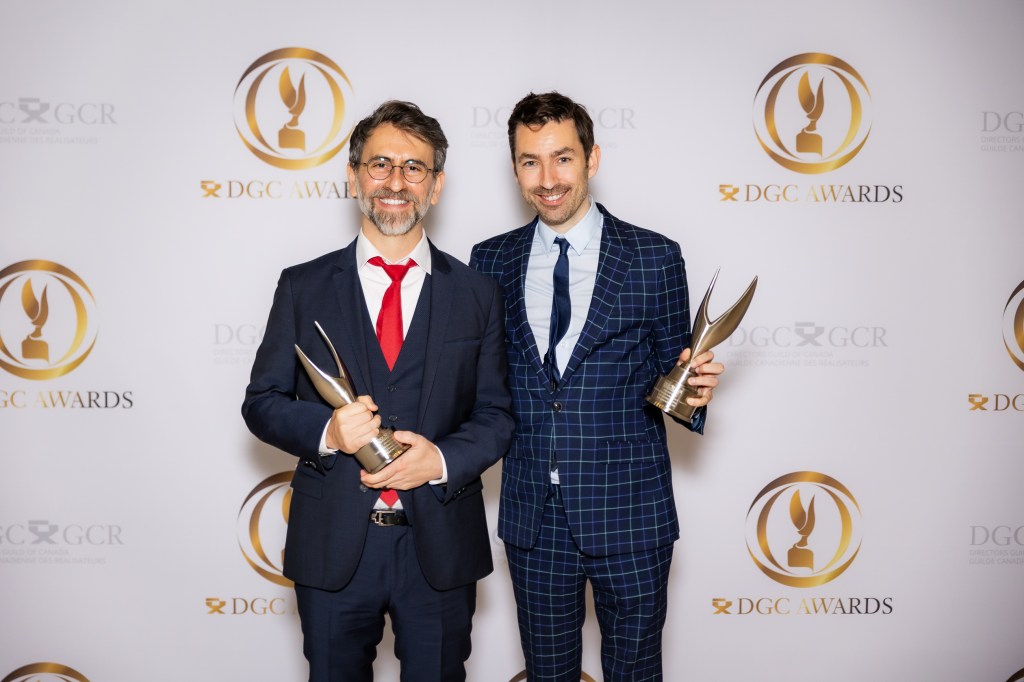
Ever in search of the next big thing, Hollywood got it when Final Destination Bloodlines arrived in theaters on May 16.
Both the best-reviewed and highest-grossing installment in the long-running premonition-themed horror franchise, Bloodlines marked a major career turning point for Zach Lipovsky and Adam Stein, a pair of filmmakers who up until this year weren’t that well known in town. They landed the job — an open directing assignment — nearly two decades after meeting as competitors on On the Lot, Fox’s one-and-done filmmaking competition series from Steven Spielberg and Mark Burnett, on which they both placed as finalists.
When the show’s casting director paired the two in a hotel room during production, they found that they shared a love for what Stein refers to as “big Hollywood commercial popcorn movies that have a lot of emotion and character to them,” with Spielberg as one of their shared idols.
The goal with On the Lot was to land a development deal with Spielberg’s storied studio, DreamWorks. But given that neither of the two won, Stein deadpans, it would take them another 18 years to get to get around to working with their idol. Lipovsky describes these years as a journey of “lots of ups and downs,” and Stein admits that before Bloodlines, he never got too comfortable with his professional prospects.
JOURNEYING THROUGH THE NO MAN’S LAND
“When you’re trying to be a director, it’s a roller coaster, an uphill climb,” Stein reflects. “We did On the Lot and for basically a decade, it was hard to say that we were going to make a living as directors. It was a long slog through the no man’s land of Hollywood.”
On the Lot left Lipovsky and Stein with a portfolio of short films to show off and got them repped. But shortly after their summer with the show, a 100-day writer’s strike hit Hollywood and a financial crisis crippled the world.
In subsequent years, Lipovsky paid his bills in part with VFX work, with Stein working as an editor, including on corporate videos. One of Stein’s editing projects, for director Miguel Arteta, introduced him to Matthew Greenfield, the producer now serving as President of Fox Searchlight Pictures, with whom he says the duo is now hatching a “secret project.”
Stein’s first DGA directing job came in helming comedy shorts for Jimmy Kimmel Live! for a couple of years. Lipovsky, meanwhile, first began gaining traction as the director of the Crackle zombie pic Dead Rising: Watchtower, as well as both the TV movie Tasmanian Devils and an installment of the Leprechaun horror franchise (Leprachaun: Origins) for Syfy. Lipovsky recalls being $40,000 in debt before he landed the first of these projects, Tasmanian Devils, and being paid only $40,000 by the gig — which put him back at square one.
As Lipovsky describes it, he and Stein were “mostly friends” for the first 10 years they knew each other. Subsequently, they began taking on small projects as a duo for fun — a short film competition here, a web series there. For the pair, the first project together of any scale was Mech-X4, a series where Lipovsky was producing director and brought Stein on to direct alternating blocks. The pair were nominated for a Children’s and Family Emmy Emmy for their work there and subsequently teamed to direct a live-action Kim Possible for the Disney Channel. Calling these early experiences of working with Stein “addictive,” Lipovsky says they demonstrated to both that it was “much more rewarding” to work together than apart.
GETTING FREAKY
Over the years, Lipovsky and Stein attached to myriad development projects — some of which they worked on for years — including one with Marc Platt Productions. But none ever got greenlighted. When it felt like each of their individual paths as filmmakers had hit a roadblock, and studio opportunities weren’t panning out, the duo elected to go a different route, taking their destiny into their own hands with an independent film that they could make at a range of budget levels, and with quite limited resources.
Described by the duo as “extremely contained” — mostly featuring just two people in a house — that film was Freaks, in which a sheltered seven-year-old girl (Lexy Kolker) with supernatural abilities escapes her paranoid father’s confinement, only to discover a world that fears people with extraordinary powers —forcing her to confront the truth about her family, her abilities, and outside threats.
This was an extremely scrappy production where Lipovsky and Stein not only wrote, directed and produced, but did craft services and cleaned toxic insulation out of an attic themselves. The work paid off, though, upon their buzzy TIFF premiere, which kicked off an award-winning run on the festival circuit. The film later found a passionate audience on Netflix, and the pair sold original pitches to both Universal and Disney off of this success, also developing a Freaks TV series for TNT with Kennedy/Marshall. None of these projects ever went anywhere, but Freaks was nonetheless critical to the duo’s rise in that it caught the eye of Warner Bros. executives, which led to the opportunity to pitch on Final Destination.
The ODA
When Lipovsky and Stein started on the path that led them to the job, they were told they were competing against 300 directors. They pitched for four to six months to land the coveted gig and came to Final Destination as fans of the franchise.
“I grew up in Vancouver, and Vancouver is where all these movies have been shot,” Lipovsky notes. “So like the bridge from my house is the bridge in FD5, and the rollercoaster near my house is the rollercoaster in FD3.”
This geographical connection to the franchise aside, though, it was two things that got the filmmakers deeply invested in directing Bloodlines. First, Final Destination was a director’s playground of a franchise — one without a flesh-and-blood villain, where filmmaking itself was the force that was coming for characters’ lives. The other was the prospect of reinvention.
Lipovsky and Stein have been open about the fact that when they first learned of the Final Destination ODA, they were ambivalent about the idea of the franchise continuing. After all, they felt that the most recent prior installment, 2011’s Final Destination 5, served as a fitting conclusion to the franchise. But this was before they learned of the story treatment by Jon Watts on which the new film is based and read the screenplay draft by Guy Busick and Lori Evans Taylor that was discussed in their first meeting with the studio. That script was fundamentally different in many ways from the film that was ultimately shot, and Lipovsky and Stein would later be part of the intensive process of developing it, from one memorable death scene to the next. But from Watts’ treatment on, this film was innovating for the Final Destination franchise in ways Lipovsky and Stein felt exciting. Firstly, it went way back into the past for an opening sequence that, in its final form, would become the one of the franchise’s most memorable. Secondly, it took the basic movie framework of the premonition in new directions. And thirdly, it had a family element in its DNA that gave the film more heart and stakes, and made it more character-driven than any prior installment in which teens died a series of grisly deaths brought on by Death itself. These aspects to the story, Lipovsky says, affirmed that the franchise was “alive” with “new frontiers” to explore.
The story of Final Destination Bloodlines then came to be about what happens when beloved IP is met with a thoughtful filmmaking take that casts its possibilities in a new light. In making the film, Lipovsky says, it was critical to service two audiences — diehards who have seen every Final Destination, and people totally unfamiliar with these films — something that was accomplished through a delicate threading of the needle.
“We basically [filled] the movie with references and stuff for the fans, but in a way that it’s all in the background, so that if you’re a fan, you notice it and delight in it, but if you don’t know the reference, it goes right over your head and you don’t even know that it’s there,” Lipovsky explains, adding that it’s key with an assignment like this to make sure that no audience member “ever feels left out.”
A ROCKET SHIP MOMENT
Interestingly, given how well Final Destination Bloodlines has fared, the film was originally intended to go straight to streaming. However, it was redirected to theaters amid shifts in strategy at Warner Bros. that predated Lipovsky & Stein’s time with the film. By the time the duo got around to testing it, they say, they knew they had done something right.
“I think our director’s cut was testing better than most of the FD movies when they were finished,” says Lipovsky. “So we were already on a really good path, which opened up the conversation for doing some additional photography.”
Doing so allowed the filmmakers to go back and add more gore to certain sequences, tinker with the ending, and heightening some of the character work. The moment Lipovsky sensed that he and his partner would be on a “rocket ship” ascent with the film was when they took a meeting with Warner Bros. Motion Picture chairs Michael De Luca and Pamela Abdy and dozens of other studio staffers to discuss tracking, three or four weeks out from the film’s opening.
“The marketing person says, ‘We’ve left all horror comps behind. We’re now tracking against things like Dune and King Kong and Godzilla,’” Lipovsky recalls. “There was this silence, and Adam and I were like, ‘That seems big.’”
Warner Bros. actually showed great confidence in Bloodlines from very early on, the filmmakers suggest, electing to lock down IMAX screens for its release when they turned in previs for the film’s opening sequence. Still, as much as the studio had total belief in the picture’s box office potential, they tempered expectations for the filmmakers when it came to critical reception.
“For the franchise traditionally, reviews have been really bad,” Lipovsky says. “So they they said, ‘It’s going to do well, it’s going to make lots of money, but we’re going to embargo [reviews] until the last second.’”
The studio needn’t have worried. Solidifying its place as one of the 20 highest-grossing horror films of all time, with over $315 million worldwide, Final Destination Bloodlines also received stellar reviews, with many calling the film out as the franchise’s best. Overachieving in this respect, Lipovsky and Stein even received a Directors Guild of Canada Award for Outstanding Directorial Achievement for their work.
CRUISING ON OPENING WEEKEND
Lipovsky and Stein spent opening weekend driving all over L.A., from AMC Burbank 16 to the Alamo and Regal downtown, to “spy” on audiences and see how they were responding to the film. By the end of that weekend, De Luca and Abdy called to offer congratulations, setting a meeting with Chris Columbus that led to a deal for them to co-write the studio’s priority title Gremlins 3. In subsequent weeks, they got to sit down with many more of their filmmaking idols and luxuriate in their praise — from Sam Raimi to Kathleen Kennedy, Arnold Schwarzenegger, M. Night Shyamalan, Jason Reitman, and Edgar Wright.
Stein recalls telling Wright, “There are shots in the movie that we stole from you.”
Lipovsky describes this period as “complete insanity” — something the pair couldn’t possibly have prepared for mentally. “I’ve had moments where you do something and it works well, but it very quickly dies off. It’s sort of like, oh, people like the movie — and then something new happens,” he says. “I kept expecting all that attention to die off very quickly, but it just kept building and building, and it’s still going on, basically. Every day, we’re meeting people responsible for creating everything that we love in cinema for the last 40 years.”
The most gratifying feedback would have to have been from Spielberg, who is now in business with the filmmakers on Gremlins 3, coming full circle from On the Lot. Spielberg, Stein reiterates, “has been our inspiration since from the beginning of our sentience as human beings.”
During that meeting, Stein recalls, Spielberg essentially said, “On the Lot was really important to me, and I’m so proud of you guys and everything you’ve accomplished.”
NEW GIGS
Beyond praise from filmmaking titans, of course, the new Final Destination‘s reception has netted Lipovsky and Stein jobs. Many of them, in fact. Naturally, the pair had right of first refusal on the the seventh Final Destination, though they felt that they’d exhausted their ideas for the franchise by the time they’d wrapped on Bloodlines, leaving it all on the field. In all candor, they were also excited about the opportunity to work on new things, after spending three years on the film, in a process delayed by the WGA and SAG-AFTRA strikes of 2023 — the second major Hollywood labor stoppage they’d faced since On the Lot.
Thus, the pair passed on another Final Destination, though they have to give the Warner Bros. team full credit — for their trust, their open collaboration on Bloodlines, and for making every effort to help the film succeed. Stein remembers studio chief De Luca being so excited about the project, he said he wanted to experience it for the first time with an audience, eschewing the process of reviewing dailies.
De Luca’s only note for the directors? “Make it gnarly.”
Stein also specifically credits Warner Bros. with offering him and Lipovsky a window into the intricacies of the project’s budget. “We were very grateful to the production team that led us into that process. Because we know a lot of times directors aren’t led into the budgeting granularity,” he says. “But we really think that that part of the process is part of the creative process. Because what you prioritize in terms of budget is what ends up on screen.”
Within 30 days of Bloodlines‘ release, Lipovksy and Stein were sent a whopping 100 scripts to review, going through a painstaking process to figure out what they did, in fact, want to do next. In concert with their team — consisting of Adam Levine & Michael Bitar at Verve and Ground Control’s Scott Glassgold — they’ve so far netted out at eight deals across almost every major studio, with more to come.
In addition to Gremlins 3, projects that have been reported on so far include The Earthling, an adaptation of the short story by Jonathan Marty, which landed at Columbia Pictures following a heated bidding war, with the duo on board to direct. Eric Heisserer’s Chronology and Glassgold’s 12:01 Films will produce that one. There’s also Long Lost, a project based on a short story by Colin Bannon that landed at Universal. They’ll also direct that one — billed as What Lies Beneath meets Rosemary’s Baby — with Spielberg, Simon Kinberg and Glassgold producing.
Another deal freshly signed— which we just reported on yesterday — is for the pair to direct Paramount’s The Traveler, a sci-fi family drama that Lee Isaac Chung had been attached to helm pre-Skydance-Paramount merger, as we first reported. Lipovsky and Stein first read a draft of the script six years ago, when the project was set up at MGM, and connected with it so deeply that Lipovsky has kept checking in on its status with his agents every six months.
“The second it became available,” the director says, “we were in there the next day pitching our hearts out to be on that film. Because it was the one that got away six years ago.”
Unlike many of the projects Lipovsky and Stein are attached to, The Traveler isn’t based on well-known IP — it’s based on a novel by Joseph Eckert that hasn’t yet been published. “It’s got everything we love in terms of an original sci-fi story that is very grounded, in terms of character, but has a very elevated theme of what it’s trying to say,” says Stein, who compares the potential of the film to what Denis Villeneuve accomplished with the likes of Arrival.
While Lipovsky & Stein’s forthcoming slate naturally consists primarily of big studio titles, given how successful their first big studio film was, they clarify that they’re not making their choices based on the size of a budget. In fact, earlier this year, the pair quietly reaffirmed their commitment to storytelling they’re passionate about, of any scope, when they wrapped production on Freaks 2. The filmmakers returned to expand on the world of their indie passion project as writers, directors and producers, with production taking place between the completion of post on Bloodlines and the beginning of their press cycle for the film.
FROM HERE
Reflecting on the future, Stein and Lipovsky admit that there’s an “immense” sense of pressure on their part to deliver now, whether the project they’re tackling be big or small — based on iconic IP or not.
“We’ve had ups and downs — moments that things went well and things that didn’t,” Lipovsky reiterates, “and so we know how incredibly precious this moment is and how fortunate we are to be in this moment.”
At the end of the day, of course, all the pair can do is focus on the work — and that, they are doing. The goal, simply expressed, is to continue creating “theatrical communal experiences for the whole world that change what people think is possible with genre” — films that make people “feel things,” Lipovsky says, “and make them laugh and cry and scream and want to see more.”
Given the directors’ affinity for genre, Lipovsky says, “All the movies we’re looking at are horror, sci-fi, fantasy, all in that space, which is everything that we love. But we want to do something new with it that will surprise people.”